
A practical guide to selling silver online: what it is
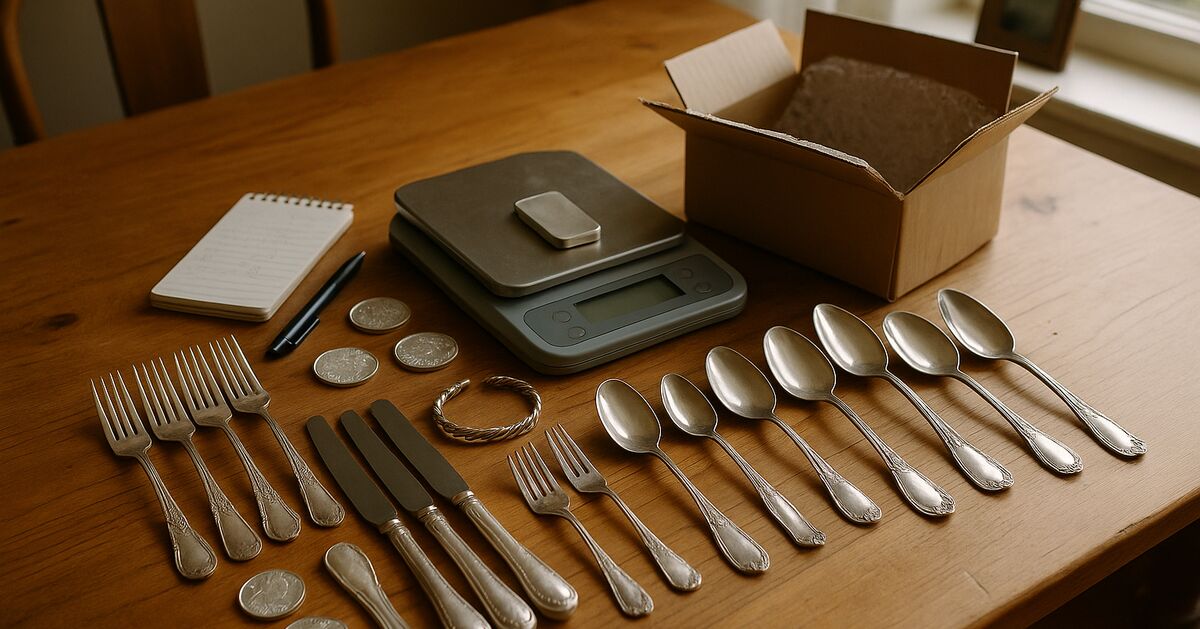
Selling silver online is one of the better financial decisions you can make with a box of old jewelry, coins, or flatware sitting in a drawer - but only if you go in knowing what drives the number on that offer sheet. After running a mail-in precious-metals buying business for eighteen years, I watched thousands of sellers leave real money behind because they skipped a few basic steps. This guide covers the whole process: value, buyer types, shipping safety, red flags, and what a fair offer actually looks like.
Start with the spot price, but do not stop there
Every legitimate silver offer is anchored to the live spot price. Spot is the per-troy-ounce price traded on commodity exchanges at that moment, and you can watch it tick in real time on sites like Kitco or the CME Group's website. If a buyer will not tell you what today's spot price is, that is already a warning sign.
Here is the thing many first-time sellers miss: spot is a ceiling, not a floor and not a target. Buyers purchase silver to resell or refine it, and every step between your drawer and the end market costs money. Testing, shipping, insurance, processing labor, overhead, and a margin thin enough to keep the lights on all come out of the spread between what the buyer pays you and what they eventually recover. Based on common industry practice, offers for sterling scrap or junk silver often fall between 70% and 90% of spot, depending on the buyer and item type. Some high-volume mail-in buyers hit the top of that range. Pawn shops and many coin shops sit lower because their overhead model is different.
Rare coins and antique silverware with maker's marks can trade well above melt, because collector demand adds a second layer of value on top of the metal content. If you have anything that looks old, unusual, or hallmarked, pause before treating it as simple scrap. Our guide on selling silver and gold jewelry together: a practical guide walks through the same principle when items are mixed.
Know exactly what you have before you contact anyone
This sounds obvious, but it matters enormously. Silver comes in several purity levels, and buyers price each one differently.
- Sterling silver (92.5% pure) is the standard for jewelry and flatware sold in the US, UK, and most of Europe. It is usually stamped "925," "Sterling," or carries one of the British hallmarks (lion passant, assay office mark, date letter, maker's mark).
- Coin silver (90% pure) appears in pre-1965 US dimes, quarters, half-dollars, and dollars, as well as some older silverware.
- Fine silver (.999) is used for bullion bars and some modern rounds. It commands the highest percentage of spot because no refining loss is needed.
- 800 silver is common in Continental European pieces and some Middle Eastern items.
- Silver plate contains no recoverable silver worth quoting as scrap. A copper or brass base is electroplated with a thin silver wash. Buyers will tell you this quickly, so do not be surprised or offended.
Weigh each category separately before you get a quote. A basic kitchen scale accurate to 0.1 gram is fine for jewelry. For coins, a jeweler's scale accurate to 0.01 gram is better. Troy ounces are the unit of trade: one troy ounce equals 31.1 grams. Buyers will convert for you, but knowing your weight protects you from arithmetic errors.
The three main channels for selling silver online
Mail-in buyers are companies that send you a prepaid, insured shipping label, test your material at an independent or in-house lab, and email you an offer within a day or two of receiving it. You can accept or decline. If you decline, a reputable buyer returns your silver at no charge. This channel tends to pay the highest percentage of spot for scrap and bullion because the buyer's volume is high and overhead per transaction is low compared to a walk-in shop. The trade-off is time: the whole cycle from mailing to check can be seven to fourteen days.
eBay and direct online sales are worth considering for coins, vintage flatware sets, or named-maker jewelry where collector demand pushes prices above melt. A set of Georg Jensen sterling hollowware, for example, may fetch two to three times its melt value from the right buyer on a marketplace. The costs are real though: eBay's final value fees, PayPal or payment processor fees, your own shipping and insurance, and the time spent photographing and listing. Do the math honestly before listing.
Local buyers found through online search (coin dealers, estate jewelers, some pawnshops) can be a fast option for walk-in transactions, though their offers vary widely. If you are in a major metro area, a competitive local coin dealer often pays fairly on bullion and recognizable coins. For a region-specific look at how local transactions typically unfold, the post on selling gold and silver in Dallas: what it's worth and how to get a fair offer covers the dynamics well, even if you are not in Texas.
How to compare offers fairly
Getting one offer and accepting it is one of the most common mistakes in this process. Get at least two or three quotes before committing, and make sure you are comparing apples to apples.
Ask each buyer:
- What is the spot price you are using today?
- What percentage of spot will you pay for my material?
- Are there any fees (assay, handling, shipping return)?
- How and when will payment be made?
- What happens if I decline your offer?
A buyer paying 85% of today's spot is better than one paying 80% of yesterday's spot, even if the dollar figure looks similar at first glance. The percentage tells you the real picture.
Be wary of any buyer who quotes a flat dollar-per-ounce price without connecting it to spot, or who cannot tell you what testing method they use. X-ray fluorescence (XRF) scanning is a widely used non-destructive method for testing jewelry and flatware, per precious metals assay guidance. Acid testing is older and acceptable for lower-value scrap but leaves a small mark. Fire assay (cupellation) is the most precise method and is used for large lots or disputed results.
If you want a broader primer on navigating buyer comparisons across precious metals, the frequently asked questions page covers a range of scenarios sellers run into.
What actually moves the price up or down
Beyond spot and purity, several factors shift where your offer lands within the realistic range.
Condition and form. Clean, separated, clearly stamped sterling flatware is easy to test and process. A tangled mix of possible sterling, possible plate, and mystery items takes more labor to sort. Buyers price that labor into the offer. Sorting and identifying your pieces before sending costs you nothing but time, and it often improves the quote.
Market volatility. When silver is moving sharply in either direction, buyers widen their spread to protect against the risk that the price shifts between receiving your package and hedging their position. A quiet, sideways market usually produces the tightest spreads and the best offers. This is not a reason to obsess over timing, but it is worth knowing.
Lot size. A single thin sterling chain might net you a few dollars. A full canteen of twelve-place flatware, a collection of rounds, or a bag of junk silver coins represents real weight, and some buyers offer a slightly better percentage on larger lots because the per-item processing cost drops.
Collectibility. This is the wildcard. American coin silver spoons by identified makers, complete sets of named British flatware, or sterling pieces with unusual hallmarks can trade at substantial premiums over melt among collectors and dealers who know the market. If anything in your collection looks like it has history, do a quick image search and check sold listings on eBay before treating it as simple scrap. You will find more detail on this dynamic in the post on selling antique silver: what it's worth and how to get a fair offer.
Shipping your silver safely
If you are using a mail-in buyer, use the label they provide. Reputable buyers offer prepaid, insured, trackable Priority Mail or equivalent courier shipping. Do not improvise with regular first-class mail, which has no tracking and no insurance. Do not photograph yourself packaging your items and then leave the package on your front porch; hand it directly to a postal worker or drop it at a staffed counter.
Pack items in a padded envelope or small box with enough bubble wrap that nothing rattles. Do not write "silver," "gold," or "jewelry" anywhere on the outside of the package. A plain, unremarkable exterior is your best theft deterrent.
Keep a record of everything: photos of each item before packing, the tracking number, the weight you measured, and any written communication with the buyer. If a dispute arises later, this documentation is your only protection.
For a step-by-step look at the physical process of getting items ready to mail safely, the post on how to safely post silver to a mail-in buyer goes into detail that is worth reading before your first shipment.
Red flags that should make you stop
After eighteen years of buying silver, I saw the same warning signs again and again on competitor sites that sellers would mention when they came to us after a bad experience.
- No published percentage or live price chart. If you cannot figure out what a buyer pays relative to spot before you send anything, that is intentional opacity.
- No clear decline-and-return policy. Every credible buyer will return your items at no cost if you reject the offer. If you cannot find this stated in plain language, ask directly. If the answer is vague, walk away.
- Pressure to accept quickly. A legitimate offer should give you at least a few business days to decide. "This price expires in two hours" is a pressure tactic.
- Payment in gift cards, prepaid debit cards, or anything other than a check or direct bank transfer. There is no legitimate reason for a silver buyer to pay in gift cards.
- No physical address or verifiable business history. Search the company name alongside "BBB," "complaints," or "reviews." A business that has been operating for several years should have a footprint you can verify.
After you accept: what happens next
Once you accept the offer, the buyer will either mail a check or initiate a bank transfer, depending on their process and your preference. Check the payment timeline before you accept, not after. Seven to ten business days for a mailed check is normal. A wire transfer can land in one to two business days with some buyers.
Once payment clears, keep your documentation for the tax year. In the United States, the IRS treats the sale of precious metals as a capital asset transaction. If you sold silver for more than you originally paid (or more than its fair market value at the time you inherited it), you may owe capital gains tax. The IRS website has guidance on collectibles and capital gains; if you sold a significant amount, it is worth a conversation with a tax preparer.
Putting it all together
Selling silver online is not complicated, but it rewards the sellers who take thirty minutes to do their homework. Know your purity and weight. Understand the spot price and what a realistic percentage looks like. Get more than one quote. Use a buyer with a transparent pricing policy and a clear return guarantee. Pack carefully. Keep records.
The home page is a good starting point if you want to keep reading about silver values before you make any decisions. And if your collection includes items beyond silver - gold pieces, watches, or designer jewelry mixed in - the posts on selling inherited or scrap gold: a practical guide to getting a fair price and selling designer jewelry online: what it's worth and how to get a fair offer cover those categories with the same level of practical detail.
Silver is a real, liquid market. You can get a genuinely fair price for it online, as long as you know what fair looks like before you start.
Sources & further reading
- Capital gains tax on collectibles guidance (U.S. Internal Revenue Service)
- Precious metals refining and assay methods overview (U.S. Environmental Protection Agency)
- USPS Priority Mail insurance and tracking services (United States Postal Service)
- Silver hallmarking and assay standards (The Assay Office London)
Revision history (1)
- Pre-publish editorial QA: 1 flagged, 1 softened; claim audit: 8 claims, 2 rewritten
Claim-by-claim audit (8 checked)
- “Based on common industry practice, offers for sterling scrap or junk silver often fall between 70% and 90% of spot, depending on the buyer and item type.” (rewritten to what the article can stand behind)
- “X-ray fluorescence (XRF) scanning is a widely used non-destructive method for testing jewelry and flatware, per precious metals assay guidance.” (rewritten to what the article can stand behind)
- “Fire assay (cupellation) is the most precise method and is used for large lots or disputed results.” (cited → epa.gov)
- “In the United States, the IRS treats the sale of precious metals as a capital asset transaction.” (cited → irs.gov)
- “If you sold silver for more than you originally paid (or more than its fair market value at the time you inherited it), you may owe capital gains tax.” (cited → irs.gov)
- “Reputable buyers offer prepaid, insured, trackable Priority Mail or equivalent courier shipping.” (cited → usps.com)
- “Do not improvise with regular first-class mail, which has no tracking and no insurance.” (cited → usps.com)
- “Sterling silver (92.5% pure) is the standard for jewelry and flatware sold in the US, UK, and most of Europe.” (cited → assayofficelondon.co.uk)