
Selling silver and gold jewelry together: a practical guide
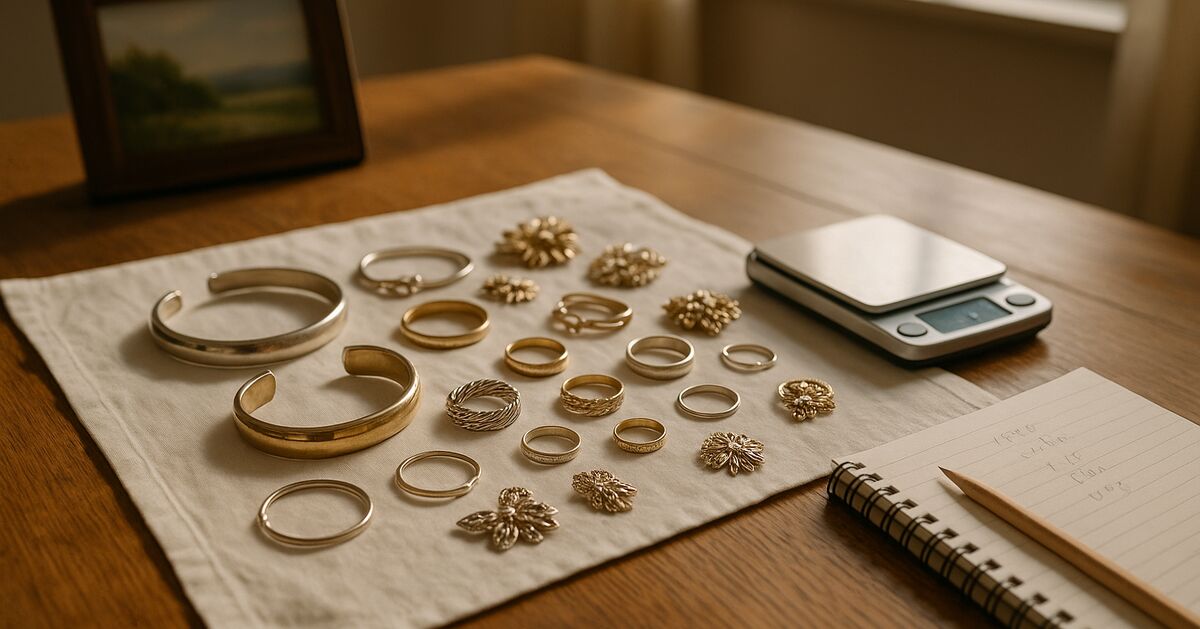
Selling a mixed collection of silver and gold jewelry is one of the most common situations that comes up for people dealing with an inherited estate or a drawer full of pieces they no longer wear. It sounds straightforward until you are actually standing in front of a buyer and realize you have no idea whether the offer is fair or whether you sorted the pieces correctly to begin with. Having run a precious-metals buying business for eighteen years, I can tell you the process is learnable, but there are a handful of places where sellers consistently lose money through no fault of their own. This guide walks through every step.
Start by separating what you actually have
Before you talk to a single buyer, sort your pieces. This matters more than people expect. Mixing silver and gold items in a single pile, or handing a buyer a bag of unsorted jewelry, puts you at a disadvantage because you cannot verify the math on a mixed lot.
Pull items into four rough groups:
- Likely gold (yellow, white, or rose metal pieces stamped 10K, 14K, 18K, 22K, 375, 585, 750, or 916)
- Likely silver (pieces stamped 925, Sterling, 800, or carrying hallmarks from British, Mexican, or Scandinavian makers)
- Likely silver plate (pieces with markings like EPNS, Sheffield, silver on copper, or no precious-metal stamp at all)
- Unknown or unmarked (set these aside for testing)
Silver plate contains no recoverable precious metal and will not earn you a melt-price offer. That does not mean it is worthless, but it trades in a completely different market, largely antique and collectibles dealers rather than metal buyers. Knowing this before you walk in saves the disappointment of watching a buyer set half your pile aside.
If you are working through inherited pieces and need help understanding the sorting process in more depth, the guide on selling inherited or scrap silver covers hallmarks and plate identification in detail.
Understand what "value" means for jewelry metal
Jewelry is not bought at the full spot price of the metal. Spot price is the commodity price for refined, investment-grade metal traded on exchanges. Scrap jewelry has to be refined before it becomes that. Buyers pay you less than spot because they have to cover the refining cost, their overhead, and a margin that keeps the business running.
For scrap jewelry sold to a reputable buyer, offers commonly fall well below full melt value, and silver often nets an even smaller share than gold due to handling costs, though exact percentages vary by buyer. Designer pieces, signed jewelry (Tiffany, Cartier, Georg Jensen and similar), and items with documented provenance can and do sell for considerably more than melt value because collectors pay for the name. Plain, undistinguished jewelry with no maker's mark trades purely on its metal content.
Knowing the spot price the day you sell is essential. The London Bullion Market Association publishes the official daily benchmark prices for both gold and silver, which you can check before any appointment.
Find the melt value before you go anywhere
The math is simple once you know the inputs.
For gold jewelry:
- Weigh the piece in grams (a small postal or kitchen scale works fine).
- Identify the karat. 14K gold is 58.5 percent pure gold by weight, 18K is 75 percent, 10K is 41.7 percent.
- Multiply the weight in grams by the purity percentage to get the pure gold content in grams.
- Convert to troy ounces by dividing by 31.1 (there are 31.1 grams in a troy ounce).
- Multiply by today's spot price.
That number is the melt value. What a buyer offers is a percentage of that number.
For silver jewelry: The same calculation applies. Sterling silver is 92.5 percent pure silver. A piece stamped 800 is 80 percent pure. Weigh it, apply the purity factor, convert to troy ounces, multiply by spot.
A worked example: a 14K gold bracelet weighs 8 grams. Its pure gold content is 8 x 0.585 = 4.68 grams. Divide by 31.1 and you get roughly 0.15 troy ounces. If spot gold is $2,300 per troy ounce, the melt value is about $345. A buyer offering 70 percent of melt would pay around $241.
Write these numbers down before every appointment. You cannot evaluate an offer without them.
Know which pieces might be worth more than their melt value
Not all jewelry should go straight to a scrap buyer. Before you sell anything, take a few minutes to consider whether a piece has collector or resale value that exceeds its metal content.
Things worth pausing on:
- Signed or maker-marked pieces. A Georg Jensen sterling brooch, a Tiffany & Co. silver bracelet, or a Cartier gold ring may fetch multiples of melt at auction or through a specialist jeweler.
- Antique jewelry with original stones. Diamonds, rubies, sapphires, and emeralds set in old platinum or gold settings may have significant independent value. A scrap buyer will usually ignore the stones or offer to return them.
- Coins and medallions made of precious metal. These are a separate category entirely. Coin dealers and bullion buyers evaluate them differently from jewelry. If you have silver or gold coins mixed into your jewelry box, pull them out and research them separately. Our guide on selling silver jewelry explains where jewelry and coin value part ways.
- Unusual hallmarks or foreign maker's marks. Scandinavian silver, Mexican silver, and British hallmarked pieces sometimes attract collector premiums.
When in doubt, a quick search of completed sales on eBay or a free auction estimate from a regional auction house costs you nothing and could save you from underselling something genuinely valuable.
Choosing where to sell
This is the step where sellers make the most consequential decisions.
Local coin and jewelry dealers are a good first stop for mixed lots. You get an in-person offer, you can ask questions, and you can walk away with cash the same day. The range of offers between dealers in the same city can be surprisingly wide, so visiting two or three before accepting anything is time well spent.
Pawn shops buy precious metals but tend to offer lower percentages of melt value because their overhead model is different and their margin expectations are higher. They can be convenient, but convenience has a price.
Mail-in buyers are a legitimate option for people without strong local dealers nearby. If you go this route, always ship with a tracked and fully insured parcel (insured for the metal's value, not just the postal service's default limit). Keep a detailed record of every piece you send, including photographs before the package is sealed. Reputable mail-in buyers will send a written offer before processing anything and will return your items if you decline.
Refiners occasionally buy directly from the public, particularly for larger lots of silver or gold. Their payout percentages are often the highest because you are cutting out the middleman, but most refiners have minimum weight requirements that make them impractical for a small jewelry collection.
Auction houses are worth considering for any piece that might have collector value. Auction houses charge a seller's commission that can be substantial, but this may be offset by access to a larger pool of buyers willing to pay over melt.
Wherever you plan to sell, check the buyer's reputation with the Better Business Bureau before your first appointment. Look at how they handle complaints, not just whether they have any. A business that resolves problems fairly is a better partner than one with no complaints simply because they are new.
Red flags that should make you walk away
After eighteen years of buying precious metals, the warning signs that a buyer is not operating fairly are fairly consistent.
- They refuse to weigh your items in front of you, or they use a scale you cannot see.
- They cannot or will not show you the purity test results.
- They give you a single number for a mixed lot without breaking down how they calculated it.
- They apply pressure to accept immediately, saying the price will drop if you leave.
- They separate your gold from your silver and hand you back different items than you brought in (this happens, and it is worth watching carefully).
- They cannot tell you what percentage of spot price they are offering.
A confident, honest buyer will welcome your questions. If they seem irritated by basic transparency requests, that tells you something important.
Selling gold and silver in the same transaction
Buyers will typically separate gold and silver in their calculation even if you bring them together. Gold is priced in dollars per troy ounce and silver in dollars per troy ounce, but because the prices differ by a factor of roughly 80 to 90, the way each is handled varies. Silver lots need to be larger by weight to generate meaningful value, which is why some buyers set minimum weights for silver purchases.
If you have a relatively small amount of silver alongside a meaningful gold lot, some buyers will accept both together. Others will decline the silver or offer a token amount that reflects their inconvenience more than the metal's actual value. In that case, it may be worth pursuing silver and gold through different channels.
For a broader look at the gold side of any mixed collection, the practical guide to selling gold covers the evaluation process in depth.
Getting multiple offers is not rude, it is sensible
One of the most common hesitations sellers have is the feeling that shopping a piece to multiple buyers is somehow impolite or disloyal. It is neither. Buyers price your metal based on their own margin requirements, and those requirements vary. Getting three offers on a significant lot can reveal a meaningful difference in what you walk away with, since buyer margins vary.
Tell each buyer you are getting multiple offers. Most will respect it, and the ones who do not were probably not going to treat you well anyway.
What to do with the pieces you decide not to sell
Not everything should go to a scrap buyer. Some inherited jewelry has sentimental or family value that is simply not measurable in metal weight. Some pieces might be better gifted to family members who would wear them. Some silver plate pieces are genuinely beautiful antiques that a dealer in decorative arts would price well above the pennies a scrap buyer would offer.
Deciding what to sell and what to keep is entirely personal. The useful discipline is making that decision consciously, with accurate information about what each piece is worth, rather than selling everything in one transaction because it felt simpler.
If you are working through a full estate, the practical considerations around sorting, pricing, and timing are worth reading through carefully. Our frequently asked questions page addresses some of the questions that come up repeatedly for first-time sellers.
A note on timing
Precious metal prices fluctuate. Gold and silver have both seen significant price increases in recent years, and selling when prices are relatively strong will always yield more dollars than selling when they are depressed. That said, trying to time the exact market peak is a strategy that has frustrated professional traders for decades. A more practical approach is to know roughly where prices sit historically, avoid selling during obvious downturns if you can wait, and recognize that getting a fair percentage of today's spot price matters more than the spot price itself.
If you want to track prices over time before deciding, the London Bullion Market Association and the CME Group both publish current and historical price data freely.
Putting it all together
Selling silver and gold jewelry together is manageable when you approach it methodically. Sort first. Calculate the melt value of each category using current spot prices. Identify anything that might be worth more than its metal content and set it aside for a specialist. Get at least two or three offers from reputable buyers. Ask every buyer to show their work. Ship anything by mail with full insurance and tracking.
The sellers who come out best are not the ones who find a magical buyer. They are the ones who show up informed enough that no buyer can take advantage of them.
For more practical guidance on selling precious metals, browse the full collection of articles on the blog or start with the fundamentals on the home page, which lays out the basics of how the selling process works from start to finish.
Sources & further reading
- Daily gold and silver benchmark prices (LBMA Gold Price) (London Bullion Market Association)
- BBB Business Profiles and complaint records for precious metal buyers (Better Business Bureau)
- FTC consumer guidance on selling gold and jewelry (U.S. Federal Trade Commission)
- USPS shipping insurance and registered mail options (U.S. Postal Service)
Revision history (1)
- Pre-publish editorial QA: 1 flagged, 1 softened; claim audit: 3 claims, 3 rewritten
Claim-by-claim audit (3 checked)
- “For scrap jewelry sold to a reputable buyer, offers commonly fall well below full melt value, and silver often nets an even smaller share than gold due to handling costs, though ex…” (rewritten to what the article can stand behind)
- “Auction houses charge a seller's commission that can be substantial, but this may be offset by access to a larger pool of buyers willing to pay over melt.” (rewritten to what the article can stand behind)
- “Getting three offers on a significant lot can reveal a meaningful difference in what you walk away with, since buyer margins vary.” (rewritten to what the article can stand behind)