
A practical guide to selling gold: what it is worth and how
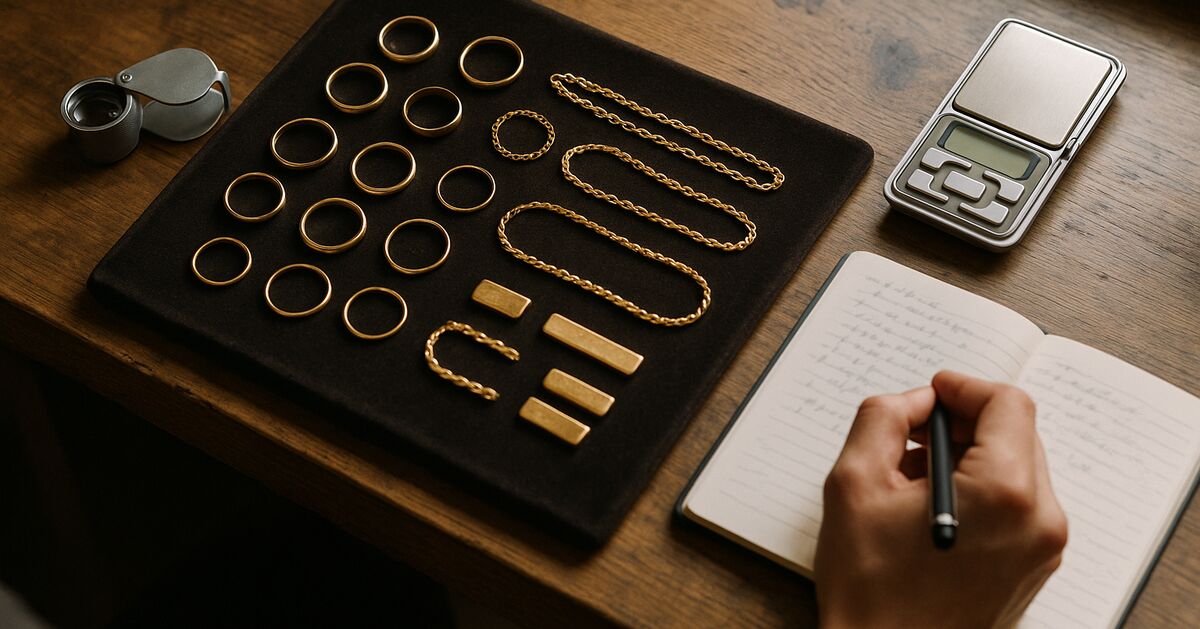
Gold is one of the few things sitting in a dresser drawer right now that is genuinely worth serious money, and the difference between a fair sale and a bad one usually comes down to preparation. After nearly two decades of buying gold and silver from the public, I watched the same mistakes play out over and over again: sellers who did not know their purity, sellers who accepted the first number they heard, and sellers who trusted a polished storefront over an honest process. This guide covers the whole picture: what gold is actually worth, what moves the price up or down, and how to choose the right buyer for what you have.
Start with the spot price, but understand what it really means
The gold spot price is the globally traded price for one troy ounce of pure (24-karat) gold at this exact moment. It is quoted in dollars per troy ounce and it changes continuously during trading hours. You can find it on financial sites like Kitco or through the London Bullion Market Association (LBMA), which publishes a twice-daily benchmark price that the industry uses as its reference.
The spot price is your starting point, not your ending point. No buyer pays spot. Buyers pay a percentage of spot because they carry overhead, they need to test and refine the metal, and they take on the risk of market movement between the day they buy from you and the day they sell the refined gold on. In practice, sellers often report offers in a wide range relative to melt value, depending on the type of gold and buyer, so it pays to get multiple quotes and compare them. Scrap jewelry at a pawn shop tends to land at the low end. A competitive mail-in refiner or a coin dealer buying investment-grade bars can push toward the high end.
The key phrase there is "melt value." That is the theoretical value of the pure gold content in your item, calculated by multiplying the weight (in troy ounces) by the spot price and then by the purity fraction. Every other number in any offer flows from that calculation, so you need to know two things before you walk into any conversation: the purity and the weight.
Purity: what the karat stamp actually tells you
Gold purity is expressed in karats in the United States and in millesimal fineness (parts per thousand) in most of the rest of the world. Here is how they translate:
- 24 karat - 999 fine, essentially pure gold
- 22 karat - 916 fine, used in many bullion coins and some high-end jewelry
- 18 karat - 750 fine, common in European and fine jewelry
- 14 karat - 585 fine, the standard for most American jewelry sold since the mid-20th century
- 10 karat - 417 fine, the legal minimum to be called gold in the United States
- 9 karat - 375 fine, common in the UK and Ireland, not legal as "gold" under US standards
When you see a stamp inside a ring or on a clasp that reads "14K," "585," "750," or "18ct," that is the purity mark. These stamps are not just decorative: US law generally requires that karat markings on jewelry be accurate within an allowed tolerance, though it's still wise to have any piece tested regardless of its stamp. That said, foreign pieces, very old pieces, and heavily repaired items sometimes carry inaccurate or missing stamps. A reputable buyer will test regardless of the stamp, which is exactly what you want.
If your piece has no stamp, or if you are not sure what it says, do not guess. Testing tells the truth, and any buyer worth dealing with will show you the test result.
How gold is tested, and why it matters to you
The two most common testing methods you will encounter are acid testing and X-ray fluorescence (XRF) analysis.
Acid testing is the old-fashioned method. A small scratch is made on a test stone, the metal is rubbed across it, and acids of known strengths are applied to the residue. Each acid dissolves gold below a certain purity. It is fast and inexpensive, but it is surface-only, which means it can miss plating and it produces a result that a skilled technician interprets visually rather than a hard number.
XRF analysis is the modern standard. A handheld or benchtop XRF gun fires X-rays at the metal and measures the fluorescent energy bouncing back. The detector identifies exactly which elements are present and in what proportions. It is non-destructive, takes about thirty seconds, and gives you a precise percentage readout. Any serious buyer uses one, or has access to one through a third-party assay lab.
Some buyers also use electronic gold testers, which measure electrical conductivity. These are inexpensive and fast but less precise than XRF. They are fine for a rough sort but not something to rely on for a final valuation.
The reason this matters to you: if a buyer quotes you a price without testing, walk away. They are either guessing low to protect themselves, or they are about to hand you a lowball number and hope you accept it before the actual purity is confirmed.
Weight: why you need a troy ounce conversion
Gold is priced by the troy ounce, which is 31.1 grams. Standard kitchen and postal scales measure in regular (avoirdupois) ounces, which are 28.35 grams. If you weigh your gold on a kitchen scale and the spot price is quoted per troy ounce, you will overestimate the value by about 9 percent if you use the avoirdupois reading directly. That is a real difference.
Get a digital jewelry scale that reads in grams. They cost less than fifteen dollars and are accurate to 0.01 grams. Weigh your gold yourself before any appointment. You are not there to catch anyone cheating necessarily, but knowing your own weight means you can follow the math the buyer puts in front of you and ask a sensible question if something does not add up.
The melt value formula is straightforward:
Melt value = (weight in grams ÷ 31.1) × spot price × purity fraction
So for a 14-karat ring that weighs 5 grams, with spot at $3,000 per troy ounce:
(5 ÷ 31.1) × 3,000 × 0.585 = roughly $283
A buyer offering 80 percent of melt would pay about $226. A buyer offering 90 percent would pay about $255. Running this calculation takes two minutes and prevents you from walking in blind.
What form is the gold in? It changes everything
Not all gold is treated equally by buyers, and understanding why helps you aim for the right buyer type.
Scrap jewelry (broken chains, single earrings, tangled pieces, heavily worn items) is worth melt value only. The craftsmanship is gone, the resale value is gone, and the buyer will melt it. The calculation above applies directly. Walk-in buyers often offer less relative to melt value than competitive refiners who specialize in scrap, so it's worth comparing both.
Wearable jewelry in good condition has a resale channel that opens up another category of buyer: jewelers, consignment shops, and online resellers. If a gold piece is attractive and in excellent condition, a pawnbroker or jeweler who intends to resell it (not melt it) may offer more than melt value, because they are pricing it as jewelry. This is not guaranteed, but it is worth getting a quote from a jeweler who also buys retail, not just a scrap buyer.
Gold coins are a special case. A well-known bullion coin (American Gold Eagle, Canadian Maple Leaf, South African Krugerrand) carries a premium over melt because it is instantly recognizable and liquid. Buyers pay more for coins than for equivalent-weight scrap, and they charge less of a spread. If you have gold coins, the guide on how to sell gold coins: identify, value, and find the right buyer covers that territory in much more detail, including how to identify what you have and when a coin's numismatic value exceeds its melt value.
Gold bars and rounds fall somewhere between coins and scrap. Name-brand bars from recognized refiners (PAMP Suisse, Valcambi, Engelhard) command a premium over generic bars because buyers can verify them quickly and resell them as-is. A no-name bar may be treated closer to scrap, which means it gets melted and assayed before you get paid.
Which buyer should you use?
This is the question that makes the biggest practical difference to your payout. There is no single right answer because it depends on what you have, how much of it there is, and how quickly you need to be paid.
Local coin dealers are often the best starting point for anything in good condition, for bullion coins, and for smaller lots of jewelry. A good dealer has XRF equipment, makes immediate offers, and pays in cash or check on the spot. The markup they take is visible and negotiable.
Jewelry buyers and pawnbrokers are convenient and fast, but the spread they take tends to be wider because their overhead (rent, staff, insurance) is higher and their volume is lower. Get the math shown to you, and compare it against melt value before agreeing.
Mail-in buyers can be very competitive on scrap jewelry and mixed lots because they operate at scale and have low overhead. The trade-off is that your items leave your hands before you see the offer. A reputable mail-in buyer will use a third-party assay lab, insure your shipment, and return your items at no cost if you decline the offer. The key questions to ask any mail-in buyer: who does the testing, can I see the results, and what happens if I say no? If the answers are evasive, look elsewhere. For general guidance on what to look for in any buyer, the FAQ on this site covers buyer vetting in plain terms.
Refiners are worth contacting directly if you have a meaningful quantity (typically several hundred dollars of melt value or more). A refiner's business model is volume, and they pass some of that efficiency back to sellers with better percentages. The tradeoff is slower payment, since they typically settle after processing a batch.
Online auction and peer-to-peer platforms (eBay, for example) can work well for collectible or attractive pieces where the right buyer will pay above melt. The risks are packaging, shipping, insurance, fees (Combined marketplace and payment processing fees on platforms like eBay can take a significant cut of your sale price, so check current fee schedules before listing.), and the occasional bad actor. If you go this route, photograph everything in detail, use insured tracked shipping, and price conservatively.
The broader principle of shopping multiple buyers applies here just as much as it does when selling silver. The home page-level idea is simple: Get at least two or three quotes before you sell anything, because offers on identical material can vary widely between buyers.
Separating your gold before getting quotes
If you have a mixed bag of gold pieces, sort them before approaching a buyer. Group items by karat (check each stamp), set aside any pieces with gemstones, and separate broken scrap from wearable pieces.
Gemstone settings matter because a buyer buying for melt has to factor in the time and cost of removing stones, and some stones (diamonds especially) have value of their own that a scrap buyer will not give you credit for. A jeweler who buys finished pieces might; a refiner will not. If a piece has a meaningful stone, consider getting it appraised separately and perhaps selling the stone and the mounting to different buyers.
Sorting also prevents a common problem: a buyer eyeballs your mixed pile, calls it all 10-karat to protect themselves, and offers you a single low-per-gram rate on the lot. If you walk in with items already grouped by purity, you make their job easier and your payout clearer.
This sorting habit is exactly the same discipline described in the guide on selling gold jewelry: what it's worth and how to get a fair offer, which goes deeper into jewelry-specific considerations like hallmark reading and designer pieces.
Red flags to watch for
A few patterns keep coming up when sellers end up with bad outcomes:
- No testing before an offer. A buyer who names a price by looking at your piece is not giving you an informed offer.
- Pressure to decide immediately. A fair buyer is comfortable letting you take twenty-four hours to think, compare, or ask questions. A buyer who says "this price is only good right now" is using a sales tactic, not giving you a genuine offer.
- Refusing to show the math. You are entitled to know the weight, the purity figure the buyer is using, and what percentage of melt value the offer represents. If a buyer will not show you those three numbers, you cannot evaluate the offer.
- Scales that are not certified or not visible. Ask to see the scale, and ask when it was last calibrated. In many jurisdictions, commercial scales used in buying transactions are subject to state weights and measures oversight.
- Paying by gift card. Legitimate buyers pay in cash, check, or bank transfer. Gift cards are the hallmark of a scam, whether in person or online.
If something feels off, trust that instinct. There are enough reputable buyers that you do not need to settle for one who makes you uncomfortable.
The tax side: a quick note
The IRS treats gold as a collectible, which means gains on the sale are subject to capital gains tax. If you paid more for the gold than you are selling it for, there is no taxable gain. If you inherited the gold, the cost basis is generally the fair market value at the date of the original owner's death. Keep records of what you paid, when you bought it, and what you received when you sold. A tax professional can advise on your specific situation; the IRS Publication 544 covers sales of assets including collectibles.
Putting it all together
Selling gold well is not complicated, but it does reward preparation. Know your purity, know your weight, run the melt value calculation yourself before any appointment, and get at least two or three quotes. Understand what kind of buyer is right for what you have, whether that is a coin dealer for bullion, a jeweler for wearable pieces, or a mail-in refiner for a box of scrap chains.
For more on the broader world of precious metals selling, browse the blog index, where you will find detailed guides on specific item types, buyer comparisons, and practical how-to pieces covering everything from hallmark reading to sorting inherited collections. The more you understand before you walk in the door, the more you walk out with.
Sources & further reading
- London Bullion Market Association gold price benchmark (London Bullion Market Association)
- IRS Publication 544: Sales and Other Dispositions of Assets (U.S. Internal Revenue Service)
- Weights and Measures laws and regulations (National Institute of Standards and Technology (NIST))
- IRS Collectibles and Capital Gains guidance (U.S. Internal Revenue Service)
Revision history (1)
- Pre-publish editorial QA: 2 flagged, 2 softened; claim audit: 8 claims, 5 rewritten
Claim-by-claim audit (8 checked)
- “In practice, sellers often report offers in a wide range relative to melt value, depending on the type of gold and buyer, so it pays to get multiple quotes and compare them.” (rewritten to what the article can stand behind)
- “Walk-in buyers often offer less relative to melt value than competitive refiners who specialize in scrap, so it's worth comparing both.” (rewritten to what the article can stand behind)
- “Combined marketplace and payment processing fees on platforms like eBay can take a significant cut of your sale price, so check current fee schedules before listing.” (rewritten to what the article can stand behind)
- “Get at least two or three quotes before you sell anything, because offers on identical material can vary widely between buyers.” (rewritten to what the article can stand behind)
- “US law generally requires that karat markings on jewelry be accurate within an allowed tolerance, though it's still wise to have any piece tested regardless of its stamp.” (rewritten to what the article can stand behind)
- “In many jurisdictions, commercial scales used in buying transactions are subject to state weights and measures oversight.” (cited → nist.gov)
- “The IRS treats gold as a collectible, which means gains on the sale are subject to capital gains tax.” (cited → irs.gov)
- “If you inherited the gold, the cost basis is generally the fair market value at the date of the original owner's death.” (cited → irs.gov)