
Selling gold jewelry: what it's worth and how to get a fair
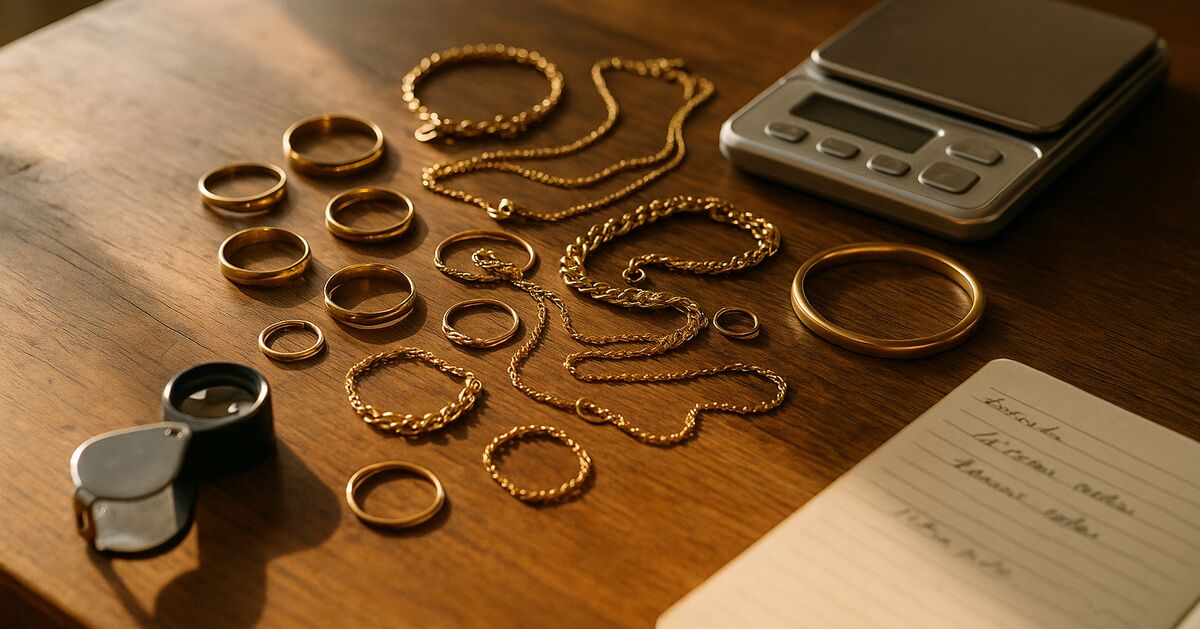
Gold jewelry sitting in a drawer is not an asset until you understand what drives its value and where to turn it into cash. After nearly two decades of buying gold and silver from the public, I can tell you that the sellers who get the best outcomes are often not the ones who know the most about gold in general. They are the ones who took thirty minutes to understand their specific pieces before accepting a single offer.
This guide covers every step of that preparation: reading the stamps, doing the math, understanding what buyers pay and why, and knowing which type of buyer to approach for which type of piece.
Why gold jewelry sells differently from gold coins or bars
A gold coin or bar has one job: store a known quantity of refined gold. The value calculation is almost mechanical. Gold jewelry is more complicated, because it was designed to be worn. That means it was almost certainly alloyed with other metals to make it harder and more durable, it may have stones or other materials attached, and it may carry design or brand value that goes beyond the raw metal.
When a buyer looks at your jewelry, they are usually thinking about the melt value first. That is the value of the pure gold content, calculated against the spot price. Everything else, including gemstones, craftsmanship, and brand names, is either added to that figure or ignored entirely, depending on the buyer and the piece. Understanding that distinction is the single most useful thing you can do before you start shopping your jewelry around.
If you have been reading about precious metals selling generally, the overview on selling silver and what moves its price covers the underlying market dynamics in a way that translates directly to gold. Spot prices, bid-ask spreads, and buyer margins all work the same way.
Reading the karat stamp
Most gold jewelry sold in the United States and the United Kingdom carries a stamp that tells you its purity. In the US and UK that stamp is expressed in karats (sometimes spelled "carats" in European contexts). The karat system divides gold into 24 parts:
- 24k is essentially pure gold, 99.9% or better. Very soft, rarely used in jewelry outside of some Asian markets.
- 22k is 91.7% gold. Common in Indian and Middle Eastern jewelry.
- 18k is 75% gold. Popular for fine jewelry, holds a good balance of purity and durability.
- 14k is 58.3% gold. The workhorse of the American jewelry market for decades. Very common.
- 10k is 41.7% gold. The legal minimum to be called "gold" in the United States.
Look for the stamp on the inside of a ring band, on the clasp of a necklace or bracelet, or on the back of a pendant or pin. Common markings are straightforward: "14K", "585" (which is 14k expressed as parts per thousand), "750" (18k), "417" (10k), and so on. European pieces often use the three-digit millesimal fineness system rather than karats.
If you have a piece with no stamp at all, that does not mean it has no value. It may be very old (stamps only became standard in the US in the 20th century), it may be foreign-made under a different convention, or it may have simply worn away. A buyer with an acid test kit or an electronic tester can verify purity in minutes. What you should not do is assume an unstamped piece is worthless or, conversely, assume the seller's word about purity was accurate.
Calculating your melt value
Once you know the karat, the next step is weighing the piece. The trade uses troy ounces and pennyweights (dwt), but a kitchen scale that reads in grams works fine for your own estimates. One troy ounce equals 31.1 grams. One pennyweight is 1.555 grams.
Here is the calculation laid out step by step:
- Find the current spot price of gold in US dollars per troy ounce. (Financial sites, commodity exchanges, and precious-metals dealers all publish this in real time.)
- Convert that to a price per gram: divide by 31.1.
- Multiply by the purity fraction of your piece. For 14k, that is 0.583. For 18k, 0.750.
- Multiply by the weight of your piece in grams.
That number is the theoretical melt value. It is what your piece would be worth if it were 100% pure gold and could be refined for free. In practice, no buyer pays 100% of melt value, because they bear the cost of refining, the risk of the spot price moving between when they buy and when they sell, and the overhead of running their business. Understanding the difference between spot value and what a buyer actually offers is covered in detail on the live price charts guide, which applies equally to gold.
Reputable buyers of scrap gold jewelry generally offer less than full melt value, with the exact percentage varying by buyer type, piece type, and market conditions. Pawn shops often land lower. Specialist gold buyers and online refiners often land higher, especially for larger lots.
What else affects the offer you receive
Melt value is the floor, but several factors push the actual offer up or down.
Stones and settings. Diamonds and gemstones are not included in a melt-value offer. A buyer will either remove and return them, deduct their weight from the gold calculation, or (in some cases) make a separate offer if they deal in stones. Do not assume a ring with a large diamond is worth twice as much at a scrap buyer as the same ring without one. Often the buyer's offer on the gold is the same, and the diamond sits in a separate conversation. If the stone has significant value, you may want a gemological appraisal before deciding where to sell.
Solder, solder points, and non-gold components. Prongs, clasps, and findings are sometimes made of a different metal than the body of the piece. White gold and yellow gold are sometimes combined. The buyer accounts for this in their testing.
Condition and wearability. For a scrap buyer, condition barely matters. A bent or broken chain melts the same as a perfect one. But if a piece is in excellent condition and is a desirable style, a buyer who resells jewelry (rather than scrapping it) may offer more. Estate jewelry dealers and some coin shops look for pieces they can sell intact.
Brand or designer provenance. A piece from a well-known jewelry house (Tiffany, Cartier, Van Cleef, and similar) is often worth more than its melt value in the right market. That premium only holds if you have the original box, papers, or other documentation that a collector or resale buyer would need to authenticate and market the piece. Without provenance, a designer piece often sells at melt value, because the buyer cannot sell the story.
Weight of the lot. A single thin ring may net you a modest check. A box of jewelry weighing several ounces is a more attractive transaction for a serious buyer, and the logistics of testing and settling are the same either way. If you have multiple pieces to sell, considering them as a lot can simplify the process.
Where to sell: a realistic comparison
The gold-buying market is genuinely competitive, which is good news for sellers who take the time to compare offers. Here is a plain-English breakdown of the main channels.
Coin and precious-metals dealers. These buyers test and buy scrap gold every day. They have the equipment, they understand the market, and they have competitive pressure to offer reasonable percentages. This is a solid default choice for most sellers.
Estate jewelry buyers and consignment shops. If your pieces are stylish, in good condition, or from a recognizable period (Art Deco, Mid-Century, Victorian), these buyers may offer above melt value because they intend to resell the piece rather than melt it. The trade-off is that they are selective and may not want everything you bring.
Mail-in gold buyers. Several reputable companies allow you to ship your jewelry and receive an offer based on their testing. The better ones are transparent about their pricing, insure the shipment both ways, and allow you to decline and have your items returned. Read reviews carefully and understand the return policy before using any mail-in service. For guidance on the physical safety side of posting precious metals, the guide to safely posting silver to a mail-in buyer covers packaging and insurance principles that apply just as well to gold.
Pawn shops. Fast and convenient, but the offer is typically the lowest of the options listed here. The pawn business model builds in a large margin to account for storage, the risk of redemption, and the cost of eventually liquidating items. If speed matters more than price, pawn shops serve that need. If you want close to market value, keep looking.
Online auction and resale platforms. Selling on a platform like eBay is an option for pieces with collector or aesthetic value, but it requires photography, listing, shipping, buyer communication, and the patience to wait for the right buyer. Melt-value lots rarely perform well at auction because specialist buyers compete and drive prices toward what they can get wholesale. For unique or branded pieces, it can be worth the effort.
"We buy gold" storefronts and mall kiosks. These vary enormously. Some are legitimate. Anecdotally, quotes from these operators can be lower than what a coin dealer or established precious-metals buyer offers, so it's worth comparing before accepting. Use them as a data point, not a final answer.
Getting multiple offers: the only reliable way to know you are being treated fairly
No single offer tells you what your gold is worth. Two or three offers from different buyer types will tell you a great deal. The spread between the lowest and highest offer you receive is real money, and it is often larger than sellers expect.
Before you approach any buyer, do your own melt-value calculation so you have a reference point. If an offer comes in at 50% of melt value and another comes in at 80%, you now know something concrete. You are not obligated to take any offer on the spot. A reputable buyer will give you time to consider.
The FAQ covers some of the most common questions sellers ask when they are in this process, including what to do when offers seem inconsistent.
A word about appraisals
An appraisal for insurance purposes is not the same as a market offer. Insurance appraisals are written to reflect replacement value, which is the retail price of an equivalent new piece. That number is typically higher, sometimes dramatically higher, than what any buyer will pay for your piece. Sellers who walk in with an insurance appraisal and expect to receive that amount are consistently disappointed, and that is not because the buyer is being unfair.
If you want a realistic picture of resale value before you commit to selling, ask a dealer for a "fair market value" opinion rather than an insurance replacement appraisal. Better still, collect actual offers, because those are real data.
Keeping records and staying safe
If you are selling a significant quantity of gold jewelry, keep a simple log: what you sold, the weight, the karat, the buyer, and the offer. This is useful for your own records and for tax purposes, since the IRS treats gains from selling precious metals as taxable income.
On the safety side, avoid advertising publicly that you are selling gold before a transaction is complete. Meet buyers in their established place of business. For mail-in transactions, use insured tracked shipping and photograph everything before it leaves your hands.
For context on how the gold market fits into the broader world of precious-metals selling, the home page pulls together the core resources on this site in one place. And if you are also dealing with silver items alongside the gold, the practical guide to selling sterling silver walks through the same fundamentals applied to silver.
The short version, for those who want it
Read the karat stamp. Weigh the piece. Calculate your own melt value before you talk to anyone. Get at least two or three offers from different buyer types. Understand that gemstones, condition, and brand value matter in some markets but not others. Take your time, because reputable buyers will not pressure you, and the ones who do pressure you are telling you something important about themselves.
Gold has long been viewed by many as a store of value over time. The piece in your drawer represents that value right now. A little preparation is what converts it from a number on paper into a fair check.
Sources & further reading
- IRS Publication 550: Investment Income and Expenses (collectibles and precious metals gains) (U.S. Internal Revenue Service)
- Gold spot price and commodity market data (U.S. Commodity Futures Trading Commission)
Revision history (1)
- Pre-publish editorial QA: 3 flagged, 3 softened; claim audit: 5 claims, 3 rewritten
Claim-by-claim audit (5 checked)
- “10k is 41.7% gold, generally considered the minimum purity marketed as gold jewelry in the United States.” (rewritten to what the article can stand behind)
- “Reputable buyers of scrap gold jewelry generally offer less than full melt value, with the exact percentage varying by buyer type, piece type, and market conditions.” (rewritten to what the article can stand behind)
- “Anecdotally, quotes from these operators can be lower than what a coin dealer or established precious-metals buyer offers, so it's worth comparing before accepting.” (rewritten to what the article can stand behind)
- “Gold has long been viewed by many as a store of value over time.” (rewritten to what the article can stand behind)
- “since the IRS treats gains from selling precious metals as taxable income.” (cited → irs.gov)