
Live price charts: what they really mean when you're
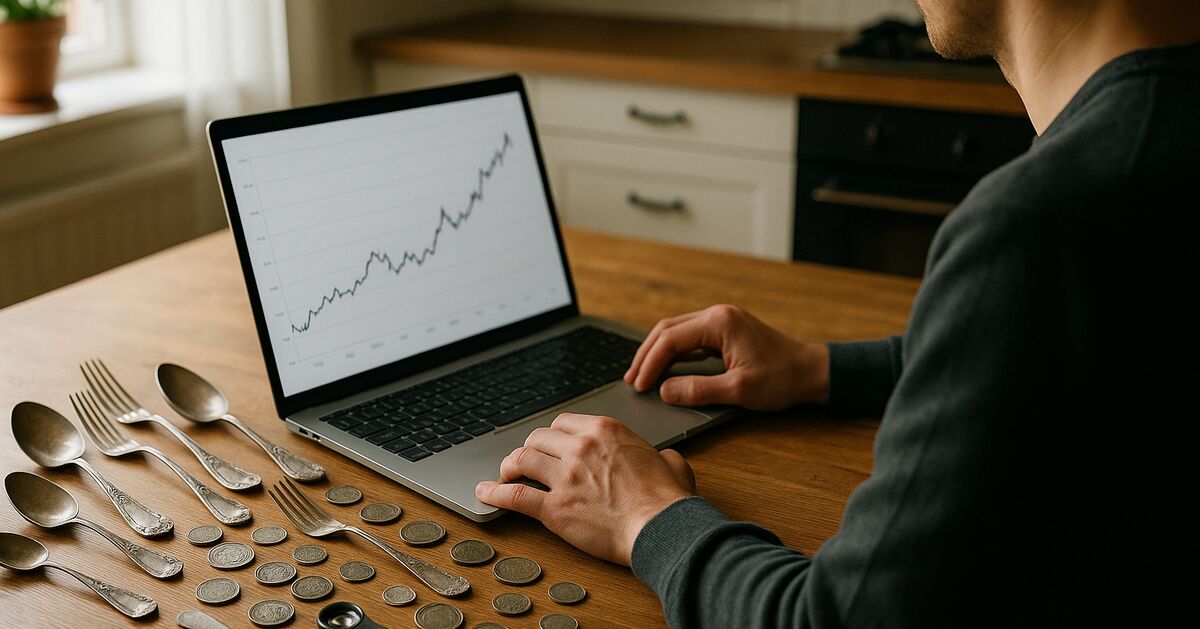
The number on a live silver price chart can feel like an answer, but it is really just the beginning of a question. If you have inherited a box of old silverware, a handful of coins, or a tangle of jewelry and you want to know what it is worth today, the spot price is the first piece of the puzzle, not the last. Understanding the gap between what the chart says and what a buyer will actually hand you is where the real work happens.
What the spot price actually is
The spot price of silver or gold is the price at which one troy ounce of that metal trades on the commodities market right now, for immediate delivery. It is set continuously during trading hours by futures markets, primarily the COMEX in New York, and it moves minute by minute in response to global supply and demand, currency shifts, geopolitical news, and speculative trading.
When a price chart on a precious metals site says "silver: $X.XX per troy ounce," that is the spot price. It reflects the cost of buying refined, investment-grade metal in standardized bar or contract form at wholesale scale. It does not reflect the price of a bent sterling spoon or a worn Walking Liberty half dollar sitting in your kitchen drawer.
That distinction matters enormously, and it is the single thing that confuses sellers the most.
Why buyers cannot pay spot, and do not
A dealer or refiner who buys your scrap silver has real costs that come straight off the top of whatever the spot chart shows:
- Assaying and testing. The buyer has to confirm the metal is what you say it is. X-ray fluorescence testing, acid testing, and fire assay all cost time and money.
- Refining. Sterling silver is 92.5% pure. Most jewelry alloys sit somewhere between 50% and 92.5%. Getting from that to .999 fine silver that can be resold on the market requires a smelter or refiner, who takes a cut.
- Overhead and profit. Shipping, insurance, staff, and a margin that keeps the lights on all reduce what can be passed back to the seller.
- Market risk. Between the day a buyer takes in your metal and the day the refiner settles up, the price can move. Buyers hedge against that, and part of that hedge comes out of your offer.
In practice, offers for scrap silver often run somewhere in the range of 70 to 90 percent of the current spot value of the pure silver content, though this varies by buyer, quantity, and form. For gold the range is similar, and for platinum it can be tighter or wider depending on market liquidity. These are general ranges based on how the scrap trade works, not guarantees of any specific deal.
If a buyer is offering you 50 percent of spot or less, that is worth scrutinising closely. If someone is claiming to pay 100 percent or more of spot for raw scrap, something in that offer is not adding up.
For a deeper look at how the melt value calculation works from the ground up, the guide on how to figure out what your silver is actually worth walks through the arithmetic step by step.
The hidden problems with price charts on buyer websites
When I was running a precious metals buying business, one thing I noticed again and again was that sellers would arrive at a negotiation with a screenshot from a competitor's website, confident they knew the market price. Sometimes that screenshot was doing them a disservice.
A few things to watch for:
Delayed or frozen prices. Some buyer websites display a price chart that looks live but is actually updated only once a day, or once a week, or sometimes not at all if the developer forgot to maintain the feed. If the market has moved sharply in the past 24 hours, a stale chart can mislead you in either direction.
Minimum quantity requirements buried in the fine print. A chart might show a generous percentage of spot, but the footnote says that rate only applies to lots of 100 troy ounces or more. If you are selling 15 ounces of inherited flatware, you may fall into a much lower tier. Always read below the chart.
Premium versus generic bullion pricing. Bars and rounds from recognized refiners like Engelhard or Johnson-Matthey can attract a small premium over generic poured silver, since their hallmarks are more readily trusted and traded. A chart that lists "bullion" prices without distinguishing between recognized-brand and generic product is compressing two different markets into one number. This matters mostly if you are selling bullion rather than scrap jewelry or coins, but it is worth knowing.
Troy ounces versus regular ounces. The spot price is always quoted per troy ounce. A troy ounce is 31.1 grams, not 28.35 grams like the avoirdupois ounce you use for food and body weight. If you weigh your silver on a kitchen scale and convert using the wrong number, your estimate of its value will be off by about 9 percent. The guide on weight and purity conversions for selling silver covers this thoroughly, including how to convert grams, pennyweights, and ounces reliably.
How to read a price chart as a seller (not a trader)
You do not need to understand futures contracts or options theory to use price data intelligently when selling. What you do need to know is:
1. The direction of recent movement matters more than the exact number today. Pull up a 30-day chart. If silver has been climbing steadily, you are in a seller-friendly environment and it is worth taking a little time to shop offers rather than rushing. If it has dropped sharply in the past week, buyers will have priced that risk in already and you may find offers feel lower than you expected.
2. Intraday swings are mostly noise for a one-time seller. Professional traders care about 15-minute candles. If you are selling a box of inherited flatware, the difference between the 10am price and the 2pm price on any given day is unlikely to change your outcome meaningfully. Focus on the weekly and monthly picture instead.
3. Check the bid, not the last price. The "spot price" shown on most charts is actually the last traded price. The price a buyer pays for your metal is closer to the bid side of the market. In normal conditions the spread is small, but in volatile markets it widens. If you see a chart price and then receive an offer that seems low, ask the buyer what percentage of spot they are offering, calculated at the current bid. That gives you an apples-to-apples number to compare across buyers.
4. Know what you have before you look at the chart. A chart showing silver at a given price is useless if you do not know whether your item is sterling (92.5%), coin silver (90%), silver plate (no intrinsic metal value), or fine silver (.999). Looking up the spot price before identifying your metal is like checking the price of beef before you know whether your freezer contains beef or tofu. For coins in particular, the question of whether a piece is genuine silver at all is the first thing to settle. The post on which coins in a jar of old change are actually silver is a good place to start if you are sorting through old change.
What to do with the price data once you have it
The live chart is most useful as a baseline for comparison shopping. Here is a practical sequence:
- Find today's spot price from a neutral source. Kitco and the CME Group both publish real-time or slightly-delayed spot prices that are not tied to any buyer's interests.
- Calculate the melt value of your specific items. Weight in troy ounces, multiplied by purity as a decimal, multiplied by spot price. That is the theoretical maximum a refiner would pay before their own costs.
- Get at least two or three written offers from different buyer types (local coin dealer, online mail-in buyer, local jeweler). Ask each one to express their offer as a percentage of spot.
- Compare the percentages, not just the dollar amounts. Buyers who express their offer clearly as a percentage of spot are easier to compare than those who give you a flat dollar figure, because the flat figure is already baked with whatever spot price was current when they calculated it.
For a broader look at how this process fits into selling inherited or scrap gold alongside silver, the guide on selling gold at the best price covers the same comparison-shopping logic applied to gold.
The form of your metal changes everything
Spot price is for refined, investment-grade, .999 fine metal in liquid form. Almost nothing an ordinary seller brings to the table is in that form. Here is how form affects what you will actually receive:
Scrap jewelry: Typically sterling (92.5%) or 14k gold. Requires assaying and refining. Expect a competitive buyer to offer somewhat less than full melt value, given the assaying and refining involved.
Pre-1965 US coins (junk silver): These are 90% silver and very easy to verify, which reduces the buyer's risk. Competitive buyers often pay a higher percentage of melt for these, since the coins are easy to verify and assay costs are minimal. The liquidity of the coin market helps here.
Sterling flatware: Similar to scrap jewelry in terms of purity (92.5%), but flatware is often heavy and consistent, which buyers appreciate. Weighted handles, however, are a known problem in this category because some handles are filled with resin or cement to give a heftier feel, and that weight is worthless. A good buyer will identify this before making an offer.
Bullion bars and rounds: Closest to spot, because the metal is already refined. Recognized-brand pieces (with assay cards, intact packaging, and legible hallmarks) will attract the best offers. Generic poured bars will attract slightly less.
Silver plate: Contains no meaningful amount of silver and has essentially no melt value. A buyer who quotes you a spot-based price on silver-plated items without disclosing this is not doing you any favors. If you are unsure whether an item is solid sterling or silver plate, the guide on how to tell sterling silver from silver plate at home covers the tests you can run yourself before calling anyone.
One practical warning about market timing
Sellers sometimes ask whether they should wait for silver to go higher before selling. That is a legitimate question, and no honest answer involves predicting the future. What I can say from years of watching the market is that people who waited for a better price sometimes got one, and sometimes watched the price move the other way for years. If you need the money or the item has no personal significance to you, the cost of waiting is real even if it is invisible. Carrying an asset hoping it will appreciate is a form of investment, and that is a different decision from simply wanting to convert something you inherited into cash.
If you are genuinely curious about the broader process of evaluating an inherited lot before selling, the practical end-to-end guide to selling silver covers identification, valuation, and getting quotes in one place.
And if any of the terminology in price charts, buyer offers, or precious metals generally is leaving you confused, the plain-English glossary of silver and gold trade terms is worth a few minutes of your time before you sit down with a buyer.
The bottom line
A live price chart tells you the temperature of the market. It does not tell you what someone will pay for the specific things sitting on your table. The gap between those two numbers is where many misunderstandings in the scrap silver business live. Once you understand how to calculate melt value, how to express an offer as a percentage of spot, and how to compare buyers on that basis, the chart becomes genuinely useful instead of just impressive-looking. You are not trading futures. You are selling something real, and the chart is just one tool in a practical process.
Sources & further reading
- Silver spot price and historical data (Kitco Metals Inc.)
- Precious metals definitions and market structure (London Bullion Market Association)
- Troy weight and precious metals measurement standards (U.S. National Institute of Standards and Technology)
- Consumer guidance on selling gold and silver (U.S. Federal Trade Commission)
Revision history (1)
- Pre-publish editorial QA: 1 flagged, 1 softened; claim audit: 5 claims, 4 rewritten
Claim-by-claim audit (5 checked)
- “In practice, offers for scrap silver often run somewhere in the range of 70 to 90 percent of the current spot value of the pure silver content, though this varies by buyer, quantit…” (rewritten to what the article can stand behind)
- “If you weigh your silver on a kitchen scale and convert using the wrong number, your estimate of its value will be off by about 9 percent.” (reasoning shown in the article)
- “Competitive buyers often pay a higher percentage of melt for these, since the coins are easy to verify and assay costs are minimal.” (rewritten to what the article can stand behind)
- “Expect a competitive buyer to offer somewhat less than full melt value, given the assaying and refining involved.” (rewritten to what the article can stand behind)
- “Bars and rounds from recognized refiners like Engelhard or Johnson-Matthey can attract a small premium over generic poured silver, since their hallmarks are more readily trusted an…” (rewritten to what the article can stand behind)