
A plain-English glossary of silver and gold trade terms
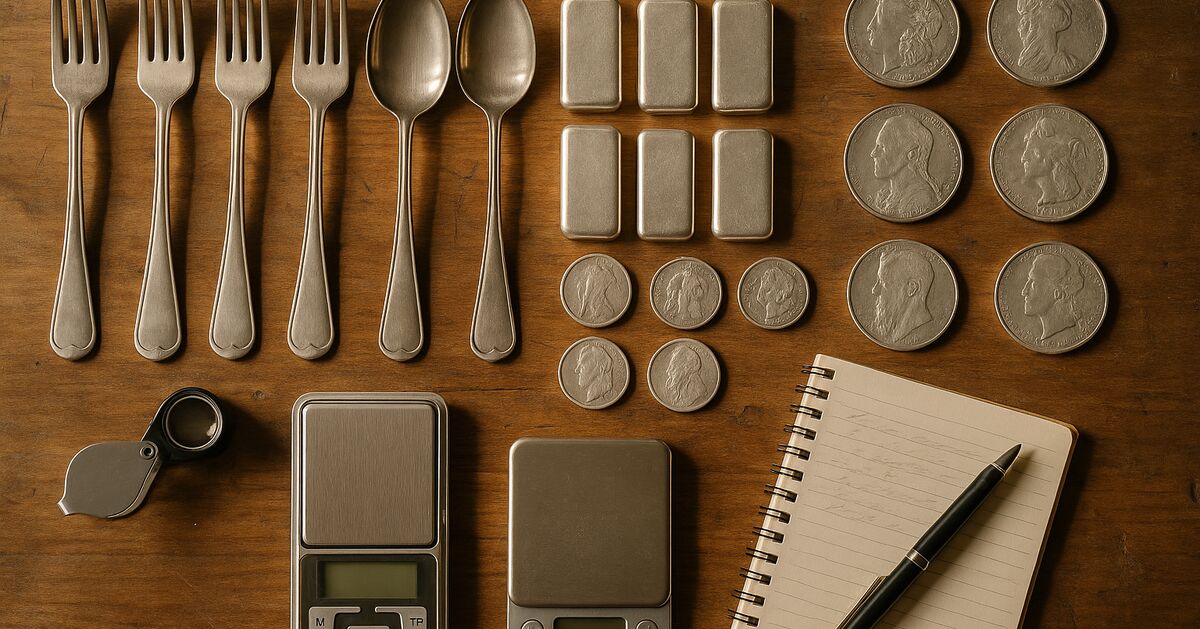
Every dealer conversation about silver or gold is built on a shorthand that the trade invented for itself, not for the person sitting across the counter. Walk into a coin shop or call a mail-in buyer and you will hear "spot," "fineness," "spread," "assay" and "melt" thrown around as though they are self-explanatory. They are not, and the gap between understanding those words and merely nodding at them can cost you real money.
This glossary covers the terms a seller is most likely to meet. It is not an exhaustive dictionary of futures-market jargon. It is a working vocabulary built around the practical question: what does this word mean for the offer I am about to receive?
Spot price
Spot is the price at which a given metal can be bought or sold for immediate settlement, right now, on the open wholesale market. It is the number you see quoted on financial websites and commodity exchanges such as the COMEX division of the New York Mercantile Exchange.
Spot is important because many other prices in the silver and gold trade are expressed as a percentage of spot or as a fixed discount below spot. When a dealer says "I am paying 95 percent of spot for sterling," or "I am paying spot minus two dollars for junk silver," the spot price is the anchor around which their offer is built.
One thing sellers are sometimes surprised to learn: spot is a live, moving number. It changes throughout every trading day and can shift noticeably between the moment you get a quote and the moment you accept it. That matters, particularly if the market is volatile. The FAQ page covers a few of the most common misunderstandings about how spot is applied to seller offers.
Melt value
Melt value is what the raw silver or gold content in an item would be worth if you melted it down and sold the resulting pure metal at spot. It is a calculated number, not a price anyone is actually offering you.
The calculation is straightforward. Take the item's weight in troy ounces, multiply by its fineness (its proportion of pure metal), and multiply by the current spot price. The result is melt value.
Melt value is the theoretical ceiling on what a scrap buyer will pay, because the buyer's revenue, after refining, is roughly that number. In practice, offers run below melt to account for refining loss, the dealer's margin, and the cost of handling. Understanding melt value tells you whether an offer is in a reasonable range or embarrassingly low.
Troy ounce
This is the unit of weight used for all precious metals, and it is not the same as the ounce on your kitchen scale.
A troy ounce is 31.1035 grams. An ordinary avoirdupois ounce (the one used for food, postage, and nearly everything else in daily life) is 28.35 grams. The difference is about ten percent. That gap matters when you are weighing silver at home to estimate value. A kitchen scale that reads in ounces is reading avoirdupois ounces, so if you weigh a piece and multiply by spot, you will overestimate the melt value by roughly ten percent before you have even accounted for fineness.
Always convert to troy ounces before doing melt-value arithmetic. The conversion is simple: multiply the avoirdupois ounce weight by 0.9115 to get troy ounces, or divide your gram weight by 31.1035.
Fineness
Fineness is the proportion of pure metal in an alloy, expressed in parts per thousand. A piece with a fineness of .925, for example, contains 925 parts pure silver and 75 parts of other metal (typically copper) out of every 1,000 parts by weight.
Fineness is usually stamped directly onto manufactured silver and gold items. On silver flatware or holloware made in Britain you may see a lion passant and a date letter rather than a numeric fineness, but those marks still guarantee .925 fineness. The four British hallmarks work together to communicate exactly what the numeric stamp communicates elsewhere.
Understanding fineness lets you calculate fine weight, which is the actual quantity of pure silver in a piece. Gross weight multiplied by fineness equals fine weight. Dealers pay on fine weight, not gross weight, so a heavier item with lower fineness can be worth less than a lighter item with higher fineness.
Sterling
Sterling is a specific fineness standard: .925, or 92.5 percent pure silver. The remaining 7.5 percent is usually copper, added for hardness. Sterling is the standard used for almost all British silver and for a large proportion of American silver made for tableware and jewelry from the nineteenth century onward.
The word "sterling" stamped on a piece is a legally meaningful mark in many countries. In the United States, the Federal Trade Commission requires that items marked "sterling" or "sterling silver" be at least .925 fine. In Britain, the Assay Offices have enforced this standard with hallmarks for centuries.
Sterling is worth more per troy ounce than coin silver (see below) because it is purer, but it is worth less than fine or Britannia silver (.999 or .958 respectively). If someone offers you the same percentage of spot for sterling as for coin silver, push back: the higher fineness of sterling means each troy of gross weight contains more silver.
Coin silver
Coin silver is a fineness standard of .900, or 90 percent pure silver, with 10 percent copper. It was the standard used for circulated United States silver coinage through 1964, which is why pre-1965 dimes, quarters, half dollars and dollars are often grouped under the shorthand "junk silver."
Coin silver was also used by American silversmiths through much of the eighteenth and nineteenth centuries for flatware and hollowware, particularly before the sterling standard became dominant. Pieces from that period are sometimes stamped "COIN," "PURE COIN," "DOLLAR," or "C" rather than any numeric fineness.
Because coin silver is .900 fine rather than .925, a gross troy ounce of coin silver contains about 2.7 percent less pure silver than the same weight of sterling. Offers should reflect that difference.
Assay
An assay is a test to determine the fineness and sometimes the weight of a precious metal. There are several methods used in the trade, ranging from the quick and approximate to the slow and precise.
Fire assay is the traditional benchmark. A small sample is dissolved in a molten flux, the silver or gold is separated chemically, and what remains is weighed to calculate fineness. It is generally considered accurate but destructive and slow, which is why it is more commonly used by refiners than retail dealers.
XRF (X-ray fluorescence) analysis has become the practical standard for most dealers and many refiners. A handheld XRF gun fires X-rays at the surface of a piece and reads the energy reflected back to calculate elemental composition. It is fast, non-destructive, and accurate to within a fraction of a percent for most alloys. The limitation is that it reads the surface, so a plated item can fool a quick surface scan. A good operator knows to test in multiple spots, including any worn areas.
Acid testing is the low-tech version. A small scraping from the metal is applied to a testing stone, and acid of a known concentration is used to assess purity by observing the reaction. It is useful for a quick pass-or-fail check but is less precise than XRF.
As a seller, you will rarely need to arrange your own assay. But knowing what an assay is means you understand why a buyer sometimes hesitates on an unusual piece, or why a refiner's settlement may differ slightly from a dealer's estimate. The refiner's process explained in this post goes into more detail about how assay fits into a refinery's workflow.
Refining loss
When silver is refined, the process of purifying it is not perfectly efficient. Some metal is inevitably lost to slag, crucible absorption, and process waste. Refiners account for this by applying a refining loss percentage to their settlement; the exact figure varies by refiner, starting material, and method used, so ask your refiner what they apply.
What this means for a seller is that the quantity of pure silver a refiner credits you for is slightly less than the quantity of pure silver the assay found in the material. The difference is the refining loss. It is a legitimate cost of doing business, not a sleight of hand, but it is worth understanding so that you are not confused when a refiner's payment does not exactly match your own melt-value calculation.
Bid and ask (the spread)
In any two-sided market, there are two prices: the bid and the ask.
The bid is the price at which a dealer is willing to buy from you. When you are selling, the bid is the number that matters.
The ask is the price at which a dealer is willing to sell to you. When you are buying, the ask is what you pay.
The spread is the gap between bid and ask. It represents the dealer's margin. A narrower spread generally means a more liquid, competitive market. A wider spread means either less competition, higher handling costs, or both.
In the silver and gold trade, the spread is often expressed not as a fixed dollar amount but as a percentage of spot. A dealer who pays 95 percent of spot for sterling silver bullion and sells it back at 103 percent of spot has an 8-percentage-point spread on that particular item. The spread on rare numismatic coins can be wider than on generic bullion, likely reflecting higher handling, grading, and marketing costs, though this varies by dealer.
As a seller, you are always on the bid side of the trade. Understanding that the ask price you see advertised on a dealer's website is not the price you will receive when selling is one of the most practically useful things this glossary can teach. The post on questions to ask before accepting an offer covers how to pressure-test a bid before you commit.
How these terms interact in a real transaction
Here is how the vocabulary connects in practice. Suppose you have a set of American sterling flatware.
You weigh it on a kitchen scale: 40 avoirdupois ounces. You convert to troy ounces: 40 x 0.9115 = 36.46 troy ounces (gross weight). Sterling is .925 fine, so the fine weight is 36.46 x 0.925 = 33.73 troy ounces of pure silver. Spot is currently $29.00 per troy ounce. Melt value is therefore 33.73 x $29.00 = roughly $978.
A dealer's bid will typically be below that melt value figure. How far below depends on the form of the silver, the current market, their overhead, and the competition they are facing. Checking multiple buyers is the practical solution, and the post on pawn shops, coin dealers, and mail-in buyers walks through how different buyer types tend to price sterling flatware.
A few terms that come up less often but are still worth knowing
Fine weight - the weight of the pure metal content only, as opposed to gross weight. Dealers pay on fine weight.
Hallmark - a mark stamped onto silver or gold by a manufacturer, assay office, or maker that identifies the piece's origin, fineness, or both. Hallmarks are the primary way buyers assess an item before they test it.
Bullion - precious metal in a form valued primarily for its metal content rather than its design or rarity. Bullion coins, bars, and rounds are all bullion. Sterling flatware is typically treated as bullion by scrap buyers.
Numismatic value - the collector or historical premium that a coin or medal carries above and beyond its melt value. A coin with numismatic value should not simply be sold as scrap; it is worth getting a second opinion from a coin specialist before doing so.
Face value - the legal monetary denomination stamped on a coin. Pre-1965 US silver quarters have a face value of 25 cents, but their silver content makes them worth far more. Face value is rarely relevant to what a buyer will pay.
Why knowing this vocabulary matters
A seller who understands these terms is far harder to shortchange than one who does not. When a buyer says "I'm paying 90 percent of spot," you can work out what that means in dollars before you walk through the door. When a refiner mentions "refining loss," you know it is not an invented fee. When someone quotes you an "ask" price and you realize that is what they sell for, not what they buy for, you will know to ask a different question.
The silver and gold trade is not inherently dishonest, but it is a trade built on information asymmetry. Dealers know these terms in their sleep. Sellers, particularly those dealing with inherited pieces or a one-time liquidation, are often encountering the vocabulary for the first time. Closing that gap is the entire purpose of a resource like this one.
If you are still working out what you actually have before getting offers, the post on sorting an inherited box of silver before getting quotes is a good practical starting point. And if you have stumbled across a piece you cannot identify, the home page has links to more identification guides that may help.
The best protection a seller has is understanding. These definitions are a place to start.
Sources & further reading
- Troy weight and avoirdupois weight standards (U.S. National Institute of Standards and Technology (NIST))
- FTC guides for the jewelry, precious metals, and pewter industries (U.S. Federal Trade Commission)
- UK hallmarking legislation and Assay Office standards (The Goldsmiths' Company Assay Office)
- XRF analysis methods for precious metal testing (Olympus Industrial (XRF instrument manufacturer documentation))
Revision history (1)
- Pre-publish editorial QA: 4 flagged, 2 softened; claim audit: 8 claims, 3 rewritten
Claim-by-claim audit (8 checked)
- “Refiners account for this by applying a refining loss percentage to their settlement; the exact figure varies by refiner, starting material, and method used, so ask your refiner wh…” (rewritten to what the article can stand behind)
- “The spread on rare numismatic coins can be wider than on generic bullion, likely reflecting higher handling, grading, and marketing costs, though this varies by dealer.” (rewritten to what the article can stand behind)
- “It is generally considered accurate but destructive and slow, which is why it is more commonly used by refiners than retail dealers.” (rewritten to what the article can stand behind)
- “It is fast, non-destructive, and accurate to within a fraction of a percent for most alloys.” (cited → olympus-ims.com)
- “In the United States, the Federal Trade Commission requires that items marked "sterling" or "sterling silver" be at least .925 fine.” (cited → ftc.gov)
- “In Britain, the Assay Offices have enforced this standard with hallmarks for centuries.” (cited → gold.ac.uk)
- “A troy ounce is 31.1035 grams.” (cited → nist.gov)
- “An ordinary avoirdupois ounce (the one used for food, postage, and nearly everything else in daily life) is 28.35 grams.” (cited → nist.gov)