
What a refiner actually does with your scrap silver
Selling a bag of old silver spoons feels simple enough, but the moment you accept an offer, a surprisingly sophisticated industrial process kicks into gear. Understanding what happens next is not just interesting trivia. It directly explains why buyers offer the percentages they do, why certain items get higher returns than others, and why "melt value" is never the same thing as the check you receive.
From your hands to the furnace: the chain of custody
When you hand over scrap silver to a coin dealer, a mail-in buyer, or a pawn shop, that business typically does not refine the metal itself. Small buyers accumulate silver until they have enough to make it worth sending to a commercial refinery. The refinery is a specialist operation with industrial-scale equipment and chemistry knowledge that would be impractical for a small dealer to replicate.
The typical chain looks like this:
- You sell to a local dealer or mail-in buyer
- The dealer accumulates a lot (often several kilograms minimum) before shipping
- The lot goes to a commercial refinery
- The refinery assays, smelts, and processes the metal
- Refined silver is sold to industrial buyers or minted into new bullion
Every link in that chain has a cost, and those costs flow back toward the price you see offered at the first link.
Step one: sorting and rough assessment
When a mixed lot of scrap silver arrives at a refinery, the first task is rough sorting. Items are grouped by likely silver content: sterling flatware (92.5% silver) goes in one pile, coin silver (usually 90% in the US) in another, and low-grade or plated material in yet another. This rough sort is done visually and by experience, not yet chemically.
Anything that looks plated, or that might be base metal with only a thin silver coating, is often set aside. Refiners often will not pay for silver plate in a scrap lot, since the silver yield per kilogram tends to be low relative to processing costs. This is worth knowing before you sell: if your lot contains obvious plate mixed in with genuine sterling, a careful buyer will discount the whole lot or ask you to separate them.
If you are unsure what you have before selling, the guide on how to sort an inherited box of silver before getting quotes is a good starting point. Arriving with clearly sorted material often earns you a better offer, because the buyer is taking on less uncertainty.
Step two: assaying (finding out what's actually there)
Before any metal is melted, a reputable refinery will assay the lot. Assaying is the process of determining the actual silver content with precision. There are several methods in common use.
Fire assay is the oldest and still one of the most accurate. A small sample is weighed, wrapped in lead foil, and heated in a furnace called a cupel. The lead oxidises and is absorbed into the porous cupel material, leaving behind a tiny bead of precious metal. That bead is weighed, and the ratio tells you the fineness of the original sample. Fire assay is generally considered a highly precise method for measuring silver content.
X-ray fluorescence (XRF) is the faster modern method. An XRF gun fires X-rays at the metal and reads the energy emitted back. Different elements emit at different wavelengths, giving a detailed composition report in seconds. XRF is non-destructive, which makes it popular for rapid screening, though fire assay is still used when extreme precision is needed or when the surface of the item might not reflect the true alloy underneath (old flatware can have composition variation through its thickness).
Wet chemical assay (titration) is also used for certain lots. A known weight of silver is dissolved in nitric acid, and a reagent is added drop by drop until a color change signals that all the silver has been precipitated. The volume of reagent used gives you the silver content. This method is thorough but time-consuming.
The assay result is what establishes the "payable silver" figure, meaning the actual grams or troy ounces of pure silver the refinery will credit you for. If you assumed your lot was all 92.5% and it turns out to average 91.8% because some items were lower-grade alloys, that difference comes out of your return.
Step three: melting and smelting
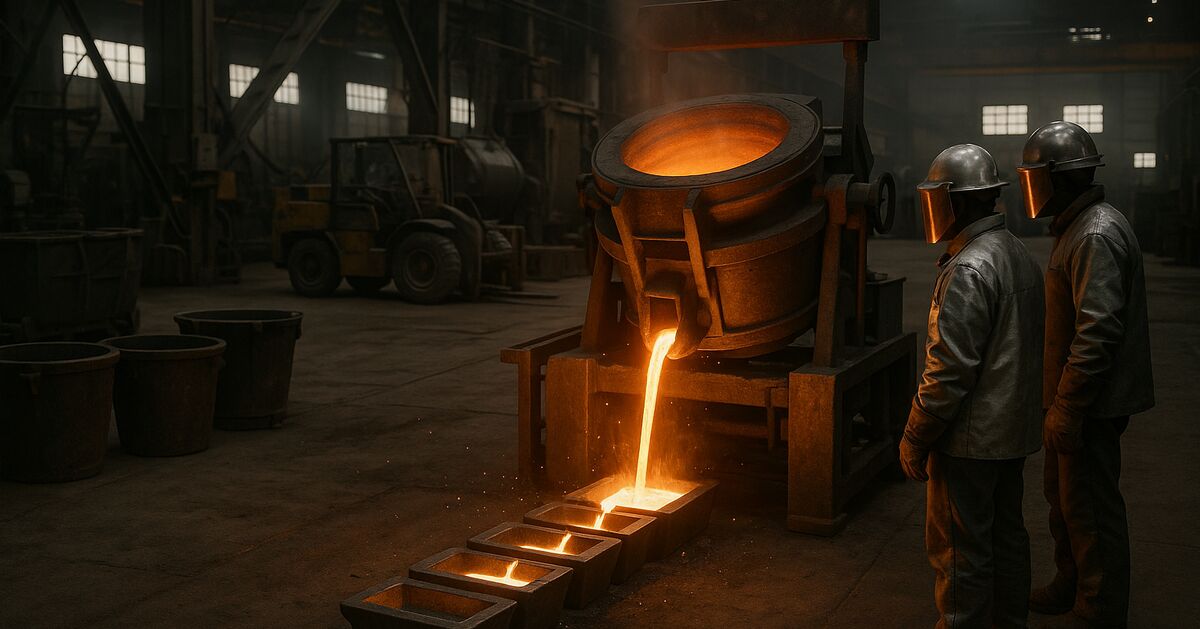
Once the lot is assayed and accepted, the silver goes into the furnace. For silver, electric induction furnaces are common. An induction furnace passes alternating current through coils surrounding a graphite or ceramic crucible; the changing magnetic field induces eddy currents in the metal itself, heating it from within rather than from outside. Silver melts at 961.8°C (1763°F), and induction furnaces can reach this easily and quickly.
During melting, fluxes are added to the melt. Flux is a chemical agent (often borax or soda ash) that helps impurities separate from the silver. The flux reacts with oxides and other contaminants, forming a layer of slag that floats to the top of the molten metal and can be skimmed off. This is an important step because sterling silver contains copper (the 7.5% that makes up the remainder), and the melt may also contain traces of lead, tin, nickel, or other metals picked up from soldering, plating, or alloying.
The molten silver is then poured into molds to produce ingots (sometimes called "dore bars" when the silver content is still less than 99.9%). These ingots are weighed and sampled again for a post-smelt assay to confirm the refinery's processing figures.
Step four: refining to fine silver
A dore bar is not yet fine silver. To get from 92.5% sterling or 90% coin silver up to 99.9% (the standard for investment-grade silver, sometimes written as .999 fine), further refining is needed.
Electrolytic refining is the industry-standard method. The impure silver is cast into thick plates that become the anode (positive electrode) in an electrolytic cell. A thin sheet of fine silver acts as the cathode (negative electrode). Both are suspended in a silver nitrate solution. When current flows, silver ions dissolve off the anode and deposit onto the cathode as extremely pure silver crystals. Base metal impurities from the anode fall to the bottom of the cell as "anode slime" and are periodically collected and processed separately (some anode slimes from silver refining contain recoverable gold and platinum-group metals).
The crystals that build up on the cathode are stripped off, washed, melted, and cast into the familiar poured-silver bars or granules you see sold as refined silver. At this point the material is typically 99.9% or better.
Chemical refining using nitric acid dissolution and selective precipitation is an alternative, particularly for smaller operations. It achieves similar purity but generates more chemical waste to manage.
What this means for the price you are offered
Every step above costs money. Assaying, fuel, furnace time, chemicals, labor, environmental compliance, and waste handling all come out of the gross value of the silver before anyone is paid. Refineries commonly charge a treatment fee and pay less than full spot price for the refined silver they sell, though exact figures vary by refiner.
The dealer who bought your silver adds their own margin on top of that. So when a buyer offers you, say, 85% to 90% of spot for clean sterling flatware, that spread is covering the refiner's charges, the dealer's shipping and insurance costs, the time value of money while the lot is in transit and processing, and the dealer's profit.
Items that require more sorting, testing, or processing yield a smaller return. A pile of clearly hallmarked sterling spoons is easier to price accurately than a mixed bag of mystery items. Understanding the questions to ask before you accept an offer on silver can help you work out whether the percentage you are being offered is reasonable for what you have.
Why some silver items skip the scrap route entirely
Not all silver that changes hands ends up at a refinery. Coins with numismatic value, decorative pieces with antique premium, and flatware from desirable makers can be worth significantly more whole than melted. A refinery will only ever pay for the metal. A knowledgeable coin dealer or antiques buyer will pay for rarity, history, and condition on top of the metal.
This is the core reason it is worth getting more than one offer before selling. If you take a box of pre-1965 US coins to a refiner as pure scrap, you will lose the numismatic layer of value entirely. The junk silver explained guide covers exactly how that plays out with common US coins.
Similarly, a Georg Jensen sugar bowl or a Paul Storr teapot has a secondary market of collectors who value it as an object, not just as 200 grams of silver. Sending it to a refiner is a one-way door that permanently destroys that additional value.
A note on what happens to your specific item
Once your silver enters a commercial melt with hundreds of other people's silver, it is gone as an individual object. The metal is fungible. The refinery does not track "the Smith family's spoons" through the process. You are credited for the assayed weight of pure silver your lot contributed, and that silver becomes part of a large pool of refined metal that is sold in bulk.
This is worth knowing emotionally as well as practically. If the silver has sentimental value that you might regret losing, the time to consider that is before the sale, not after. The frequently asked questions page on this site addresses some of the common hesitations people have before parting with inherited silver.
Common misunderstandings about refining
"The refinery pays full spot price." No refinery pays 100% of spot. Processing costs are real costs. Even a large-lot seller working directly with a refinery tends to receive less than full spot price, and smaller lots sold through intermediary dealers typically receive less still.
"Silver plate is worth refining." Electroplated silver (EPNS, Sheffield plate from the modern era, silver-plated cutlery) contains so little silver per kilogram of material that the refining cost often exceeds the silver value. Some specialist reclaimers handle it, but the return is minimal. The article on silver plate and its real value goes into detail on what silver plate actually is and what you can realistically expect.
"I can refine silver at home." There are hobbyist methods using acids and chemicals to recover silver from small amounts of photographic waste or electronics. These methods are generally impractical for flatware or coins, and the chemical waste, disposal rules, and safety risks make them unsuitable for anyone without proper chemical training and facilities.
"Higher karat means I get paid more per gram." This is partly true, but the calculation is on pure silver content, not the item's gross weight. A 100-gram piece of sterling yields 92.5 grams of pure silver. A 100-gram piece of coin silver yields 90 grams. The difference in price you receive reflects that underlying difference in metal, not a quality premium in any other sense.
Putting it together
Understanding the refining process turns abstract percentages into logical outcomes. The gap between spot price and the offer you receive is not arbitrary. It reflects assaying costs, smelting costs, electrolytic refining costs, dealer margins, and the simple economics of processing small lots of mixed material. Knowing this lets you evaluate offers more clearly, sort and present your silver in ways that reduce the uncertainty buyers price in, and recognize when an item is better sold as an antique or collectible than as scrap.
For more practical guidance on the selling process from start to finish, the home page has a growing collection of topic guides covering every stage, from identifying what you have to choosing the right buyer and getting your silver there safely.
Refining is ancient technology made precise by modern chemistry. Your great-grandmother's sugar tongs may end up as a medical instrument, a solar panel contact, or a new bullion bar sold to an investor on the other side of the world. The process that gets them there is more careful and more interesting than the phrase "melted down" suggests.
Sources & further reading
- Silver: commodity overview and industrial uses (U.S. Geological Survey)
- Silver: physical and chemical properties (Royal Society of Chemistry)
Revision history (1)
- Pre-publish editorial QA: 1 flagged, 1 softened; claim audit: 6 claims, 5 rewritten
Claim-by-claim audit (6 checked)
- “Refiners often will not pay for silver plate in a scrap lot, since the silver yield per kilogram tends to be low relative to processing costs.” (rewritten to what the article can stand behind)
- “Refineries commonly charge a treatment fee and pay less than full spot price for the refined silver they sell, though exact figures vary by refiner.” (rewritten to what the article can stand behind)
- “Even a large-lot seller working directly with a refinery tends to receive less than full spot price, and smaller lots sold through intermediary dealers typically receive less still…” (rewritten to what the article can stand behind)
- “Fire assay is generally considered a highly precise method for measuring silver content.” (rewritten to what the article can stand behind)
- “Anode slimes from silver refining can sometimes contain other recoverable metals such as gold or platinum-group metals.” (rewritten to what the article can stand behind)
- “These methods are generally impractical for flatware or coins, and the chemical waste, disposal rules, and safety risks make them unsuitable for anyone without proper chemical trai…” (rewritten to what the article can stand behind)