
How to figure out what your silver is actually worth
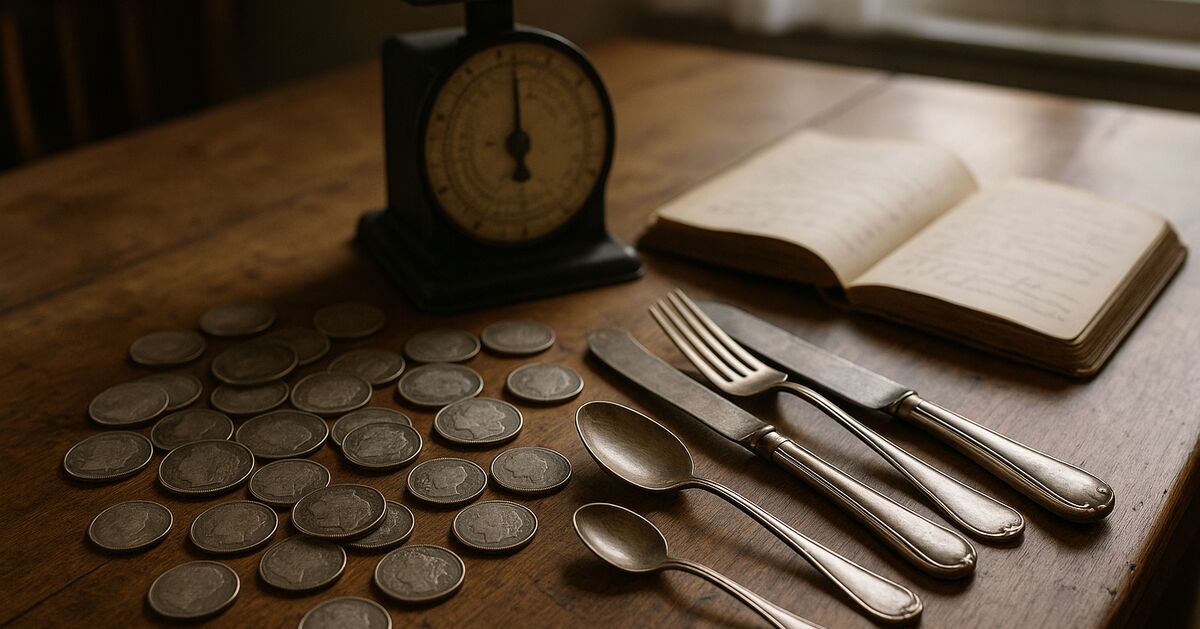
Knowing what your silver is worth before you walk into any buyer's shop is the single most useful thing you can do as a seller. Not after the offer lands on the table - before. That gap between "I have no idea" and "I have a reasonable ballpark" is exactly where sellers lose money, and it is entirely closeable with a few hours of honest research.
This guide covers the full picture: the metal value underneath everything, the collector premium that can sit on top of it, how condition and timing feed into both, and the practical steps to figure out which category your silver actually belongs in. It is written from eighteen years of buying silver and coins directly from the public, a business I have since closed. The patterns I saw in that work are the backbone of everything below.
Start with the floor: melt value
Every piece of silver has a floor price. That floor is its melt value - the raw worth of the metal it contains, calculated from the spot price of silver on any given day. No legitimate buyer will pay you less than a reasonable percentage of melt, and understanding melt value lets you immediately spot offers that are too low.
The melt value formula is straightforward:
Weight of pure silver (in troy ounces) x current spot price = melt value
The tricky part is getting the weight of pure silver right, because almost nothing you will encounter is 100% pure. Sterling silver flatware and holloware is 92.5% silver. Pre-1965 US dimes, quarters, and half dollars are 90% silver. Older European pieces use marks like 800 (80%) or 830 (83%). If the purity expressed as a decimal stumps you, our guide to weight and purity conversions for selling silver walks through every common standard with worked examples.
Once you have the troy-ounce figure, you multiply by today's spot price, which you can find on any live commodities feed. The result is the theoretical 100%-recovery melt value. Buyers will offer a percentage of that, not the full amount, because they carry operating costs and refining fees - but you now have a benchmark to judge any offer against.
The layer above melt: collector and investor premiums
Here is where silver valuation gets genuinely interesting, and where sellers who skip research leave real money on the table.
Some silver is worth considerably more than its metal content because buyers want it as a collectible or as a specific investment vehicle, not just as raw material. The two categories behave very differently and you need to know which one you are holding.
Collector value attaches to coins (and occasionally to silver objects) based on rarity, historical significance, condition, and demand from enthusiasts. A coin that is genuinely scarce in high grade can trade at multiples of its melt value. A common date in worn condition may trade at or barely above it.
Investor premiums are a separate thing. Some pre-1965 US silver coins are popular with precious metals investors as a convenient way to hold 90% silver. That demand adds a modest premium above pure melt that has nothing to do with numismatic rarity. These are commonly called "junk silver" in the trade (a misleading name, since the metal content is very real).
The practical question to ask yourself about any coin: is this piece sought after because of what it is, or because of what is in it? The answer determines who your ideal buyer is and what price is realistic.
How coin condition shapes the collector premium
Condition is the factor that beginners are most likely to underestimate, and it can swing the value of a coin dramatically. The professional grading scale runs from 1 to 70 in numismatic use. A score of 70 is a perfect, flawless specimen. A score in the 60s means uncirculated - never spent in everyday commerce. Coins in the 50s show only the faintest signs of handling. Once you drop into the 40s and below, wear becomes increasingly visible, and at the low end of the scale the coin is identifiable but heavily worn.
Why does this matter so much? Because coin collectors value scarcity, and a scarcity that exists in high grades is far more pronounced than overall mintage numbers suggest. A coin minted in the millions may be genuinely rare in grades above 65, because the vast majority were circulated and worn. A single grade point at the top of the scale can represent thousands of dollars of difference on a key-date coin.
For everyday sellers, the practical implication is this: before you assume a coin is "just silver," look it up. A coin that appears ordinary may be a scarcer date, or may have a mintmark variant that commands a premium. A coin that looks impressive may turn out to be a high-mintage common date in average condition, worth a few dollars above melt. Appearances in coins are genuinely deceiving.
One caution worth repeating because it matters so much: do not clean your coins. Not with polish, not with a cloth, not with anything. Cleaning removes the natural patina that develops over decades, and graders and collectors generally view this as damage to the coin's surface. A cleaned coin is typically worth less, not more, even if it looks shinier to you. The full reasoning behind this is laid out in the post on why you should never clean silver coins before selling.
Researching coins you do not recognize
If you have inherited coins and genuinely do not know what you are looking at, start with the basics before paying anyone for an assessment.
- Read the coin's details. Date, denomination, country of origin, and any mintmark are your starting points. US coins carry mintmarks (letters like D, S, O, P) that indicate where they were struck, and the same date from different mints can vary significantly in value.
- Check auction records. Major auction houses publish realized prices for coins that have sold. Searching by date, denomination, and grade on a site that aggregates these results gives you a realistic picture of what the market has actually paid, not what a dealer is asking.
- Look at asking prices with skepticism. Online marketplace listings show what sellers want, not what buyers will pay. Sold prices are far more informative.
- Visit a coin show. Walking a coin show and talking to multiple dealers with your coins in hand costs nothing beyond admission and gives you a range of informal opinions quickly. It also tells you whether any dealer lights up at a particular coin, which is useful information in itself.
For coins with possible significant collector value, a formal grading service (PCGS and NGC are the two most recognized in the US) provides an encapsulated, certified grade that removes ambiguity when selling. There is a fee involved, so it is only worth doing on coins where the potential premium justifies the cost.
Researching scrap silver and flatware
Silver that has no meaningful collector value - flatware sets, holloware, mismatched serving pieces, broken jewelry, or heavily worn coins - is sold on its metal content alone, and the research process is simpler.
The critical steps are:
- Confirm what you actually have. Hallmarks tell you purity. On British sterling pieces, the lion passant is the reliable indicator, along with three other marks that confirm assay office, date, and maker. On American sterling, look for the word "sterling" or "925." If you see "EPNS," "silver plate," "silverplate," or no mark at all, the piece may not be solid silver. Understanding what those marks mean is worth a few minutes of your time; our plain-English glossary of silver and gold trade terms covers the key vocabulary.
- Weigh it. A kitchen scale that reads in grams is adequate for an estimate. Convert grams to troy ounces (divide by 31.1) and apply the purity percentage.
- Calculate melt value. Multiply pure troy ounces by today's spot price. This is your floor.
- Get multiple quotes. Melt-value buyers vary in how much of the melt value they pass on to sellers. Coin shops, pawnbrokers, online mail-in refiners, and local scrap buyers all operate at different margins. Getting three quotes costs you only time and dramatically improves your position.
For a worked example of how this plays out with a real flatware set, the post on sterling flatware valuation on our blog covers the arithmetic in full detail.
The timing question
Silver's spot price moves constantly. It tends to respond to factors such as currency movements, interest rates, industrial demand, and investor sentiment. Over the span of years, the swings can be enormous. Within a single week, the price can shift by meaningful percentages.
This creates a genuine timing question for sellers. A few honest observations from experience:
- If you are selling for melt value, timing matters. The same parcel of silver can bring meaningfully different amounts depending on where spot sits on the day you sell.
- If you are selling a genuinely rare coin at a significant collector premium, timing matters less, because collector demand is not as tightly coupled to the daily spot price.
- Waiting indefinitely for a "better" price is a real risk. Spot prices can fall as easily as they rise. Sellers who wait years for a hoped-for price spike sometimes sell at the bottom instead.
A practical approach is to watch the spot price for a few weeks to get a feel for the recent range, identify a level at which you would be satisfied, and act when it is reached rather than holding out for a hypothetical peak.
Getting the most from the selling process
The research you do before any conversation with a buyer is not wasted effort. It protects you in concrete ways.
Knowing your melt floor means you can immediately identify an offer that is insultingly low and walk away confidently. Knowing which coins may carry a collector premium means you do not accidentally sell a valuable piece to a scrap buyer at metal prices. Knowing the condition grade of your coins means you can have a meaningful conversation with a specialist rather than relying entirely on their assessment.
If you have inherited a mixed collection and are not sure where to start, the systematic approach is to sort before you seek quotes. Group by type: pre-1965 US silver coins together, foreign coins separately, sterling flatware and holloware separately, jewelry separately, and anything you cannot identify in its own pile. That sorting step alone makes the research more manageable and makes the quoting process cleaner. The post on how to sort an inherited box of silver before getting quotes goes into detail on exactly how to do this.
If you have inherited a broader estate with silver mixed among other household goods, there is also guidance on clearing an estate and handling silver when you did not choose it, which addresses the practical and sometimes emotional complexity of that situation.
A note on who buys what
Different buyers are optimized for different types of silver, and matching seller to buyer correctly matters.
- Coin dealers who specialize in your type of coin are the right buyers for numismatically significant pieces. A dealer who focuses on early American coinage will pay more for a key-date Morgan dollar than a general metals buyer, because they have the collector customers for it.
- Precious metals buyers and refiners are the right buyers for scrap silver, heavily worn coins with no collector premium, and sterling items valued purely on weight.
- Online marketplaces and collector forums can be excellent for coins with clear identifiable collector demand, because they connect you directly with enthusiasts who want specific pieces.
The mistake to avoid is treating all silver as the same. Selling a genuinely valuable coin to a scrap buyer is the equivalent of trading a rare book by weight at a paper recycling facility. The silver is recovered, but the premium above it is lost entirely.
For a fuller breakdown of the different buyer types and how their offers compare, the frequently asked questions section covers common seller questions including the buyer comparison question in plain terms.
Putting it together
Valuing your silver honestly takes a little time and a willingness to treat it as a research task rather than a gut-feel exercise. The core framework is always the same: establish the melt floor, check for any collector or investor premium sitting above that floor, understand how condition affects that premium for coins, and match the piece to the right type of buyer.
You do not need to be an expert numismatist to protect yourself in this process. You need a scale, a current spot price, a few hours of looking up dates and mintmarks, and the discipline to get more than one offer before you commit.
The home page of this site has more context on the philosophy behind the guidance here, written by someone who spent nearly two decades on the buying side of this trade and has since stepped back from it. That background informs everything: a buyer who ran an honest shop understands exactly where sellers get taken advantage of, and why it does not have to happen to you.
Start with the research. The offers will make more sense once you do.
Sources & further reading
- Silver spot price and commodity data (Kitco Metals Inc.)
- Precious metals refining and silver purity standards (U.S. Environmental Protection Agency)
Revision history (2)
- Pre-publish editorial QA: 2 flagged, 0 softened; claim audit: 7 claims, 3 rewritten
- Pre-publish editorial QA: 2 flagged, 0 softened; claim audit: 6 claims, 2 rewritten
Claim-by-claim audit (7 checked)
- “Sterling silver flatware and holloware is 92.5% silver.” (reasoning shown in the article)
- “Pre-1965 US dimes, quarters, and half dollars are 90% silver.” (reasoning shown in the article)
- “Some pre-1965 US silver coins are popular with precious metals investors as a convenient way to hold 90% silver.” (rewritten to what the article can stand behind)
- “A coin minted in the millions may be genuinely rare in grades above 65, because the vast majority were circulated and worn.” (reasoning shown in the article)
- “Cleaning removes the natural patina that develops over decades, and graders and collectors generally view this as damage to the coin's surface.” (rewritten to what the article can stand behind)
- “A cleaned coin is typically worth less, not more, even if it looks shinier to you.” (rewritten to what the article can stand behind)
- “It tends to respond to factors such as currency movements, interest rates, industrial demand, and investor sentiment.” (rewritten to what the article can stand behind)