Why you should never clean silver coins before selling
Picking up a dull, dark silver coin and reaching for the polish is one of the most expensive mistakes a seller can make. It feels logical: a shiny coin looks nicer, so surely it will fetch a better price. In practice, the opposite is often true for coins with any collector premium above melt value, and even for common "junk silver" pieces, cleaning can complicate a sale in ways some sellers don't anticipate.
This post explains the science and the market logic behind that warning, so you understand the why and not just the rule.
What buyers actually see when they look at a coin
Coin dealers and serious collectors examine coins under magnification and at an angle to a raking light source. They are not looking for sparkle. They are looking for the condition of the surface at a microscopic level, specifically for the original mint luster, the flow lines left by the striking dies, and the natural chemical patina that forms over decades or centuries of careful storage.
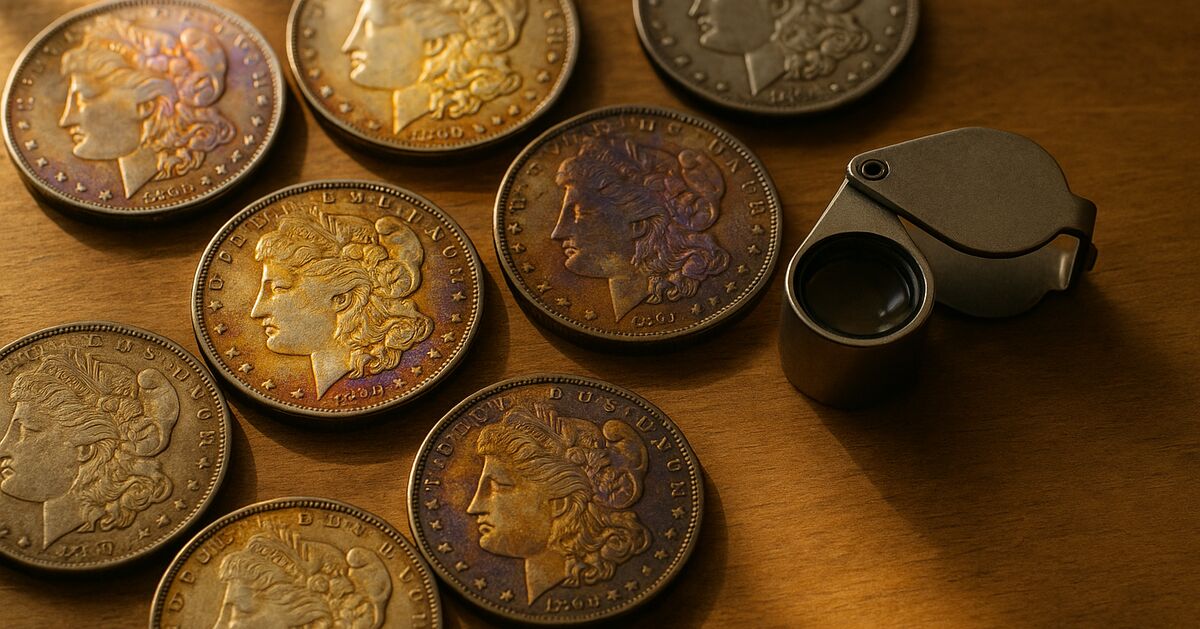
That patina, often called "toning," is a thin layer of silver sulfide and other compounds that develops slowly and evenly on the coin's surface. A coin toned in an original mint bag or an old paper envelope develops color in predictable, attractive gradients: pale gold, rose, violet, sometimes deep cobalt or russet at the edges. These colors are prized. They are direct evidence that the coin has not been interfered with. In the grading industry, the term for a coin that retains its original surfaces is "original skin," and it is something buyers actively seek.
When you clean a coin, even gently, you strip that layer. Worse, you almost certainly introduce fine parallel scratches across the surface called "hairlines." Under a loupe, hairlines are unmistakable. No amount of re-toning or subsequent handling hides them from an experienced eye.
The grading system makes cleaning a permanent black mark
The two major third-party coin grading services in the United States, PCGS (Professional Coin Grading Service) and NGC (Numismatic Guaranty Company), maintain clear policies on cleaned coins. Grading services generally give cleaned coins a "details" grade instead of a numerical grade, based on their published grading policies. Instead of grading as MS-63 (Mint State, a grade that commands a strong premium), the coin comes back labeled "AU-55 Details - Cleaned" or similar. That details designation signals to every buyer in every market that the coin's surfaces have been compromised.
The price difference is stark. A genuine uncirculated Morgan silver dollar in an original, untouched state might trade at several times its silver melt value. A cleaned coin in a details holder can lose most of its collector premium and may trade close to melt value, since collectors and dealers tend to avoid cleaned coins. You can read more about how the numismatic premium works in our post on Morgan and Peace dollars: when the coin beats the melt value.
"But mine are just junk silver, not rare coins"
This is the most reasonable pushback, and it deserves a straight answer. Pre-1965 US dimes, quarters, and half dollars that are heavily worn and worth only for their silver content (so-called "junk silver") are less sensitive to cleaning than a mint-state rarity. If a coin is already graded Good-4 or Very Good-8 by any reasonable estimate, there is little collector premium to destroy.
Even so, cleaning junk silver creates two practical problems. First, it is very hard to know without experience whether a coin genuinely has no collector value. Some key-date coins, like a 1916-D Mercury dime, can be worth far more than melt even when worn, so it's worth checking dates before cleaning anything. Certain dates, such as 1932-D or 1932-S Washington quarters, can carry a meaningful premium even in circulated grades, so check before assuming a coin is common. Cleaning either coin before you know what you have removes that premium permanently. Second, some mail-in and local buyers will scrutinize even junk silver for better dates and condition, and a batch of obviously cleaned coins can make a buyer wonder what else about the lot they need to be cautious about. It introduces friction into a transaction that could otherwise be simple.
The safer habit is to sort first, identify what you have, and then let an expert evaluate condition before you touch anything. Our guide on how to sort an inherited box of silver before getting quotes walks through that process in detail.
The specific damage different cleaning methods cause
Understanding the mechanism of damage helps make the rule stick.
Polishing cloths and silver polish cream are the most destructive tools you can apply to a coin. These products are formulated for silverware and hollow ware, where the goal is a bright, reflective surface and no one cares about microscopic flow lines. They contain mild abrasives and chemical reducing agents. On a coin, they strip toning and leave a bright, "whizzed" surface covered in hairlines. Dealers call this look "polished" and it is immediately obvious.
Toothpaste is a persistent folk remedy and it is nearly as bad. Toothpaste is mildly abrasive by design. It will remove toning and introduce surface scratches.
Baking soda paste or aluminum foil electrochemical baths (the trick where you put the coin in hot water with baking soda and aluminum foil to reverse tarnish chemically) will strip sulfide toning without mechanical abrasion, so they leave fewer hairlines. The result still looks artificial, though, because the surface becomes unnaturally bright and flat in a way that natural toning never produces. Experienced buyers recognize it immediately.
Soaking in acetone is a different case. Acetone is used conservatively by professional numismatists to remove PVC contamination (a green, oily residue from old soft plastic coin holders) without harming original surfaces, because acetone is not an abrasive and does not react with silver. It is not a cleaning agent in the polishing sense. Even so, acetone should be handled with care (it is highly flammable and the vapors are harmful in enclosed spaces), and its use in any form should be disclosed to a buyer. If you suspect PVC contamination, the right move is to ask a coin dealer to advise you before you do anything.
What toning actually looks like, and why some of it adds value
Not all toning is equal. Natural, original toning that formed slowly over decades in original mint storage is considered desirable and can add a premium to a coin's value. Artificial toning meant to fake age is generally viewed as deceptive in the numismatic community, and grading services often flag coins suspected of it.
Ugly, blotchy, or heavily spotted toning can detract from a coin's eye appeal and thus its price, but the solution is still not to clean it. A coin with unattractive toning but original surfaces will grade and sell better than the same coin cleaned. A coin that has been improperly cleaned has no path back to a genuine grade. The damage is irreversible.
What to do instead
If you have silver coins to sell and you are unsure what they are worth, the steps are straightforward.
- Leave the coins exactly as they are. Do not wipe, rinse, soak, or polish anything.
- Photograph each coin in good natural light, flat on a neutral surface, both obverse and reverse. A decent smartphone camera is sufficient. These photos help you research dates and mintmarks.
- Look up the date and mintmark combination before assuming a coin is common. A basic reference like the Red Book (A Guide Book of United States Coins, published annually by Whitman) lists key dates and their approximate values in various grades.
- Get multiple opinions before accepting an offer. A coin dealer who specializes in numismatics will give you a more accurate assessment of collector value than a general precious-metals buyer. Our overview of pawn shop, coin dealer or mail-in buyer: who pays most for silver? helps you think through which type of buyer fits your situation.
- Ask the right questions before you commit. There is a lot of useful guidance in our post on the questions to ask before you accept an offer on silver.
A note on inherited collections
Inherited coin collections present a particular risk because heirs are often working quickly, under emotional pressure, and without numismatic background. A well-meaning family member may clean an entire collection thinking they are helping prepare it for sale. Anecdotally, this is a frequent source of regret among people handling inherited coin collections.
If you have inherited coins alongside silverware and other items, it is worth pausing before you do anything with the coins specifically. The broader context of handling inherited silver is covered in our post on clearing an estate: handling silver when you did not choose it. The short version: coins are the category where a single wrong decision in five minutes can cost you hundreds of dollars or more of value that cannot be recovered.
The one partial exception worth knowing
There is a narrow category where professional conservation (not cleaning) is sometimes considered: coins with active corrosion, verdigris, or bronze disease (rare on silver, more common on copper). In those cases, a professional numismatic conservator may treat the coin to stop the corrosion from progressing, not to make it look prettier. This is specialist work done with non-abrasive solvents under controlled conditions, and the outcome is always disclosed. It is not something to attempt at home, and it is categorically different from polishing.
For the overwhelming majority of silver coins a private seller is likely to encounter, the rule holds without exception: do not clean them.
The broader principle
The cleaning question is really a subset of a larger idea that runs through the entire process of selling silver honestly and well: the buyer's job is to assess what you actually have, and your job is to present it accurately without altering it. Cleaning a coin to make it look more appealing is, even when done with good intentions, an interference with that process. It destroys information that the market has already priced.
If you want to learn more about how buyers think about silver in general, or how the selling process works from start to finish, the how to sell silver home page and our frequently asked questions are good places to start. There is also a full archive of practical guides on the blog covering everything from reading hallmarks to understanding what refiners actually pay.
The coin sitting in front of you, dark and dull as it may look, is presenting its history honestly. Leave it that way. That honesty is part of its value.
Revision history (1)
- Pre-publish editorial QA: 1 flagged, 1 softened; claim audit: 6 claims, 6 rewritten