
Morgan and Peace dollars: when the coin beats the melt value
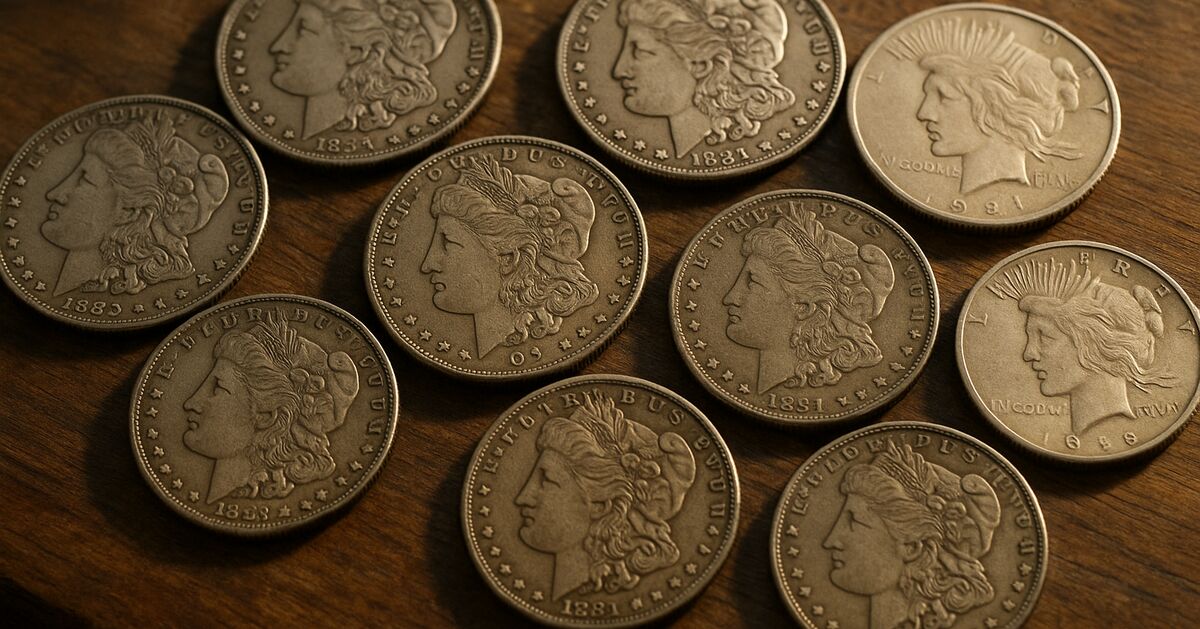
Silver dollars feel substantial in your hand for good reason. A Morgan or Peace dollar contains 0.7734 troy ounces of pure silver, and at almost any spot price from the last decade that has made each one worth something real. But here is the part that surprises a lot of people who inherit a jar of them or find a roll tucked in a drawer: the melt value is often just the starting point. For a meaningful share of Morgan and Peace dollars, the coin's numismatic value, what a collector will pay because of its date, mint mark, and condition, comfortably exceeds what a refiner would pay to melt it. Understanding when that premium kicks in, and why, can be the difference between selling a valuable coin for scrap price and selling it for what it is actually worth.
What melt value actually means for these coins
Before getting into collector premiums, it helps to be precise about the baseline. Morgan dollars (minted 1878 to 1904, then again in 1921) and Peace dollars (minted 1921 to 1935) are both composed of 90% silver and 10% copper. Each coin weighs 26.73 grams, giving it a fine silver content of 0.7734 troy ounces.
To find the melt value on any given day, multiply 0.7734 by the current spot price of silver. If spot silver is $28 per troy ounce, the melt floor is roughly $21.66 per coin. If spot climbs to $32, the melt floor rises to about $24.75. This is useful to know, because no reputable silver buyer will offer you less than melt on a common-date coin in circulated condition. If someone does, walk away.
For more background on how pre-1965 U.S. silver coins are valued as a group, the junk silver explained guide covers the broader picture including dimes, quarters, and half dollars.
The four factors that push a coin above melt
A coin trades above its silver content when collectors want it more than refiners do. That demand is driven by four interlocking factors.
1. Scarcity (mintage and survival rate)
The U.S. Mint published mintage figures for every year and mint facility, and they are publicly available through the Numismatic Guaranty Company (NGC) and Professional Coin Grading Service (PCGS) population reports. A low mintage alone does not make a coin rare; what matters is how many survived in collectible condition. Morgan dollars were heavily used in commerce, melted in large batches historically, and stored carelessly for decades. Many dates that started with modest mintages are genuinely scarce today.
2. Grade (condition)
Coin grading runs from Poor (P-1) to Perfect Mint State (MS-70). Circulated coins showing heavy wear are graded AG-3 through AU-58. Uncirculated coins occupy the Mint State (MS) range from MS-60 to MS-70. The jump in value between, say, MS-63 and MS-65 can be enormous for key dates. A 1921-S Morgan's value can rise sharply with grade, from a few hundred dollars in lower Mint State grades to several thousand in higher ones, according to price guides. Condition matters more than almost any other single variable once you are above the common-date threshold.
3. Mint mark
Morgan dollars were struck at Philadelphia (no mint mark), New Orleans (O), San Francisco (S), Carson City (CC), and New Orleans. Peace dollars came from Philadelphia, San Francisco, and Denver (D). Carson City coins in particular carry a strong collector following because the mint had relatively small output and CC coins have an appealing western frontier association. A coin's mint mark appears on the reverse, just above the tail feathers on Morgans and above the eagle's tail on Peace dollars.
4. Strike quality and eye appeal
Even within a given grade, coins struck from fresh dies with strong detail on the hair, feathers, and lettering command premiums over weakly struck examples. Collectors often regard San Francisco strikes as sharper than New Orleans strikes, which can give S-mint coins a premium over O-mint coins of the same date and grade. Professional graders also assign a Designation such as Deep Mirror Prooflike (DMPL) to Morgans with highly reflective fields, and those coins attract specialist collectors willing to pay substantially more.
Key dates: the coins most likely to beat melt
Not every Morgan or Peace dollar is worth a premium. A worn 1921 Philadelphia Morgan, the most common date by far with over 44 million struck, will typically sell very close to melt. Here are the dates and varieties where collector demand consistently lifts prices well above silver content. These are widely cited in the numismatic literature published by NGC and PCGS.
Morgan dollar key and semi-key dates:
- 1893-S is widely regarded by collectors as highly coveted, with worn examples often selling for hundreds of dollars and higher-grade examples selling for much more; check a current price guide for specifics.
- 1895 Philadelphia Morgans are believed to exist only as proofs, which collectors consider one of the series' great rarities.
- 1889-CC and 1893-CC: Carson City dates with low surviving populations in higher grades
- 1892-S and 1894: semi-keys with meaningful premiums in circulated grades
- 1901 (Philadelphia): low mintage with very few surviving in Mint State
Peace dollar key and semi-key dates:
- 1921: the first year of issue, struck in high relief; this is genuinely scarce and carries a premium even in VF condition
- 1928 Philadelphia had a very low mintage of about 360,000 coins and is generally considered the key date of the Peace series.
- 1934-S: a semi-key that becomes quite valuable in higher circulated and Mint State grades
- 1927-S and 1927-D: semi-keys worth researching before selling
This is not an exhaustive list, and values move with the market and collector demand. The point is that before you sell a handful of silver dollars as scrap or bulk silver, it is worth taking five minutes to check each date individually.
How to check a coin's approximate collector value
You do not need to be an expert to do a basic lookup. Here is a practical workflow:
- Identify the date and mint mark. On a Morgan, the mint mark is on the reverse above "DO" in DOLLAR. On a Peace dollar, it sits on the reverse to the right of the eagle's tail.
- Assess the grade roughly. Circulated coins showing all major design elements but with obvious wear are probably in the Fine (F-12) to Extremely Fine (EF-40) range. Coins with luster still visible are approaching About Uncirculated (AU-50 to AU-58). Full luster with no wear at all is Mint State.
- Look up the date and grade in a current price guide. The NGC and PCGS websites both publish free online price guides updated regularly. The "Red Book" (A Guide Book of United States Coins, published annually by Whitman) is another well-regarded reference.
- Compare to melt value. If the price guide shows a meaningful premium over melt, consider getting the coin professionally assessed or graded before selling.
The grading question: when is it worth submitting to NGC or PCGS?
Professional third-party grading costs money, with fees varying by service level; check current pricing directly with NGC or PCGS before submitting. It makes financial sense only when the expected premium is large enough to justify the cost and turnaround time. A rough rule of thumb used in collector circles: if the spread between the coin's melt value and its potential collector value in a certified holder is at least two to three times the grading fee, submission is worth considering.
Coins that are cleaned, polished, or damaged are likely to receive an "Impaired" or "Details" designation rather than a numeric grade, which significantly reduces their collector appeal. Always examine a coin carefully before spending money on grading.
Common mistakes when selling Morgan and Peace dollars
A mistake that comes up again and again in collector and selling forums is treating all silver dollars as interchangeable melt material. That approach works fine for worn, common-date coins, but it leaves real money on the table for key dates.
Another frequent error is cleaning coins before selling them. A natural, original surface that has developed patina over a century is considered desirable by collectors. Cleaning removes that patina and leaves microscopic hairlines that graders can detect. A cleaned key-date coin can lose a substantial portion of its collector premium. Our FAQ covers this question in more detail.
It also helps to understand how the broader market is behaving before you decide to sell. When silver spot prices are volatile, buyers often widen their spreads on bullion-grade material. The post on why a silver buyer offers less when the market is volatile explains the mechanics behind that, which is useful context when you are negotiating.
Selling channels and what they mean for collector coins
Where you sell a Morgan or Peace dollar matters as much as knowing what it is worth.
- Coin dealers: a local coin shop is a convenient first stop. Dealers need to buy below retail to run a business, so expect offers noticeably below guide value for circulated key dates, though amounts vary by dealer and demand. A reputable dealer will tell you honestly if a coin has collector value.
- Auction houses: for genuinely rare, high-grade, or certified coins, a numismatic auction house (Heritage Auctions, Stack's Bowers, and similar firms) can reach the widest pool of specialist collectors. Seller's fees at auction houses vary but can represent a meaningful percentage of the hammer price, so ask about fee structure before consigning.
- Online marketplaces: eBay completed listings are a useful real-world price reference. Selling there yourself is viable for common semi-keys but requires accurate self-grading and good photographs.
- Silver buyers and refiners: appropriate for worn, common-date coins with no meaningful collector premium. Expect an offer somewhat below the melt-equivalent price, as buyers typically build in a margin that varies by buyer and quantity. Never sell a key-date coin this way.
The home page, which covers the basics of selling silver broadly, can help you orient yourself if you are new to the process and dealing with a mixed lot that includes both bullion-grade and potentially collectible pieces.
What about uncirculated rolls and bags?
Large quantities of Morgan dollars are known to have been released from Treasury vaults in the 1960s. Some of those coins turned out to be conditionally rare Carson City dates in high Mint State grades that had been sitting untouched for decades. Today, original-roll Morgans or coins from estate collections that have clearly never circulated are worth examining individually, because condition is everything for collector premiums. Do not assume a coin is "just common" because it looks clean and bright; that might be the best argument in favor of looking closer.
Putting it all together
Morgan and Peace dollars occupy a unique position in the silver market: they are simultaneously bullion (their silver content guarantees a floor price) and potential collectibles (their date, mint mark, and condition can push value far above that floor). The melt value is always your safety net. The collector market is the opportunity.
Before you sell, take a few minutes with each coin. Check the date and mint mark. Compare them to a current price guide. If anything looks potentially valuable, get a second opinion from a knowledgeable coin dealer or the NGC/PCGS lookup tools before committing to a bulk sale.
For a broader look at how silver content intersects with collector value across other categories, the sterling silver flatware worked example and the how to tell sterling from silver plate guide are both worth reading if you are sorting through a mixed estate. And if you have questions specific to your situation, the contact page is the best place to start a conversation.
The coins that look the most unremarkable on the outside are sometimes the ones worth the most. That is what makes this worth understanding before you sell.
Revision history (1)
- Pre-publish editorial QA: clean; claim audit: 11 claims, 11 rewritten