
What is my sterling flatware actually worth? A worked
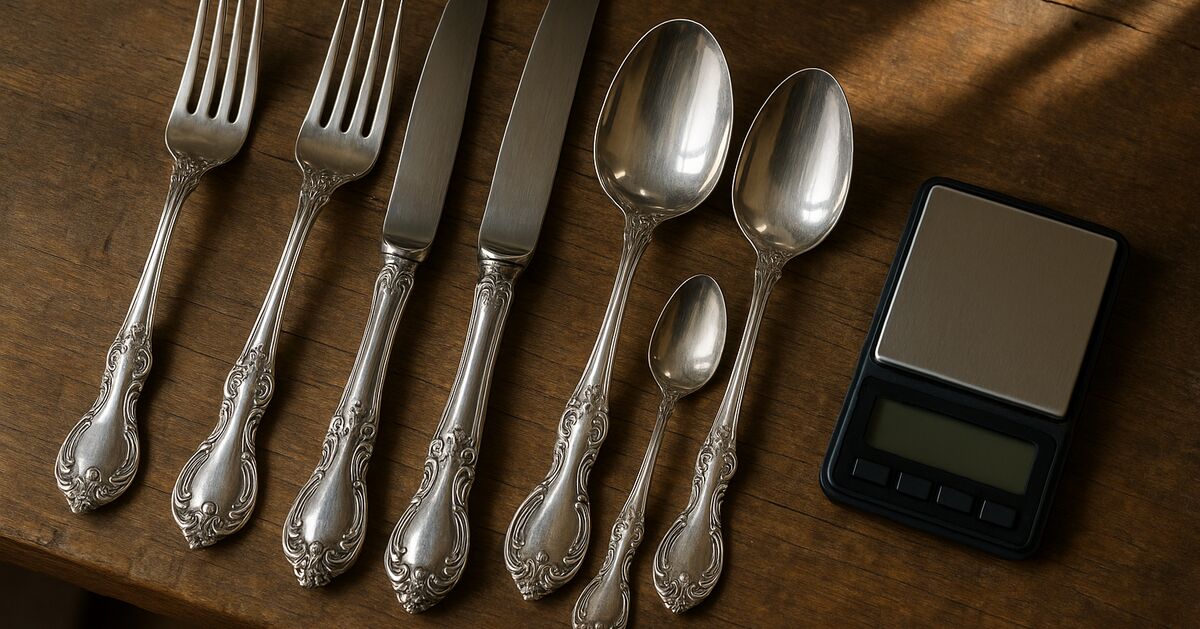
Sterling flatware sitting in a drawer for decades has real money tied up in it, and the gap between what people hope to get and what the market actually pays can be surprising in both directions.
This post walks through a single, realistic example from start to finish: a 45-piece sterling flatware set inherited from a grandparent. By the end you will know exactly how to run the same numbers on your own pieces, what factors push the offer up or down, and why dealers land where they do. No guessing, no vague ranges, no "it depends" non-answers.
Step one: confirm it is actually sterling
Before any math makes sense, you need to be certain you have sterling silver and not silver plate. Sterling silver is a legal standard: 92.5% pure silver, with the remaining 7.5% typically copper. Look for one of these hallmarks stamped somewhere on each piece:
- 925 (the most internationally common mark)
- Sterling (very common on American flatware, used since the mid-1800s)
- 92.5
- Lion passant (a walking lion, used on British pieces)
American sterling flatware from makers such as Gorham, Reed & Barton, Tiffany, Wallace, and International Silver will typically say "Sterling" somewhere on the shank of each piece. If you see "EPNS," "Silver Plate," "Silverplate," or just a pattern name with no purity mark, the piece is plated and the math below does not apply.
If you are unsure how to read the marks, our detailed guide on how to tell sterling silver from silver plate at home covers every test worth running, from magnet checks to acid tests.
Step two: weigh every piece
Silver is bought by weight, so an accurate scale is the most important tool you own going into this process. A kitchen scale that reads in grams and can handle a few kilograms is fine for a full set. For individual pieces, a jeweler's scale reading to 0.1 g is better.
Weigh each piece type separately if you can. Different pieces within a set vary significantly:
- Dinner knives are often weighted (the handle is filled with cement or resin), which means their silver content is much lower than their total weight suggests.
- Dinner forks and tablespoons tend to be solid sterling all the way through.
- Hollow-handle serving pieces follow the same pattern as dinner knives.
For our worked example, the 45-piece set breaks down like this:
| Piece type | Qty | Weight each (g) | Notes | |---|---|---|---| | Dinner forks | 8 | 38 g | Solid sterling | | Salad forks | 8 | 28 g | Solid sterling | | Dinner knives | 8 | 95 g | Weighted handle | | Teaspoons | 8 | 22 g | Solid sterling | | Soup spoons | 5 | 42 g | Solid sterling | | Tablespoons | 2 | 60 g | Solid sterling | | Serving pieces | 6 | 70 g avg | Mixed: some solid, some hollow |
Total gross weight: approximately 2,350 g.
Step three: subtract the non-silver weight
Dinner knives with cement-filled handles are a classic trap. A knife weighing 95 g might only have 30 to 40 g of actual sterling in the blade and collar. As a rough starting point, some sellers estimate the silver portion of weighted knives at roughly 30 to 45% of total knife weight, but this varies by maker and pattern, so weigh and check with your buyer directly. Some dealers weigh knives separately and apply a flat deduction per piece.
For our example, let's be conservative:
- 8 dinner knives at 95 g each = 760 g gross
- Estimated sterling portion: 40% = 304 g of actual silver
- Deduction: 456 g
Revised total sterling weight: 2,350 g minus 456 g = 1,894 g of sterling silver.
Step four: calculate melt value
Sterling is 92.5% silver. To find the fine silver content:
1,894 g × 0.925 = 1,752 g of fine silver
Now convert grams to troy ounces. One troy ounce equals 31.1035 grams:
1,752 ÷ 31.1035 = 56.3 troy ounces of fine silver
Spot price of silver changes every trading day. For this example, let's use a round number of $28.00 per troy ounce (check a live spot price source such as Kitco or the LBMA for today's actual figure before you run your own numbers).
56.3 troy oz × $28.00 = $1,576.40 melt value
That is the theoretical maximum: what the metal itself is worth if you melted every piece into a bar and sold it as refined silver. No buyer pays full melt value, and the next section explains exactly why.
Step five: understand the dealer's margin (and why it exists)
A dealer buying your flatware has real costs to cover before they see a cent of profit:
- Refining fees. Silver flatware has to be sent to a refiner (or melted in-house if the dealer has that capacity). Refiners typically charge a percentage of the metal value plus a per-lot fee. Refining fees vary, but sellers should expect them to noticeably reduce the offer on small lots, so ask the dealer for their fee structure.
- Assay and processing time. Sorting, weighing, photographing, and logging inventory takes labor.
- Market risk. The dealer holds the metal until they can move it. If silver drops while they wait, that margin disappears.
- Overhead. Rent, insurance, and staffing all come out of the spread.
Offers from coin dealers, pawn shops, or estate buyers for plain-pattern sterling flatware are typically below full melt value, so compare several offers before accepting one. Prestigious patterns from high-name makers (Tiffany & Co., Georg Jensen) can push above melt in the right venue, but that is not the baseline.
For our example at 80% of melt:
$1,576.40 × 0.80 = $1,261.12
That is a realistic ballpark for a solid cash offer from a dealer buying this set for its silver content alone.
Step six: consider whether collectible value applies
Melt value is the floor, not always the ceiling. A handful of situations push the real-world value higher:
- Pattern desirability. Patterns like Tiffany's "Chrysanthemum," Gorham's "Chantilly," or Wallace's "Grande Baroque" have devoted collector followings. A complete or near-complete set in excellent condition in one of these patterns can sell above melt at auction or to a specialist dealer.
- Completeness. A full service for 12 with all the serving pieces is more appealing to a buyer who wants to use the set. Missing pieces drag value down.
- Condition. Monograms can reduce collector value, because many buyers want unmarked flatware. Monogrammed sets are often bought mainly for melt. Deep scratches, bent tines, and worn pattern details also hurt value.
- Maker prestige. Tiffany, Georg Jensen, and Cartier flatware can command multiples of melt at specialist auction.
If your pattern is a common one (Rogers, International "1847," plain Gorham patterns), assume melt-based pricing and shop your offer around accordingly.
Step seven: get more than one offer
Dealer buy prices for the same piece can vary noticeably, so it's worth calling a few buyers before accepting an offer. Types of buyers to approach include:
- Local coin and precious metals dealers. They buy silver daily and usually have tight spreads.
- Estate jewelry buyers. Good option if your set has maker or pattern value.
- Online silver buyers. Several reputable national services mail you a prepaid kit. They tend to compete on convenience but can be competitive on price.
- Auction houses. Worth considering only if your set has genuine collector or maker value. Auction house commissions on the seller's side can be substantial and can eat deeply into melt-only lots, so check the fee schedule before consigning.
- Direct sale (eBay, Facebook Marketplace, Craigslist). You keep more of the value but take on the work of listing, packing, shipping, and the risk of non-payment or returns.
The FAQ page covers a lot of the common questions that come up when comparing buyer types, including what to watch out for with mail-in services.
Common mistakes that reduce what you walk away with
A pattern that shows up again and again in seller forums is going to the first buyer who expresses interest without running the numbers first. Here are the other mistakes worth avoiding:
- Not weighing before you go. If you show up without knowing your weights, you are negotiating blind. Weigh at home, run the math, know your floor.
- Ignoring knife handle weight. Sellers who don't know about weighted handles are sometimes caught off guard when a dealer offers what seems like a low percentage. Ask the dealer to walk you through how they handled the knife calculation.
- Selling monogrammed flatware to a collector market. Monograms can reduce a set to melt value in the collector world. Price it accordingly from the start rather than spending weeks chasing collector prices.
- Waiting for spot to "come back." Timing the silver market is genuinely hard. If you need the cash or the drawer space, the practical move is usually to sell at today's price rather than speculate on a future price.
- Mixing sterling and plated pieces. Keep them separated before you go. A dealer who has to sort through a mixed box will do it on their clock, not yours, and it creates room for mistakes.
A quick note on taxes
In the United States, the sale of silver is generally treated as the sale of a collectible for capital gains purposes. If you sell for more than your cost basis, that gain may be reportable. The IRS publication on collectibles and capital gains is worth a quick read if the numbers are meaningful. This is especially relevant for inherited pieces where the stepped-up basis rules may apply. A tax professional familiar with precious metals can give you specifics for your situation.
What to do right now
If you have a set sitting in a drawer and you have been wondering whether it is worth acting on, start with the scale. Weigh what you have, note which pieces are likely weighted, run the math above with today's spot price, and you will have a real number to work with rather than a vague hope.
For more background on the whole process of selling silver, the home page lays out the full landscape, and the blog has pieces covering specific scenarios from coins to jewelry to flatware. If something in this post raised a question that isn't answered here, the contact page is the right place to send it.
The math is not complicated. What matters is doing it before you walk into a buyer's shop rather than after.
Sources & further reading
- Silver spot price and market data (London Bullion Market Association)
- IRS Publication 550: Investment Income and Expenses (collectibles and capital gains) (U.S. Internal Revenue Service)
- Troy weight and precious metals measurement standards (U.S. National Institute of Standards and Technology)
- Sterling silver hallmarking standards and assay guidance (World Gold Council (silver purity standards reference))
- Consumer guidance on selling precious metals (U.S. Federal Trade Commission)
Revision history (1)
- Pre-publish editorial QA: 4 flagged, 4 softened; claim audit: 5 claims, 5 rewritten
Claim-by-claim audit (5 checked)
- “As a rough starting point, some sellers estimate the silver portion of weighted knives at roughly 30 to 45% of total knife weight, but this varies by maker and pattern, so weigh an…” (rewritten to what the article can stand behind)
- “Refining fees vary, but sellers should expect them to noticeably reduce the offer on small lots, so ask the dealer for their fee structure.” (rewritten to what the article can stand behind)
- “Offers from coin dealers, pawn shops, or estate buyers for plain-pattern sterling flatware are typically below full melt value, so compare several offers before accepting one.” (rewritten to what the article can stand behind)
- “Dealer buy prices for the same piece can vary noticeably, so it's worth calling a few buyers before accepting an offer.” (rewritten to what the article can stand behind)
- “Auction house commissions on the seller's side can be substantial and can eat deeply into melt-only lots, so check the fee schedule before consigning.” (rewritten to what the article can stand behind)