
A practical guide to selling sterling silver: value, price
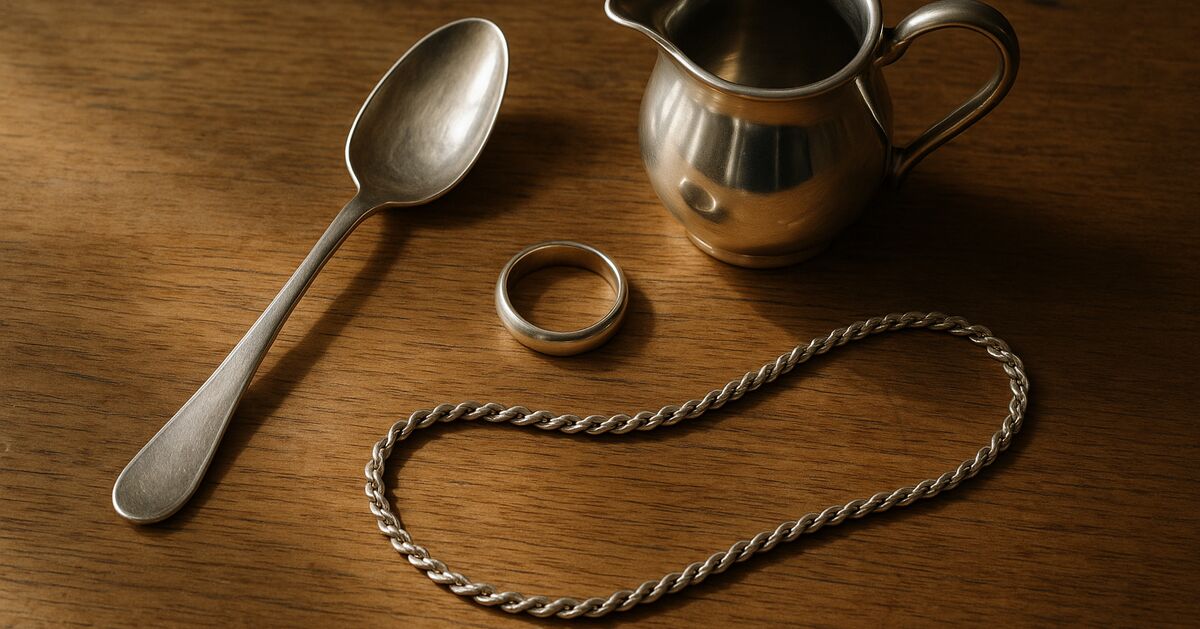
Sterling silver sitting in a drawer earns nothing, but selling it poorly earns almost nothing either. After eighteen years of buying and testing silver at a physical counter, I watched sellers leave real money behind again and again, not because they were foolish but because nobody had explained the basics clearly. This guide does exactly that.
What sterling silver actually is, and why purity is the whole ballgame
Sterling silver is a specific alloy: 92.5% fine silver combined with 7.5% base metal, typically copper. The copper makes the material harder and more workable than pure silver, which is why silversmiths have used the standard for centuries. In the United States that purity threshold is expressed as 925 parts per thousand, or simply ".925." In the United Kingdom and most Commonwealth countries the same standard applies, and pieces are hallmarked accordingly.
Why does this matter when you sell? Because silver buyers are ultimately buying silver, not craftsmanship. A buyer calculates the weight of the piece, multiplies by 0.925 to find the fine silver content, then applies the current spot price. That calculation is the floor of every offer you will receive. Everything else, the age of the piece, the maker's name, the condition of the surface, adds to or subtracts from that floor.
The corollary is equally important: silver-plated items share almost none of that value. A piece stamped EP, EPNS, "Silver on Copper," or "A1" contains a thin layer of silver deposited over a base-metal core. The total silver content might be a fraction of a gram, making it essentially worthless as a precious metal even if it is beautiful to look at. Silver plate is its own topic with its own trade realities, but the short version is: do not expect melt value from a plated piece.
Reading hallmarks before you do anything else
The single best investment you can make before approaching a buyer is five minutes with a magnifying glass. Sterling pieces carry stamps that tell you exactly what you have.
On American-made silver you will typically see "925," "Sterling," or "Sterling Silver" stamped somewhere discreet: the inside of a ring shank, the back of a brooch, the underside of a handle. Some older American pieces, particularly those made before the twentieth century, use "COIN" to indicate coin-silver content, which is 90% pure, slightly below sterling.
British silver carries a more elaborate system of four or five small punched marks. The lion passant (a walking lion) is the most recognizable and confirms sterling standard. A date letter, an assay office mark, and a maker's mark round out the set. The full British hallmark system is worth understanding in detail if you have inherited older English pieces, because the date information can affect value significantly.
Continental European silver uses numeric purity marks directly: "800," "830," "900," and "925" are all common. These pieces are genuine silver, but 800 and 830 are noticeably lower purity than sterling, and buyers will price them accordingly.
If you cannot find any stamp at all, that is informative too. Absence of a hallmark does not prove a piece is plated, but it raises the question. A responsible buyer will test any unmarked piece before making an offer, using acid testing, XRF analysis, or both. You should expect that, and welcome it.
How the melt value calculation works in practice
The spot price of silver changes every trading day, every hour, and sometimes by meaningful amounts within a single session. Understanding what live price charts are really telling you is genuinely useful before you sit down across from a buyer.
The melt calculation is straightforward:
- Weigh the piece in troy ounces (1 troy ounce = 31.1 grams).
- Multiply by 0.925 to get the fine silver content.
- Multiply that figure by the current spot price per troy ounce.
The result is the intrinsic metal value. No buyer pays 100% of that figure because they need a margin to cover refining costs, overheads, and the small but real risk that the spot price moves against them before they can process your metal. In my experience buying and observing the trade, reputable buyers often offer somewhere between 70% and 90% of melt value for straightforward sterling, though this varies by volume, item type, and refinery spread. Based on typical trade margins, offers below 70% of melt are worth questioning, while offers close to spot may reflect low refining costs or competitive pressure.
A practical example helps. Suppose you have a sterling chain that weighs 28 grams. Convert to troy ounces: 28 ÷ 31.1 = approximately 0.90 troy ounces. Apply the sterling factor: 0.90 × 0.925 = 0.833 troy ounces of fine silver. If spot is at $28.00, the melt value is roughly $23.30. A fair offer at 80% of melt would be around $18.60. That arithmetic takes about thirty seconds and gives you a solid reference point before any negotiation begins.
What moves the price up from melt value
Plain melt value is not always the ceiling. Several factors can push a buyer's offer higher, or redirect you to a different type of buyer entirely.
Maker and period. Pieces by recognized silversmiths, particularly from the Georgian and Victorian eras in Britain or the Colonial and Federal periods in America, carry collector premiums that can far exceed melt value. Pieces by well-known Arts and Crafts makers such as Kalo or Lebolt can carry collector premiums, so it's worth researching with a specialist before accepting a melt-based offer.
Weight and completeness of sets. A complete canteen of flatware in its original fitted case is easier for a buyer to resell intact than a jumble of loose spoons. Some buyers will pay a modest premium for complete, matched sets because the resale path is cleaner.
Condition relative to collectability. For items sold purely on melt, condition barely matters. For items with collector value, condition matters enormously. Deep polishing scratches, repairs, monograms, and removed parts all reduce a collectable piece's premium, though they do nothing to the underlying melt value.
Current silver market conditions. When spot prices are rising quickly, buyers sometimes tighten their margins because they are confident they can move metal at a profit. When markets are volatile or falling, buyers widen the margin to protect themselves. Understanding why buyers behave differently in a choppy market saves you the frustration of thinking the offer is personal when it is really mathematical.
What pushes the price down from melt value
Just as certain factors add value, others reduce what a buyer can offer.
Small quantities. Refining small amounts of silver costs roughly the same per batch as refining large amounts. A buyer processing a single bracelet absorbs proportionally higher costs than one processing a kilogram of mixed sterling. Many buyers handle this with a minimum transaction size or a slightly lower percentage for very small lots.
Solder content. Jewelry that has been repaired or constructed with a lot of lead or silver solder will test below .925 at the refinery. Experienced buyers factor this in for certain item types, particularly heavily repaired chains or older holloware with patched seams.
Weighted bases. Some candlesticks, knife handles, and decorative objects are loaded with pitch, plaster, or cement to add stability. The sterling casing might weigh only a fraction of the total weight. A buyer will weigh the sterling parts only and offer on those, not the total object weight. This surprises sellers who have not been warned about it. Weighted items appear in inherited flatware sets more often than people expect and it is worth understanding the issue before you hand anything over.
Gem-set jewelry. Sterling pieces set with stones require the stones to be removed before refining. That labor costs money, and buyers factor it in. Diamonds and precious stones may be worth recovering separately, but semi-precious and synthetic stones are usually discarded. Ask the buyer how they handle set stones before you agree to anything.
Sorting what you have before approaching buyers
A few minutes of sorting saves time and prevents confusion at the counter or during a mail-in appraisal. Group your items roughly as follows:
- Confirmed sterling (clearly stamped .925, Sterling, or carrying legible British hallmarks)
- Probably sterling but unconfirmed (old pieces with worn or missing marks)
- Possibly plated (stamped EP, EPNS, or similar, or carrying no mark at all)
- Potentially collectable (signed pieces, matched sets, anything that looks genuinely old and fine)
Keep the groups separate and handle the "potentially collectable" pile with extra care. Antique silver deserves its own evaluation process because the right buyer for an antique is often not the same buyer who handles scrap sterling efficiently.
For the confirmed sterling pile, weigh everything you can on a kitchen scale accurate to one gram, note the weights, and do the rough melt calculation described above. Walking in with your own numbers is not adversarial; it is simply informed, and reputable buyers respect it.
How to shop for a fair offer without wasting a week
The single most effective tactic is also the one sellers resist most: get more than one offer. I say this as someone who used to be on the buying side of that equation. Competition is the only reliable mechanism that keeps individual buyers honest, and most sellers simply do not use it.
A practical approach that came up repeatedly in my years at the counter: if you have several pieces, do not bring everything on your first visit to any buyer. Bring one representative item, see what the process looks like and what percentage of melt they offer, then compare. Once you have a sense of the market, you can decide who gets the rest.
When evaluating buyers, look at the process as much as the price. A buyer who weighs pieces in front of you, shows you the scale reading, states the spot price they are using, and walks through the arithmetic openly is operating honestly regardless of whether their final percentage is the highest you find. A buyer who disappears into a back room and returns with a lump-sum number is giving you nothing to verify. Ask questions. "What spot price are you using?" and "What percentage of melt is that offer?" are completely reasonable things to ask.
Mail-in buyers add a layer of distance that requires extra care. Check independent reviews, look for a clear written process for what happens if you disagree with the offer, and understand whether return shipping is free if you decline. The broader guide to selling silver covers the full landscape of buyer types and what to expect from each.
Jewelry versus holloware: the practical differences
Sterling silver falls into two broad categories that buyers treat somewhat differently.
Jewelry (rings, chains, bracelets, earrings, brooches) is dense, relatively easy to test, and easy to refine. Buyers process it in volume and the market is competitive. The main complications are solder content and set stones, both covered above.
Holloware (teapots, bowls, trays, pitchers, candlesticks, sugar casters) comes in a wider range of purities and constructions. Genuine sterling holloware is marked and valuable. Sheffield plate and Old Sheffield Plate are different things; fused silverware from the eighteenth and early nineteenth centuries can carry collector value but has little melt value. Electroplated holloware, which is far more common and dates from the mid-nineteenth century onward, has effectively no precious metal value. Sorting holloware correctly before you sell matters more than with jewelry, simply because the gap between sterling and plated value is so large.
Flatware sets sit in their own category and are worth treating separately from other holloware because the quantity of metal in a complete canteen can be substantial, and the melt value calculation becomes meaningful.
A word on timing
Silver prices move. Whether to wait for a higher spot price or sell now is genuinely a personal decision that depends on your circumstances, not a question with one right answer. Timing the silver market is difficult even for professional traders who follow it full time, so treat any attempt to time your sale with caution.
What does make sense is avoiding forced sales in the middle of an obvious price dip if you have any flexibility, and being realistic about the fact that a 5% improvement in spot price translates to a much smaller improvement in the cash in your hand once buyer margins are applied. The buyer relationship and the percentage they offer often matter more to your final outcome than catching a good week in the silver price. You can find a running discussion of all these variables on the main selling-silver overview page.
What to do right now
If you have sterling silver you are thinking of selling, here is a sensible sequence:
- Sort by category: confirmed sterling, uncertain, and plated.
- Identify anything that might have collector value and set it aside for specialist evaluation.
- Weigh the confirmed sterling on a kitchen scale.
- Check the current spot price on any reputable financial data site and calculate approximate melt value.
- Approach two or three buyers with a single test piece, note the process and the percentage offered.
- Make your decision based on transparency and percentage, not on the buyer who gives the most confident pitch.
For more grounding on the fundamentals, the FAQ covers the questions that come up most often, and the blog has detailed guides on specific item types if you want to go deeper on coins, scrap silver, or antiques before you commit to selling anything.
Sterling silver has real, calculable value. The work of selling it well is mostly the work of understanding the arithmetic and refusing to skip the step of comparison. Neither takes long, and both pay off.
Sources & further reading
- Precious metals spot price data and market information (Kitco Metals Inc.)
- Hallmarking standards and assay information (UK Assay Office)
- UK hallmarking legislation and standards (Assay Office London)
- Troy weight and precious metals measurement standards (U.S. National Institute of Standards and Technology (NIST))
Revision history (1)
- Pre-publish editorial QA: 1 flagged, 1 softened; claim audit: 7 claims, 5 rewritten
Claim-by-claim audit (7 checked)
- “In my experience buying and observing the trade, reputable buyers often offer somewhere between 70% and 90% of melt value for straightforward sterling, though this varies by volume…” (rewritten to what the article can stand behind)
- “Based on typical trade margins, offers below 70% of melt are worth questioning, while offers close to spot may reflect low refining costs or competitive pressure.” (rewritten to what the article can stand behind)
- “Some older American pieces, particularly those made before the twentieth century, use "COIN" to indicate coin-silver content, which is 90% pure, slightly below sterling.” (reasoning shown in the article)
- “Pieces by well-known Arts and Crafts makers such as Kalo or Lebolt can carry collector premiums, so it's worth researching with a specialist before accepting a melt-based offer.” (rewritten to what the article can stand behind)
- “Refining small amounts of silver costs roughly the same per batch as refining large amounts.” (reasoning shown in the article)
- “Sheffield plate and Old Sheffield Plate are different things; fused silverware from the eighteenth and early nineteenth centuries can carry collector value but has little melt valu…” (rewritten to what the article can stand behind)
- “Timing the silver market is difficult even for professional traders who follow it full time, so treat any attempt to time your sale with caution.” (rewritten to what the article can stand behind)