
Selling silver flatware: what it's worth and how to get a
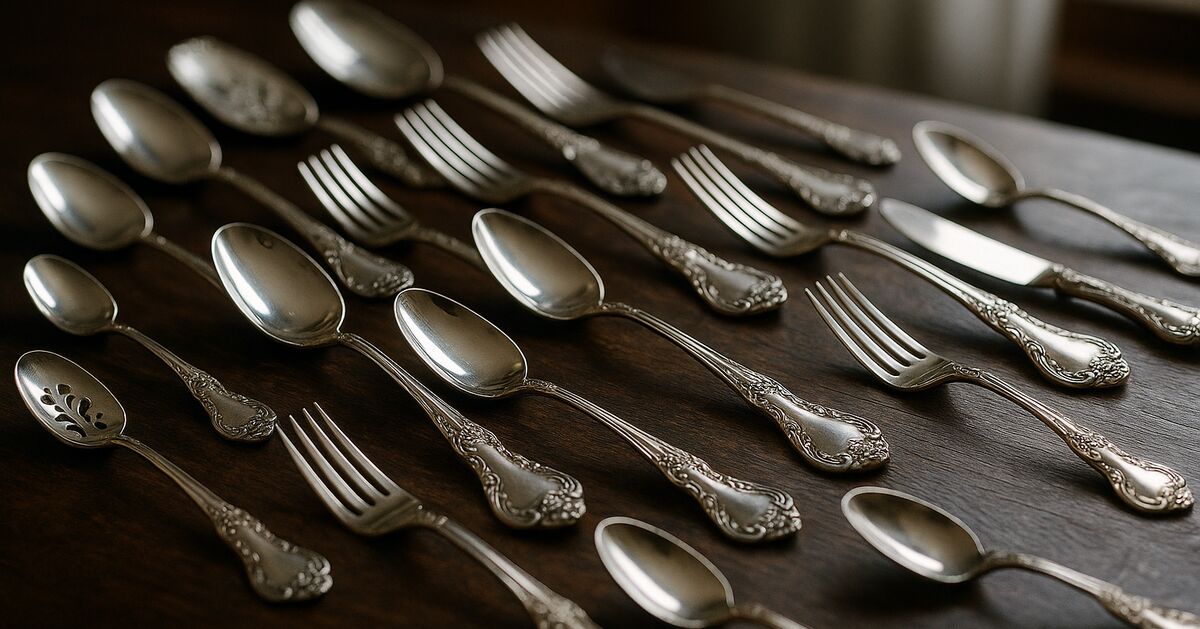
Sterling flatware is one of those things that surprises people. A drawer full of old spoons and forks looks like a practical domestic object, not a financial asset, but once you sit down and do the numbers, you can be looking at several hundred dollars or, in some cases, several thousand. The gap between those two outcomes depends on things you can find out yourself before you ever talk to a buyer.
This guide covers the whole picture: how flatware value is built, what makes one set worth more than another, the traps that reduce what you get, and how to approach the selling process with some confidence.
Sterling silver versus silver plate: the starting point
Before anything else, you need to know whether your flatware is sterling silver or silver plate. This is not a minor detail. Sterling flatware has intrinsic metal value built in at every piece. Silver-plated flatware has a thin coating of silver over a base metal core, and its value is almost entirely decorative or antique, not metallic.
On sterling pieces, look for a mark that reads "Sterling" or the numbers "925" or ".925". These marks tell you the alloy is 92.5% pure silver, which is the legal standard for sterling in the United States. British and European pieces use a different hallmarking system, but the principle is the same: look for an official purity declaration. If there is no purity mark and the piece says "Silver Plate," "EPNS," "A1," or nothing at all, it is not sterling and will not command a metal-content price from a silver buyer.
Knives in a flatware set deserve a special mention. Even in a complete sterling set, table knives typically have stainless steel blades and hollow handles. Only the outside of the handle is sterling silver. This means a sterling knife weighs far less in terms of actual silver content than a fork or spoon of similar physical size. Buyers who weigh sets by the piece know this, but if you are calculating value yourself, you need to account for it. Do not weigh your knives alongside your spoons and forks and assume the same silver percentage applies across the board.
How silver content translates into a base value
Every sterling flatware set has a melt value: what the raw silver in the metal is worth if it were refined down to pure silver and sold on the commodity market. That figure changes every day because silver trades on global exchanges, but the calculation is straightforward.
You weigh your flatware, convert the weight to troy ounces (one troy ounce equals 31.1 grams), multiply by 0.925 to get the pure silver content, and multiply that by the current spot price. The result is your melt value. No buyer will pay you 100% of melt, because they need to cover the cost of refining, their margin, and business overhead. In practice, scrap buyers for sterling flatware often offer less than full melt value, since they need to cover refining costs and margin, so compare multiple offers before deciding. The guide to selling scrap silver covers that dynamic in more detail if you want to dig into the mechanics.
Melt value is the floor, not the ceiling. Certain flatware sells for well above melt, and understanding why is the most practically useful thing you can take away from this article.
Pattern and maker: when the flatware is worth more than its weight
This is where flatware gets genuinely interesting, and where a lot of sellers leave money on the table by selling to the wrong buyer.
Certain patterns made by certain manufacturers have a collector market that runs entirely separate from the silver commodity market. People who are building out a set, replacing broken pieces, or restoring a family collection are actively searching for specific patterns. When demand exists for your specific pattern, a flatware dealer or an auction house can return more than any scrap buyer ever would, because they can sell individual pieces into that collector market at retail prices.
The names that come up reliably in this context include Gorham, Wallace, Tiffany, Towle, Reed and Barton, Whiting, Durgin, and Dominick and Haff, among others. That does not mean every piece by these makers is a windfall, but it does mean you should research your specific pattern before assuming the melt price is all you can get.
Pattern identification is easier than it used to be. Most major manufacturers marked their pieces on the back, and pattern reference databases are widely available online and in reference books. Once you know what you have, you can search completed sales on platforms like eBay to see what individual pieces and full sets in that pattern actually sold for recently. That is real market data, not asking prices, which can be inflated.
If the pattern turns out to be obscure, discontinued for a century, or from a less-collected maker, the collector premium may be small or nonexistent. In that case, the melt value becomes the realistic number to work from. Either way, knowing which situation you are in puts you in a much stronger position when talking to buyers.
Condition and completeness
Condition matters in two different ways depending on what you are selling.
For flatware being sold into the collector market, pieces that are monogrammed, bent, badly scratched, or thinned from years of aggressive polishing are worth less than clean, unmonogrammed, well-preserved pieces. Monograms are a particularly common issue with inherited flatware. A personalized set is much harder to sell to someone who wants it for their own table, which shrinks the potential buyer pool considerably and pushes the price back toward melt.
For flatware being sold purely for scrap, condition is largely irrelevant. Dents, tarnish, and even some damage do not change the silver content. Refining works the same regardless of the surface.
Completeness matters a great deal on the collector side. A full service for twelve, with all the serving pieces, in a single pattern is worth more per piece than the same pieces sold individually, because it saves a collector the work of assembling a set. Partial sets, or sets missing key pieces like serving spoons or sugar tongs, are harder to place at a premium price.
How to get a fair offer
Getting a fair offer is really about two things: knowing what you have before the conversation starts, and getting more than one number.
Start by sorting your flatware. Separate sterling from plate if you have both. Set knives aside from forks and spoons so you can handle the weight question accurately. Identify the pattern and maker if you can. Weigh everything you plan to sell in grams, then run the melt value calculation using the current spot price. That gives you a benchmark. The how to figure out what your silver is actually worth page walks through the full process if you want a step-by-step reference.
Once you have a number in mind, approach at least two or three different types of buyers. A local coin or precious metals dealer, a flatware specialist or antique silver dealer, and a reputable mail-in buyer will often give you meaningfully different offers because they have different business models and different customer bases. A mail-in buyer is optimized for scrap volume. A flatware specialist has the customer relationships to sell your pieces individually at a collector price. Neither is automatically better; it depends on what you have.
When you get offers, compare them against your melt benchmark. An offer that seems far below your melt calculation is worth questioning or comparing against other buyers before accepting. An offer from a specialist that exceeds your melt calculation is probably reflecting a genuine collector premium, which is exactly what you want to find.
For mail-in selling specifically, make sure you understand the insurance coverage on your shipment before you send anything. A set of valuable sterling flatware sent without adequate declared value coverage is a risk that is not worth taking. The practical end-to-end guide to selling silver covers what to look for in a mail-in buyer if that route appeals to you.
The flatware that falls between the categories
Not every set fits neatly into "sell for scrap" or "sell to a collector." A set might be sterling, from a recognizable maker, in decent condition, but in a pattern that was produced in enormous quantities and is no longer particularly sought after. Or it might be a lovely set from a less-known regional maker whose pattern never built a collector following.
In those situations, melt value tends to be the realistic outcome, but it is still worth checking. Flatware that has been sitting in a sideboard for fifty years may have gone from uninteresting to sought-after as tastes cycle. Some patterns that were ignored for decades have developed collector communities that did not exist when the original pieces were sold. A quick search of current completed sales costs you nothing and can occasionally be a genuine surprise.
The broader guide to selling silver has useful context on how silver spot prices shift over time and why timing your sale can affect the outcome, which is relevant if you are in no particular hurry.
What not to do
A few mistakes come up again and again among sellers who end up disappointed with what they received.
Selling to the first buyer you speak to is a common one. Even a small amount of comparison shopping often results in a meaningfully better offer, and for a set worth several hundred dollars or more, the effort is easily worth it.
Assuming all the pieces are the same is another issue, particularly with knives. As noted above, hollow-handled knives contain far less silver than they appear to, and a buyer will factor that in. If you have not factored it in yourself, the offer can feel lower than expected even when it is actually fair.
Polishing aggressively before selling is worth resisting. On pieces you are selling for scrap, it makes no difference. On pieces that might have collector value, harsh polishing can damage the surface and reduce value. Light cleaning with a soft cloth to remove obvious tarnish is reasonable. Anything more aggressive is a risk that rarely pays off.
Selling plate as sterling, even accidentally, can damage your credibility with a buyer and complicate the transaction. Sort carefully before you go.
A word on timing
Silver trades on open markets, and the price moves every day. If the spot price is significantly higher than it was when you first thought about selling, your melt value is correspondingly higher. If spot has been falling, waiting for a recovery might make sense if you have no particular pressure to sell now.
There is no way to predict where silver goes, but following the spot price for a few weeks before you sell gives you a feel for whether you are catching the market at a reasonable point. The live price charts guide explains how to read those numbers in a way that is actually useful for sellers rather than traders.
Putting it all together
Sterling flatware rewards a little preparation. Identify what you have, sort it carefully, calculate your melt value, research your pattern, and get more than one offer. That sequence does not take long and it is the difference between leaving money behind and walking away feeling that you got a fair deal.
If you are working through a larger estate that includes flatware alongside coins, jewelry, or bullion, the frequently asked questions page covers a range of situations that come up for sellers in exactly that position. And if you have questions that are not answered there, the contact page is the right place to raise them.
The flatware sitting in that drawer has real value. With a bit of groundwork, you can find out exactly what that value is and make sure you receive it.
Sources & further reading
- Silver - commodity price and market data (Kitco Metals)
- Troy weight and precious metals measurement standards (U.S. National Institute of Standards and Technology (NIST))
- Hallmarking and silver purity standards (Assay Office London)
- Consumer guidance on buying and selling precious metals (U.S. Federal Trade Commission - Consumer Advice)
Revision history (1)
- Pre-publish editorial QA: 1 flagged, 1 softened; claim audit: 2 claims, 2 rewritten
Claim-by-claim audit (2 checked)
- “In practice, scrap buyers for sterling flatware often offer less than full melt value, since they need to cover refining costs and margin, so compare multiple offers before decidin…” (rewritten to what the article can stand behind)
- “An offer that seems far below your melt calculation is worth questioning or comparing against other buyers before accepting.” (rewritten to what the article can stand behind)