
How to sell gold coins: identify, value, and find the right
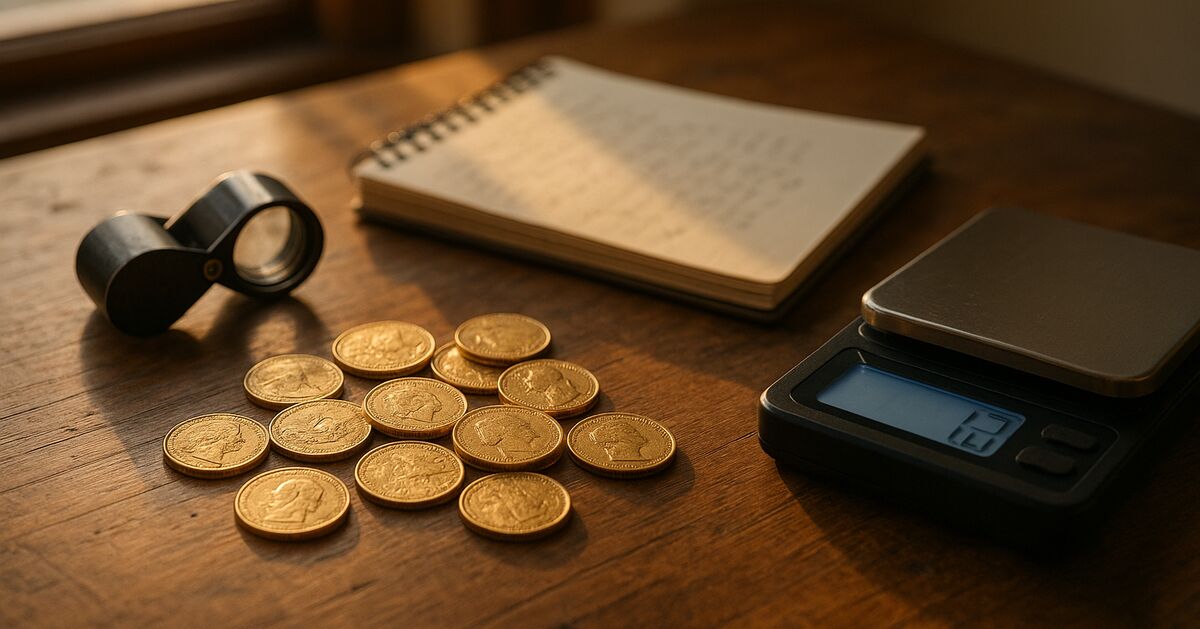
Knowing what you have is the single most important thing you can do before you sell a gold coin, and it costs nothing but a little time.
That sounds obvious, but a surprising number of people walk into a dealer's shop with a handful of coins and a vague hope that someone will give them a fair number. Dealers are professionals. They see coins every day. The more uncertain you look, the more pressure there is on the price you end up accepting. The fix is simple: do your homework first, then negotiate from a position of confidence.
I ran a precious-metals buying operation for eighteen years. The sellers who did best were rarely the ones with the rarest coins. They were the ones who arrived knowing roughly what their coins weighed, what the metal content was, and what the spot price was that morning. This guide is about building exactly that kind of preparation.
Start with a proper inventory
Before you think about buyers or prices, lay everything out and write it down. A rough list scribbled on paper is fine; a spreadsheet is better. You want to record:
- The name of each coin (American Gold Eagle, Krugerrand, Canadian Maple Leaf, pre-1933 US gold, sovereign, etc.)
- The year and mint mark if visible
- The face denomination where one exists
- Any obvious condition issues (scratches, cleaning marks, discoloration)
- The weight, if you have a decent scale
Working coin by coin forces you to look at each piece individually. That matters because gold coins do not all behave the same way in the market. Some are worth exactly their metal content. Others carry a premium because collectors want them. A few are worth considerably less than their metal content because they are damaged, altered, or counterfeit. Sorting them into rough categories before you approach anyone gives you a framework for the conversation.
Understanding what kind of gold coin you actually have
Gold coins fall into a few broad categories, and the category determines how you should think about value.
Bullion coins are coins minted specifically to hold gold in a convenient tradeable form. Examples include the American Gold Eagle, the South African Krugerrand, the Canadian Gold Maple Leaf, the Austrian Philharmonic, and the Australian Kangaroo. Their value tracks the gold spot price closely. Premiums over spot exist (dealers need to make money, and mints charge for production), but for selling purposes, you are essentially selling by the troy ounce of gold content. A one-ounce Gold Eagle contains one troy ounce of pure gold. A one-quarter-ounce Eagle contains a quarter ounce. The math is straightforward once you know the spot price.
If you are specifically working out what American Gold Eagles are worth, the post on selling Gold Eagle coins: what they're worth and how to get a fair offer goes into useful detail on that particular coin.
Pre-1933 US gold coins (and equivalent coins from other countries made in the same era) are a different matter. These include the $20 Double Eagle, the $10 Eagle, the $5 Half Eagle, and the $2.50 Quarter Eagle. They were circulating currency until the US went off the domestic gold standard. They have both a melt value based on their gold content and a collectible value based on date, mint mark, and condition. For common dates in well-worn condition, melt value is often close to the total value. For scarcer dates or coins in exceptional condition, collectible value can run far above melt. This is why condition and specific date matter so much for older coins.
Foreign gold coins run the gamut. British sovereigns are fairly standard bullion-adjacent coins. Mexican gold pesos, French Napoleons, and similar coins from the early-to-mid twentieth century trade at modest premiums over melt. Older, rarer foreign gold can be genuinely numismatic. If you have something unfamiliar, a reference like the Standard Catalog of World Coins or a quick look through a coin auction archive will help you gauge whether it is primarily a bullion piece or a collectible piece.
Gold-plated and gold-filled coins are not gold coins in the meaningful sense. A silver dollar that has been gold-plated (the "colorized" and "gilded" commemoratives sold by private mints and advertised in newspaper inserts) is worth its silver content, not gold content. The plating is negligible. These coins are a recurring source of disappointment for sellers who believed the marketing around them.
Working out what your coins are worth
Value for gold coins has two components that you need to keep separate in your head: melt value and any premium above melt.
Melt value is the floor. It is simply: (weight in troy ounces of pure gold) multiplied by (the current gold spot price). The US Geological Survey and the London Bullion Market Association both publish accessible information on how spot pricing works. The spot price itself is quoted widely on financial sites and changes throughout the trading day.
To find the pure gold weight, you need two numbers: the coin's total weight and its fineness (purity). A one-ounce American Gold Eagle has a total weight of 1.0909 troy ounces but contains exactly one troy ounce of pure gold (the rest is copper and silver for hardness). A Krugerrand also contains one troy ounce of pure gold but is 22-karat (91.67% pure). Manufacturer and US Mint specifications, which are publicly available, give you these figures without guesswork.
Premium above melt is where things get interesting. Common bullion coins in good condition often sell to dealers close to spot, though the exact discount varies by dealer, so get multiple quotes to see the range. Rare numismatic coins can carry large premiums over melt value, so consider getting them independently graded before selling. A 1927-D Double Eagle or a proof coin in certified mint state is a completely different proposition from a circulated 1924 Double Eagle.
If you believe a coin might have numismatic value, get it independently evaluated before you sell. The Professional Coin Grading Service (PCGS) and the Numismatic Guaranty Company (NGC) both offer third-party grading and encapsulation. A certified grade from either service removes ambiguity from the conversation with a buyer and is often worth the fee on coins where condition genuinely matters.
For coins that are clearly bullion-grade (worn, common dates, nothing special about the strike), certification is rarely worth the cost. Know which category your coins fall into.
Preparing before you approach any buyer
A few practical steps make the whole process go better.
Check the spot price the morning you plan to negotiate. Gold moves, sometimes substantially, on central bank announcements, inflation data, and currency moves. Knowing where spot is right now means you can do quick math in your head when a dealer quotes you a number. Per the World Gold Council, the spot price is set by ongoing trading on major exchanges and is the same benchmark all buyers use, even if what they pay you relative to that benchmark varies widely.
Do not show all your coins at once if you have a large collection. This is one of the more useful practical lessons from years of watching transactions. When a dealer sees the full size of a collection, the negotiating dynamic shifts. Test with one or two representative coins first. Once you understand what a particular buyer will offer, you can decide whether to continue.
Keep a note of which coins are which. Misidentifying a coin is an easy mistake that can cost real money. A sovereign is not the same as a Double Eagle. A Gold Eagle is not the same as a gold-plated commemorative. Label your inventory clearly before you leave the house.
Photograph anything unusual. If you have a coin you think might be rare or in exceptional condition, photograph it before it leaves your hands. Good photos help if you want a second opinion remotely, and they provide a record.
Choosing where to sell
The landscape of gold coin buyers includes coin dealers, precious metals dealers, pawn shops, online buyers, auction houses, and private collectors. Each has trade-offs.
Coin dealers and precious metals dealers are the natural first stop for most gold coins. A good dealer will give you a transparent breakdown: here is the weight, here is the purity, here is the spot price, here is what I can pay. Opacity on any of those points is a reason to walk away and try somewhere else. In most cities there are multiple dealers, and you should get at least two or three quotes before committing. Dealers who resist giving you a written offer are worth avoiding.
Online or mail-in buyers can be competitive, particularly for bullion coins where grading subjectivity is low. The key is making sure you ship insured and trackable, that you understand the offer process before your coins leave your hands, and that you know whether the buyer covers return shipping if you decline their offer. Reputable mail-in buyers publish their process clearly.
Auction houses make sense primarily for coins with genuine numismatic value. A rare pre-1933 date in high certified grade can reach the right collectors through a major numismatic auction in a way that a local dealer simply cannot replicate. Auction fees (buyer's premiums paid by the winning bidder, plus seller's commission) reduce your net, but on a coin worth thousands over melt, the audience access can more than compensate. For ordinary bullion coins, auction is rarely the efficient choice.
Pawn shops are convenient and fast, but convenience has a cost. The offers are typically the lowest you will encounter because the pawn model is built around quick turnover and broad margin. If speed matters more than price, that trade-off might make sense for you. If you have time to shop around, you will likely do better elsewhere.
For a broader comparison of buyer types and what to expect from each, the frequently asked questions page covers common seller concerns across all precious metals.
Red flags to watch for
A few specific things should make you cautious with any buyer.
A buyer who refuses to tell you the spot price they are using, or who quotes a price per gram without converting it so you can check the math, is obscuring something. Legitimate buyers work transparently from spot.
A buyer who pressures you for an immediate decision on the same visit is worth leaving. "This offer expires when you walk out the door" is a pressure tactic. A fair offer on a bullion coin is calculable from publicly available data; it does not expire in an hour.
A buyer who offers a flat per-coin price without weighing or testing is not giving you a real market offer. Weight and purity are the inputs. Any buyer skipping those steps is either guessing or working from assumptions that may not favor you.
A buyer who offers noticeably more than spot for common bullion coins is worth scrutinizing. Dealers cannot pay above spot and survive; if an offer seems too good, look carefully at whether hidden fees, a delayed payment, or disputed weights surface later in the process.
Selling gold coins versus selling other gold items
Gold coins are generally simpler to sell than gold jewelry because their composition is known and standardized. You do not need to worry about alloys of uncertain karat or the deduction for stones. That said, the same fundamental principles apply across all gold selling: know the metal content, know the spot price, get multiple quotes, and do not let urgency push you into a bad deal.
If you are also working through gold jewelry alongside coins, the post on selling gold jewelry: what it's worth and how to get a fair offer covers the additional considerations that apply to rings, chains, and similar items where karat marking and alloy composition add complexity.
And if you have silver coins in the same collection, selling silver coins: what they're worth and how to get a fair offer walks through the equivalent process for that metal, including the junk silver question that comes up whenever pre-1965 US coinage is in the mix.
What to expect from the process
For common bullion coins, the process from walking in to walking out with an offer is usually quick. A dealer with a proper scale and a live price feed can give you a number in minutes. For numismatic coins, expect more time and potentially a need to return after the dealer consults references or contacts a specialist buyer.
Payment methods vary. Cash, check, and bank transfer are all standard. Be wary of buyers who insist on payment methods that are hard to trace or reverse.
If you sell by mail, the process takes longer: shipping time, testing time, and payment processing time. Budget a week to ten days for the full cycle with a reputable buyer.
The bigger picture
Gold coins are one of the more pleasant things to sell in the precious-metals world because the information you need is genuinely available. Spot prices are public. Coin weights and purities are published by the mints that produced them. Dealer premiums, while variable, are bounded by competitive pressure.
The sellers who come away unhappy are often the ones who skipped the preparation and relied on a single buyer's word for the value of what they had. Take an hour to build your inventory, look up the current spot price, and understand whether your coins are bullion-grade or potentially numismatic. That hour is the most valuable thing you can do before you start making calls.
For a wider view of the gold selling process across different item types, the blog has detailed guides on everything from scrap to coins to jewelry. And if you want to understand the general dynamics that move precious-metal prices up and down, selling silver: what it's worth, what moves the price, and how to get a fair deal covers the market fundamentals in plain language that apply equally well to gold.
The market for gold coins is liquid, transparent, and competitive when you know how to navigate it. Preparation is the whole game.
Sources & further reading
- Gold price benchmarking and spot price methodology (London Bullion Market Association)
- Gold market statistics and price data (World Gold Council)
- Mineral commodity summaries including gold (U.S. Geological Survey)
Revision history (1)
- Pre-publish editorial QA: 2 flagged, 2 softened; claim audit: 5 claims, 2 rewritten
Claim-by-claim audit (5 checked)
- “A one-ounce American Gold Eagle has a total weight of 1.0909 troy ounces but contains exactly one troy ounce of pure gold (the rest is copper and silver for hardness).” (reasoning shown in the article)
- “A Krugerrand also contains one troy ounce of pure gold but is 22-karat (91.67% pure).” (reasoning shown in the article)
- “Common bullion coins in good condition often sell to dealers close to spot, though the exact discount varies by dealer, so get multiple quotes to see the range.” (rewritten to what the article can stand behind)
- “Rare numismatic coins can carry large premiums over melt value, so consider getting them independently graded before selling.” (rewritten to what the article can stand behind)
- “Dealers cannot pay above spot and survive; if an offer seems too good, look carefully at whether hidden fees, a delayed payment, or disputed weights surface later in the process.” (reasoning shown in the article)