
Selling Gold Eagle coins: what they're worth and how to get
Gold Eagle coins look straightforward on the surface: they are made by the U.S. Mint, they carry a stated face value, and they contain a known amount of gold. But the gap between what is stamped on the coin and what a buyer will actually pay you is enormous, and if you walk into a sale without understanding that gap, you will almost certainly leave money on the table.
I spent eighteen years buying precious metals before closing that business, and Gold Eagles were among the most regularly misunderstood items that crossed my desk. Sellers either undervalued them (not realizing how much gold they held) or overvalued them (expecting a collector premium that usually does not materialise). This guide explains the real mechanics: what the coins are, what drives their price, what damages their value, and how to shop for an offer that is genuinely fair.
What a Gold Eagle actually is
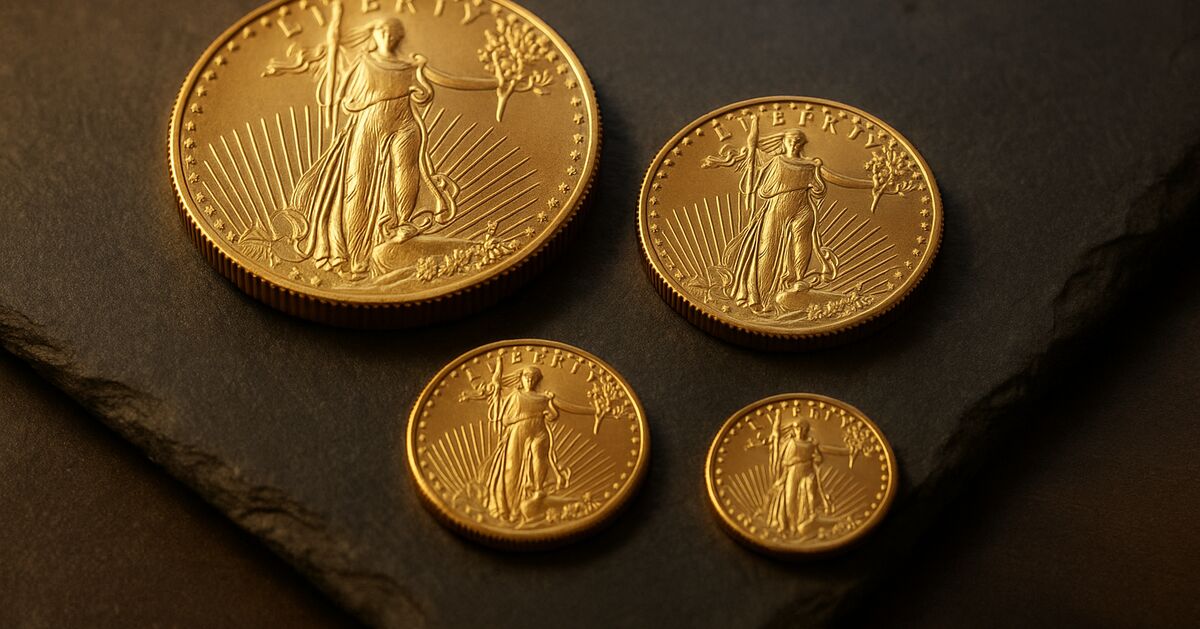
American Gold Eagle coins are the official gold bullion coin of the United States, first issued in 1986 under the Gold Bullion Coin Act. The U.S. Mint produces them in four sizes:
- One ounce - $50 face value, contains one troy ounce of gold
- Half ounce - $25 face value, contains 0.5 troy ounces of gold
- Quarter ounce - $10 face value, contains 0.25 troy ounces of gold
- Tenth ounce - $5 face value, contains 0.1 troy ounces of gold
Those face values are legal tender denominations, not market values. Nobody pays or receives a Gold Eagle coin at face value in ordinary commerce. The real value is almost entirely a function of the gold inside.
The alloy matters too. Gold Eagles are struck in 22-karat gold, which means they are 91.67% pure gold by weight. The remaining 8.33% is a mix of silver and copper, which gives the coin its characteristic warm, slightly reddish hue and makes it harder and more resistant to everyday wear than a 24-karat coin would be. Despite not being pure gold, each coin still delivers its stated gold content. A one-ounce Gold Eagle contains exactly one troy ounce of fine gold; it simply weighs a little more than one troy ounce in total because of the alloy added to it.
The design is genuinely beautiful and carries real historical weight. The obverse uses Augustus Saint-Gaudens' Liberty figure, adapted from his iconic 1907 double eagle design and widely considered one of the finest coin designs in American history. The reverse, designed by Miley Busiek, shows a male eagle carrying an olive branch flying above a nest where a female eagle tends to hatchlings. These design details matter to collectors, though as we will see below, they rarely move the price for most sellers.
What actually sets the price
If you want to understand why a buyer quotes you a particular number, start here. The price of a Gold Eagle is built from three layers.
Layer one: the spot price of gold. This is the foundation of every offer. Spot is the real-time global market price for one troy ounce of pure gold, quoted in U.S. dollars. It changes by the minute during trading hours and is driven by currency movements, interest rates, geopolitical tension, and supply-demand dynamics in gold futures markets. You can check it on financial sites such as Kitco or the London Bullion Market Association's published data. Whatever spot is when you sell, that is the ceiling from which buyers work down. For a detailed look at how live price charts translate into real-world offers, see our post on live price charts and what they really mean when you're selling silver - the mechanics are identical for gold.
Layer two: the gold content multiplier. A one-ounce Eagle at a spot price of, say, $3,000 per troy ounce has a melt value of $3,000. A tenth-ounce Eagle at that same spot price has a melt value of $300. Buyers start there and work from that number.
Layer three: the buyer's margin. No buyer pays 100% of melt value and stays in business. They need to cover their costs (overhead, shipping, insurance, assay, and the time-value of money while the gold sits unsold) and make a profit when they eventually sell into the market or to a refiner. The margin a buyer takes is expressed as a percentage below spot, and it varies considerably depending on the type of buyer, the volume you are selling, and market conditions at the time.
For a broader look at how these same dynamics play out across precious metals sales, our guide to selling silver at the best price walks through the full framework in plain terms.
The collector premium question
This comes up constantly. Someone sees that a Proof Gold Eagle in its original mint packaging sells for considerably more than a bullion coin of the same size, and they wonder whether their coin qualifies.
Here is the honest answer: for the overwhelming majority of Gold Eagles in circulation, there is no meaningful collector premium. Bullion-strike Eagles produced in large quantities are bought and sold almost purely on gold content. A well-worn 1990 one-ounce Eagle and a brilliant uncirculated 2020 one-ounce Eagle will typically receive nearly identical offers from bullion buyers.
The exceptions are narrow but real:
- Proof coins in original packaging with their certificate of authenticity. Proof Eagles are struck to a higher standard, with mirror fields and frosted devices. They command a premium over bullion coins, but only when they are complete. A Proof coin removed from its capsule and mingled with other coins loses most of that premium.
- Early-date coins with lower mintages. Certain years from the late 1980s and early 1990s had relatively small production runs, and specialist coin collectors pay attention to those dates.
- Key-date or error coins. These are rare and require authentication before any premium applies.
If you suspect you have a Proof coin or a low-mintage date worth more than melt, take it to a coin specialist rather than a general bullion buyer. A specialist can attribute the coin properly and connect you with collector buyers who will pay for that premium. For general bullion-strike coins, focus on the gold content and the buyer's percentage.
Condition: it matters less than you think, but not zero
One of the things I told sellers repeatedly: Gold Eagles are more forgiving than silver coins when it comes to condition, because their value is dominated by gold content rather than numismatic grade. A coin that is 70% melt value to a collector is still 100% melt value to a refiner.
That said, condition is not completely irrelevant. A Proof coin that has been cleaned, scratched, or removed from its capsule loses its collector premium permanently. A bullion coin with deep gouges or obvious damage may draw lower offers from buyers who worry about authenticity or who know a collector won't touch it. The damage does not reduce the gold content, but it can reduce the universe of buyers willing to pay a full premium.
A few basic care points are worth knowing even if you are selling soon:
- Store coins in a dry environment. Moisture does not harm gold the way it harms silver, but humidity encourages handling damage to softer alloy components and can affect any original packaging.
- Never clean a coin with chemicals, abrasives, or anything stronger than a soft, dry cloth. Cleaning marks destroy collector value instantly and permanently.
- Keep Proof coins in their original mint capsules. Once you crack that plastic, the coin is a bullion coin for pricing purposes.
- If you have multiple coins, store them so they do not rub against each other. Contact marks (called bag marks in the trade) are one of the main ways coins lose grade.
For a more detailed discussion of why cleaning is so damaging, the same principles explained in the context of silver coins apply directly here.
Where to sell and what to expect from each type of buyer
The buyer landscape for Gold Eagles is healthier than for many other precious metals items, because Eagles are standardized, widely recognized, and easy to value. That works in your favor.
Coin dealers and bullion shops. A good local coin dealer who handles bullion regularly is often the best starting point. They can examine the coin in person, confirm authenticity on the spot, and give you an immediate offer. Their margins vary; A high-volume shop dealing in common bullion Eagles often offers a higher percentage of spot on a one-ounce coin than a smaller shop less focused on bullion, though exact figures vary by dealer. Always compare.
National mail-in buyers. Reputable mail-in precious metals buyers often publish their buy prices for standard bullion coins. Because they operate at scale, their offers can be competitive. The trade-off is that you cannot compare the offer to spot in real time while standing in front of them; get their posted buy price, compare it to live spot at that moment, and you have their percentage. For a detailed look at the trade-offs between different buyer types, see our broader guide to selling silver coins and what they're worth, which covers the same buyer landscape.
Online auction platforms. Gold Eagles sell well on major auction platforms because the buyer pool is large and competitive. You may achieve close to or occasionally slightly above the spot-based price a dealer would offer, but you pay platform fees, assume shipping costs and insurance, and carry the risk of a non-paying bidder. For larger holdings, auction can be worth the effort. For one or two coins, a dealer visit is usually more efficient.
Pawnshops. Generally not the best choice for Gold Eagles unless you need cash immediately and no other option is available. Pawnshops that do not specialize in bullion often apply wide margins because they are uncertain about their resale channel.
Banks. A small number of banks accept gold coins, but this is not a standard service in the United States, and the pricing is typically not competitive.
The practical approach: get at least three offers from different buyer types before committing to any of them. Note the spot price at the time of each quote and calculate what percentage of spot each offer represents. That single calculation tells you everything you need to know about whether an offer is fair or thin.
Small coins versus large: the premium gap you should know about
This is one of the most practically useful things to understand before you sell. Smaller denomination Eagles - the quarter-ounce and especially the tenth-ounce - typically sell for a higher percentage of spot when you buy them and receive a lower percentage of spot when you sell them.
Why? Because the per-coin handling cost for a dealer is roughly the same whether the coin contains a tenth of an ounce or a full ounce. That fixed cost represents a much larger slice of a $300 coin than a $3,000 coin. Buyers compensate by widening their margin on smaller coins.
If you have a mix of sizes, you may find that your one-ounce Eagles draw meaningfully better percentage offers than your tenth-ounce Eagles. Do not assume the percentage will be the same across all four sizes. Ask explicitly, compare the percentages separately, and factor that into your decision about whether to sell everything at once or focus on the larger coins first.
Authentication: what buyers check and why it protects you too
Legitimate bullion buyers will verify that your coins are genuine before completing a purchase. Common methods include weight checks (A genuine one-ounce Eagle has a total weight close to 33.93 grams, which buyers can verify with a scale.), diameter checks, and increasingly, electronic or XRF (X-ray fluorescence) testing that confirms metal composition without damaging the coin.
This verification process protects both parties. Counterfeit coins with tungsten cores have been reported in the market, so responsible buyers screen for them. If a buyer offers to purchase your coins without any verification at all, that is actually a warning sign rather than a convenience. A professional who skips authentication either does not know what they are doing or is operating in a way that should make you uneasy.
Bring whatever documentation you have: original mint packaging, certificates of authenticity for Proof coins, receipts from your original purchase. These do not substitute for physical verification, but they support the transaction and can help establish provenance for higher-value coins.
Practical steps before you sell
Pulling this together into a concrete sequence:
- Identify exactly what you have. Note the year, denomination, and whether each coin is a bullion strike or a Proof. Check the original packaging if you have it.
- Look up the current spot price of gold from a reliable source. This is your reference point for every conversation that follows.
- Get at least three quotes from different buyer types. Calculate each offer as a percentage of the gold content value at current spot.
- For any coin you think might carry a collector premium (early dates, Proofs, low mintages), get an opinion from a coin specialist before selling to a bullion buyer.
- Never clean the coins between now and the sale. Not with anything.
- Sell to the buyer offering the highest percentage of spot, all else being equal. "All else" includes the buyer's reputation for paying promptly and returning coins if a deal falls through.
For a full end-to-end framework that covers everything from valuation to final payment, the complete guide to selling gold at the best price goes deeper on several of these steps.
A note on timing
Sellers often ask whether they should wait for a higher gold price before selling. The honest answer is that nobody can reliably predict short-term gold price movements. What you can control is the percentage of spot that your buyer pays you, and that is where the real effort is worth spending. Getting 97% of spot on the day you sell is worth far more than getting 85% of spot after waiting six months for a price move that may or may not arrive.
If you want a broader sense of the factors that move precious metals prices and how they affect sellers, our main resource on selling silver - what it's worth and what moves the price covers the underlying economics in detail. Gold and silver move on many of the same forces.
Gold Eagles are among the easiest precious metals items to value and sell, which is one reason they were designed the way they were. The U.S. Mint built them to be a recognizable, trusted, easily authenticated store of gold. That design intent works in your favor as a seller. Do the simple homework on spot price, shop the offer, and you will do well.
Sources & further reading
- Gold Bullion Coin Act of 1985 (Public Law 99-185) (U.S. Government Publishing Office)
- London Bullion Market Association: gold price data and market information (London Bullion Market Association)
Revision history (1)
- Pre-publish editorial QA: 1 flagged, 0 softened; claim audit: 5 claims, 3 rewritten
Claim-by-claim audit (5 checked)
- “American Gold Eagle coins are the official gold bullion coin of the United States, first issued in 1986 under the Gold Bullion Coin Act.” (cited → govinfo.gov)
- “Gold Eagles are struck in 22-karat gold, which means they are 91.67% pure gold by weight.” (reasoning shown in the article)
- “A genuine one-ounce Eagle has a total weight close to 33.93 grams, which buyers can verify with a scale.” (rewritten to what the article can stand behind)
- “A high-volume shop dealing in common bullion Eagles often offers a higher percentage of spot on a one-ounce coin than a smaller shop less focused on bullion, though exact figures v…” (rewritten to what the article can stand behind)
- “Counterfeit coins with tungsten cores have been reported in the market, so responsible buyers screen for them.” (rewritten to what the article can stand behind)