
Selling designer jewelry online: what it's worth and how to
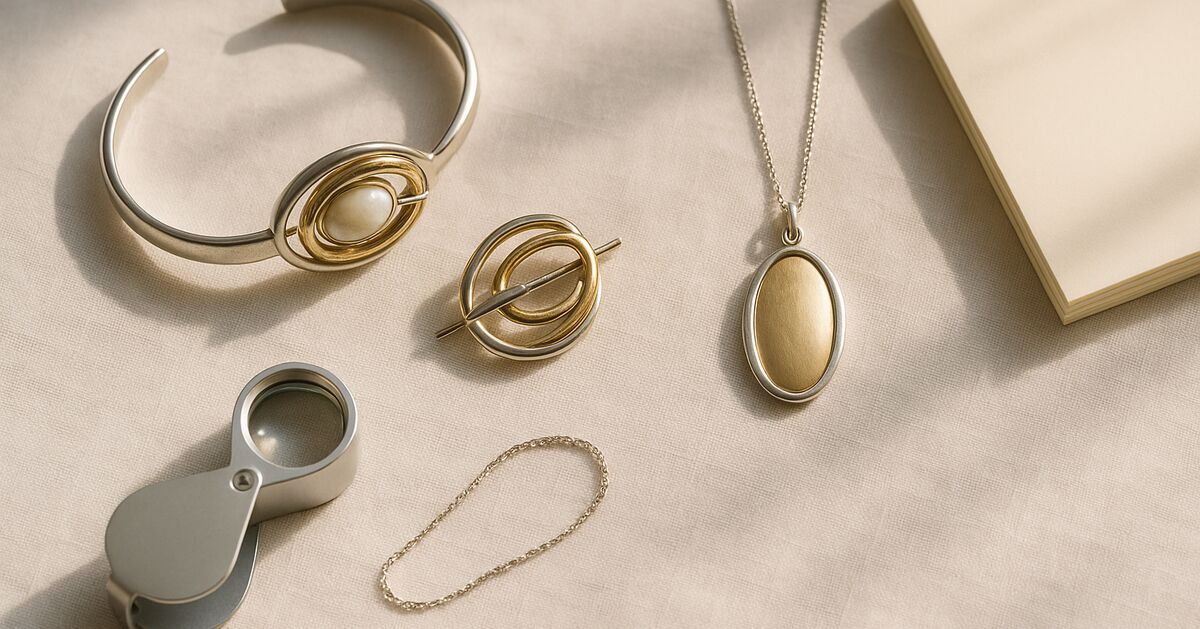
Designer jewelry sits in a frustrating in-between world when it comes to selling. It is not quite fine art, not quite scrap metal, and not quite a collectible in the coin sense. Some buyers default to treating it as raw material and offer you melt value. That can leave money on the table, and understanding why is the first step to getting a fair return.
This guide draws on eighteen years of buying and selling precious-metal jewelry, including a lot of designer pieces, before closing that business. It covers what actually moves the price on designer jewelry, how to research your own piece before approaching any buyer, and what to watch for in the selling process.
Why designer jewelry is different from ordinary jewelry
When you bring a plain gold chain to a buyer, the math is simple. You weigh it, you test the purity, and you calculate the melt value. Subtract the buyer's margin and that's the offer.
Designer jewelry adds another layer. A Tiffany sterling cuff, a Cartier Love bracelet, a Georg Jensen brooch, or a David Yurman cable ring each carries a brand premium that survives even when the piece is old, worn, or has a clasp that needs repair. The buyer who only runs the melt calculation is ignoring that premium entirely.
One reason some buyers default to melt value is straightforward: it is safe, measurable, and requires no research. Paying above melt means the buyer has to resell the piece as jewelry, not scrap it, which takes longer and requires a different kind of customer. Many buyers simply don't want that complexity.
That gap between what a buyer offers and what a piece could realistically sell for on the secondary market is exactly where sellers lose money.
What actually drives the price on designer pieces
Several factors stack on top of metal value when it comes to designer jewelry. Understanding each one helps you evaluate any offer you receive.
Brand recognition and demand
Not all designer names carry the same resale premium. Tiffany and Cartier have deep, global secondary markets. A regional jeweler who made beautiful one-of-a-kind pieces might be a great artist but carry very little brand premium because buyers outside a small geography don't know the name. Before you assume a piece is worth a big premium, check whether there is an active resale market for that specific brand.
Condition
Scratches, dents, missing stones, broken clasps, and worn hallmarks all reduce value. A piece in very good condition tends to sell for a noticeably higher share of its original retail price than a heavily worn piece, which often fetches closer to melt value. Be honest with yourself about condition before you form a price expectation.
Original packaging and paperwork
Boxes, pouches, certificates of authenticity, and receipts meaningfully increase resale value for certain brands, particularly Tiffany, Cartier, Bulgari, and Van Cleef and Arpels. If you have original packaging, keep it together with the piece and mention it to every buyer.
Authentication
This is the critical one that sellers often underestimate. The secondary market for Cartier and Tiffany in particular is flooded with counterfeits. Any serious buyer paying a brand premium above melt will want to authenticate the piece, either themselves or through a third party. A piece that cannot be authenticated will likely be offered melt value regardless of what it appears to be.
The current precious metal price
Designer or not, every piece of gold or silver jewelry has a melt floor. If the market price of gold or silver is high, that floor is higher, which is good for sellers. The brand premium tends to be a multiplier on top of that floor, so rising metal prices lift designer jewelry values from both ends. You can follow live silver and gold spot prices through financial data sites and commodity exchanges to track where the melt floor sits on any given day.
Style cycles
Some designer styles age well; others become dated. Tiffany's core sterling pieces have held value for decades because the aesthetic is clean and timeless. A heavily designed piece from a brand's 1990s maximalist period might be harder to move because the style is out of fashion even if the brand is not.
How to research what your piece is worth before approaching buyers
Walking into any negotiation without a number in your head is a disadvantage. Here is a practical research sequence.
Start with the hallmarks. Every legitimate designer piece will be stamped with a metal purity mark and a maker's mark. Tiffany, for example, stamps pieces with "TIFFANY and CO." and a purity mark such as "925" for sterling or "750" for 18-karat gold. If you cannot find clear hallmarks, that is a warning sign and affects both authentication and value.
Weigh the piece. A kitchen scale accurate to 0.1 grams is enough for a rough calculation. Look up the current spot price of the relevant metal, convert grams to troy ounces (divide by 31.1), and multiply by the purity fraction (0.925 for sterling, 0.75 for 18k gold, and so on). That gives you the melt floor, which is the absolute minimum a serious buyer should offer for the metal alone.
Search completed sales, not listed prices. eBay's sold listings, 1stDibs sold prices, and TheRealReal's sold inventory all show what buyers actually paid, not what sellers hoped to get. Filter for the same brand, similar style, similar condition, and similar metal. A realistic range from real completed sales is far more useful than any retail comparison.
Check the authentication question. Search for your specific piece on the brand's official website if it still exists in their archive, or look for collector forums and authentication guides specific to that brand. Some brands (Tiffany is a good example) have well-documented hallmark evolution over the decades that makes authentication by a knowledgeable buyer relatively straightforward.
If you are also dealing with gold pieces from an estate alongside designer silver, the guide on selling inherited or scrap gold: a practical guide to getting a fair price covers the melt-value research side of things in useful detail.
Where to sell designer jewelry online
The right venue depends on the piece and your priorities.
Auction houses (Heritage, Bonhams, Doyle, and regional houses) are worth considering for high-value Cartier, Van Cleef, Bulgari, or signed Art Deco pieces. Buyer's premiums can be substantial and are paid by the buyer on top of the hammer price, while the seller receives the hammer price minus the seller's commission. For pieces that could realistically hammer at $1,000 or more, this is often the best option because you get competitive bidding from an authenticated pool of buyers.
Luxury resale platforms like TheRealReal, Vestiaire Collective, and 1stDibs handle authentication, photography, and marketing, but take a significant commission (typically 30 to 50 percent of the sale price depending on tier). The trade-off is convenience and access to a pre-qualified audience.
eBay sold listings are your best price research tool, but selling there means handling authentication questions from buyers yourself. A lack of provenance documentation makes selling high-value pieces on eBay difficult because buyers are cautious.
Specialist online buyers who focus on designer jewelry are worth approaching for mid-range pieces ($200 to $1,000 in estimated value). Unlike general gold buyers, they maintain resale channels for designer goods, which means they can pay above melt. Get at least two or three offers before accepting any, and always confirm the return policy in writing before shipping anything.
Local estate jewelers and consignment shops should not be overlooked just because this guide is focused on online selling. For certain pieces, particularly well-known American brands in good condition, a local jeweler who knows their customer base may offer a better net price than an online buyer after shipping costs and fees.
If you are sorting through a broader collection that mixes designer pieces with plain jewelry, the practical advice in selling silver and gold jewelry together: a practical guide on how to separate and value a mixed lot is directly applicable.
What to watch out for when getting offers
A handful of problems come up again and again when sellers go through this process.
Offers that only quote melt value. If a buyer quotes you purely on weight and purity without asking anything about the brand, condition, or original packaging, they are treating your designer piece as scrap. That may be convenient, but it is unlikely to be fair for a genuine designer piece in good condition. It is perfectly reasonable to ask a buyer directly: "Are you factoring in the brand premium, or is this a melt-value offer?"
Pressure to decide before you can compare. A legitimate buyer will give you a written offer and allow you reasonable time to accept or decline. High-pressure tactics, expiring-in-minutes offers, or "special deals" that disappear if you hang up the phone are signs of a buyer who knows their offer is below market.
Vague return policies. If you are shipping a piece to an online buyer, the return policy matters enormously. Before you ship, confirm in writing that the piece will be returned to you at no cost if you decline the offer. Get the name of the shipping service they will use for returns, and check that the piece will be insured at full value during transit both ways.
Not getting the piece authenticated before you sell. If you have a piece you believe is genuine Cartier or Tiffany, and the buyer wants to pay only melt value because they cannot verify it, consider having the piece independently authenticated first. A certified gemologist or an appraisal from the American Society of Jewelry Appraisers can produce a written report that you can use with multiple buyers. An appraisal typically has a modest cost that can more than pay for itself on a valuable piece.
Undervaluing silver pieces. Sellers sometimes assume designer silver jewelry is only worth its metal content because silver spot prices are lower than gold. That ignores the brand premium entirely. A Georg Jensen sterling brooch or a Tiffany Elsa Peretti cuff can sell for many times its melt value because of collector demand. The selling inherited or scrap silver: a practical guide page covers the silver melt calculation clearly, and it is a useful baseline, but for genuine designer pieces it really is just the floor.
Getting the piece ready to sell
A few practical steps before you photograph or ship a piece.
Clean it gently with a soft cloth. Do not use silver dip, ultrasonic cleaners, or polishing compounds unless you know exactly what you are doing, because some designer finishes are intentionally oxidized and chemical cleaning destroys value. For silver in particular, light surface tarnish is not a problem for experienced buyers and is far preferable to a chemically cleaned piece with a stripped finish.
Photograph it in natural light, close up, from multiple angles. Capture the hallmarks clearly, because a buyer who can read the marks in a photo has fewer reasons to lowball on uncertainty. Show any wear, damage, or stone issues honestly. Misrepresenting condition creates problems at the point of sale and can lead to revised (lower) offers after the buyer receives the piece in person.
If you are mailing the piece, use a tracked and insured service and declare the full value. General advice on packaging precious metal jewelry for postal shipping is covered in detail elsewhere on the blog, but the short version is: padded envelope inside a rigid box, at minimum.
Setting realistic expectations
A piece that retailed for $800 five years ago is not going to sell on the secondary market for $800. A realistic recovery rate for designer jewelry in good condition with original packaging is generally a meaningful fraction of original retail for the most liquid brands, and lower for brands with thinner secondary markets. Pieces in poor condition, without documentation, or from lesser-known designers often recover only a small fraction of retail, sometimes approaching melt value.
That might sound discouraging, but compare it to what a general precious-metal buyer who only pays melt would offer. On an 18-karat gold Tiffany bangle weighing 20 grams, the melt value at $2,000 per troy ounce gold would be roughly $780. A buyer who recognizes and pays the brand premium might offer significantly more for the same piece in good condition. That difference is real money, and it is entirely recoverable if you approach the right buyer.
For anyone selling silver coins or bullion alongside jewelry, the overview on how to sell silver dollars: identify, value, and find a buyer is a helpful companion read for the metal-value research side of the process.
The home page at How To Sell Silver, and the frequently asked questions page, both have additional grounding on how precious-metal valuations work in practice, which is useful context whether you are selling scrap or something considerably more valuable.
The bottom line
Designer jewelry is worth more than its metal content, and some buyers know this even if they don't volunteer it. Your job as a seller is to know what you have, document it well, research realistic comparable sales, and approach buyers who actually maintain a resale channel for designer goods rather than defaulting to the smelter.
The process takes more effort than selling scrap, but on a meaningful piece the extra research pays for itself many times over.
Sources & further reading
- Precious metals spot price data and commodity markets (U.S. Commodity Futures Trading Commission)
- Gold and silver karat and fineness standards (National Institute of Standards and Technology (NIST))
- Consumer tips for selling valuables and avoiding fraud (U.S. Federal Trade Commission - Consumer Information)
Revision history (1)
- Pre-publish editorial QA: 5 flagged, 5 softened; claim audit: 8 claims, 6 rewritten
Claim-by-claim audit (8 checked)
- “A piece in very good condition tends to sell for a noticeably higher share of its original retail price than a heavily worn piece, which often fetches closer to melt value.” (rewritten to what the article can stand behind)
- “Buyer's premiums can be substantial and are paid by the buyer on top of the hammer price, while the seller receives the hammer price minus the seller's commission.” (rewritten to what the article can stand behind)
- “Luxury resale platforms like TheRealReal, Vestiaire Collective, and 1stDibs handle authentication, photography, and marketing, but take a significant commission that varies by tier…” (rewritten to what the article can stand behind)
- “An appraisal typically has a modest cost that can more than pay for itself on a valuable piece.” (rewritten to what the article can stand behind)
- “A realistic recovery rate for designer jewelry in good condition with original packaging is generally a meaningful fraction of original retail for the most liquid brands, and lower…” (rewritten to what the article can stand behind)
- “Pieces in poor condition, without documentation, or from lesser-known designers often recover only a small fraction of retail, sometimes approaching melt value.” (rewritten to what the article can stand behind)
- “On an 18-karat gold Tiffany bangle weighing 20 grams, the melt value at $2,000 per troy ounce gold would be roughly $780.” (reasoning shown in the article)
- “A buyer who recognizes and pays the brand premium might offer significantly more for the same piece in good condition.” (rewritten to what the article can stand behind)