
How to sell silver dollars: identify, value, and find a
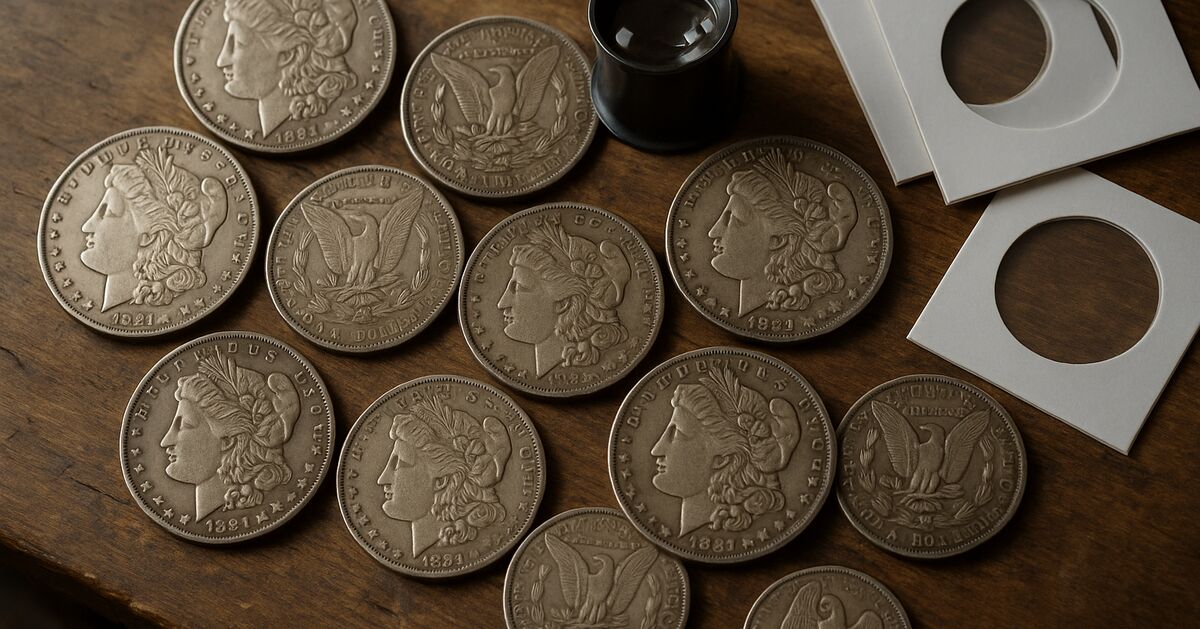
Silver dollars are one of the most satisfying things to pull out of an old drawer, and also one of the easiest to undervalue or mishandle before you ever get to a buyer.
I spent eighteen years buying silver and gold across the counter and by mail. Silver dollars came in constantly - inherited collections wrapped in tissue paper, rolls pulled from bank boxes, single coins tucked inside envelopes with a note that said "grandpa said this was worth something."" He was usually right, though not always for the reason he thought. Getting a fair price starts well before you contact a buyer. It starts with knowing what you actually have.
The eight series of American silver dollars
The United States has issued silver dollars across eight distinct design series, and the series alone tells a buyer a great deal about a coin before they even look at the date or condition.
- Flowing Hair (1794-1795) - The first American silver dollar. Very few examples are believed to survive today, so get it appraised by a professional numismatist before doing anything else. If you think you have one, treat it with extreme care and get it to a professional numismatist before you do anything else.
- Draped Bust, Small Eagle (1795-1798) - Early coinage, hand-struck, low mintages. Genuinely rare in circulated grades.
- Draped Bust, Large Eagle (1798-1804) - The "1804 dollar" is one of the most famous rarities in American numismatics, though most coins people call 1804 dollars are later restrikes or outright fakes.
- Seated Liberty (1836-1873) - A long-running series with many sub-types. Most circulated examples trade above melt, some dates trade far above it.
- Trade Dollar (1873-1885) - Struck specifically for commerce in Asia, slightly heavier than a standard dollar at 420 grains. Often found chopmarked by Asian merchants who tested them. Chopmarks reduce collector value but do not eliminate it entirely.
- Morgan Dollar (1878-1904 and 1921) - The most commonly encountered silver dollar in the United States. Hundreds of millions were minted. Key dates and mint marks matter enormously here.
- Peace Dollar (1921-1935) - Issued to mark the end of World War One. The 1921 high-relief issue is a one-year type that commands a premium over later dates.
- Eisenhower Dollar (1971-1978) - Copper-nickel clad for circulation, silver-clad 40% for collector sets. Most circulated Eisenhower dollars contain no silver at all, so identification matters before you assume.
Understanding which series you have is the foundation of everything that follows. A worn Morgan dollar is worth its silver melt value plus a modest premium. A key-date Morgan in fine condition is worth multiples of that. Lumping them together and selling by weight is a mistake that comes up again and again among first-time sellers.
Identifying key dates and mint marks
Within any given series, a handful of dates and mint marks drive a large share of the total collector value. On Morgan dollars, the mint mark appears on the reverse, just below the eagle's tail feathers. The letters to look for are S (San Francisco), O (New Orleans), CC (Carson City), and D (Denver, only for 1921). No letter means Philadelphia.
Dates and mint mark combinations that attract serious attention on Morgan dollars include 1879-CC, 1889-CC, 1893-S, 1895 (Philadelphia, proof only), 1901, and 1903-O among others. On Peace dollars, the 1921 and the 1928 Philadelphia issue are the standout dates to check first.
A reference like the PCGS CoinFacts database or the NGC coin explorer will show you auction records for nearly every date and mint combination. Spending twenty minutes on those databases before you approach any buyer is time very well spent.
Why grading changes the number so dramatically
A coin's condition (its "grade" in numismatic language) is expressed on a scale from Poor-1 at the bottom to Mint State-70 at the top. For a common-date Morgan dollar, the difference between a well-circulated example grading Very Fine-20 and a lustrous uncirculated coin grading MS-63 can be the difference between a $30 coin and a $150 coin or more, even though both contain exactly the same amount of silver.
For rarer dates the gap is far more dramatic. An 1893-S Morgan in Good-4 condition is known to command very high auction prices; check PCGS CoinFacts or NGC's price guide for current figures. The same date worn down to Fair-2 still brings serious money. Context matters.
You do not need to be a professional grader to get a working sense of your coins' condition. The main things a buyer will look at are: the sharpness of the high points (hair above Liberty's ear, eagle's breast feathers), the presence of original mint luster in the fields, and whether the surfaces show any evidence of cleaning or artificial treatment. That last point leads directly to the most common and costly mistake sellers make.
The cleaning problem: why you should leave coins alone
Do not clean your silver dollars. This is worth stating plainly, because the instinct to present something in its best light before selling is entirely natural. The problem is that numismatists and dealers can spot a cleaned coin almost instantly, and a cleaned coin - even one cleaned gently with a soft cloth - trades at a substantial discount to an equivalent uncleaned example.
Original surface on a silver coin develops over decades. Luster moves in a specific way called "cartwheel" when you tilt the coin under light. Cleaning disrupts the microscopic surface texture that creates that effect. Even a rinse in water and a light rub can leave hairlines in the fields that immediately signal artificial treatment.
Coins with heavy verdigris or corrosion are a separate matter, and those should be discussed with a conservator or experienced dealer before you do anything. But if your coins are simply dark or toned, leave them. Toning is not damage. Buyers understand it, and some collectors actively prefer naturally toned coins over bright, shiny ones.
For more context on this point in relation to silver more broadly, the post on selling inherited or scrap silver: a practical guide covers handling decisions in detail.
How to work out a realistic value before you sell
There are two components to a silver dollar's value: the melt value (the worth of the silver content itself) and the numismatic premium (the collector value above and beyond the metal). For common-date, well-circulated coins in most series, the numismatic premium above melt is modest. For key dates, scarce mint marks, or high-grade examples, the numismatic premium can dwarf the melt value entirely.
To work out the melt value of a standard silver dollar, you need two numbers: the coin's silver weight and the current spot price of silver. A standard Morgan or Peace dollar is generally cited as containing about 0.7734 troy ounces of pure silver (90% silver, weighing about 26.73 grams gross); check a reference source to confirm before calculating melt value. Multiply 0.7734 by the current spot price and you have the melt floor.
Spot price updates continuously during trading hours. You can find it on financial data sites, and it is the same number every dealer in the country is looking at. A buyer will offer you a percentage of spot, not spot itself, because they need a margin to cover their operating costs and the risk of holding inventory. Understanding that structure helps you evaluate offers rationally rather than emotionally.
For numismatic value above melt, check recent completed auction results on PCGS CoinFacts, NGC's price guide, or eBay's completed listings. Completed listings (not active listings, which can be wishful thinking) show you what buyers actually paid. That is the number that matters.
The site's frequently asked questions covers some of the common sticking points around spot price versus offer price if you want more background on that relationship.
Storing your coins before you sell
If you are not selling immediately, storage matters. Silver dollars should be kept in a cool, dry environment away from direct sunlight. Fluctuating humidity accelerates toning and can encourage the kind of spotting that reduces collector value.
Acceptable storage options include individual 2x2 cardboard flips (make sure they are PVC-free - PVC off-gasses and destroys coin surfaces over time), hard plastic coin capsules, or archival-quality cardboard coin envelopes. Do not store coins loose in drawers where they can rub against each other, and do not store them in soft PVC flips or plastic bags not rated for archival use.
If coins are in original mint sets or original packaging, leave them in that packaging. Original government packaging is part of the coin's provenance and sometimes adds value on its own.
Choosing the right buyer
This is where a lot of silver dollar sellers lose money without realizing it, because not all buyers are equally suited to all coins.
Coin dealers and numismatists. For any coin with genuine collector value above melt, a coin dealer or numismatist is usually the right first stop. They buy and sell coins every day, they understand premiums, and they can quickly tell you whether a date is common or scarce. Look for dealers who are members of the Professional Numismatists Guild (PNG) or the American Numismatic Association (ANA). Membership does not guarantee a good offer, but it does mean the dealer has agreed to a code of ethics.
Coin shows. A coin show puts multiple dealers in one room, which means you can get several offers in an afternoon without shipping anything anywhere. For better coins, this is an underused option. Dealers at shows are there to buy as much as to sell, and competition in the room tends to sharpen offers.
Online auction platforms. Platforms like eBay can achieve strong prices for the right coins, because you are reaching a national pool of collectors rather than a single local buyer. The trade-off is time (listings run days), fees (eBay and PayPal fees will eat into proceeds, so factor that into your pricing.), and the effort of accurate description, photography, and shipping. For truly rare dates, the price difference can justify all of that. For common-date coins, the overhead may not be worth it.
Mail-in silver buyers. For common-date circulated coins that are essentially trading on melt value, a reputable mail-in buyer is a perfectly reasonable option. They process large volumes efficiently and generally offer competitive rates on bullion-grade material. The practical guidance in the post on how to sell silver coins: identify, value, and pick the right buyer covers the mail-in process and what to look for in a buyer.
Pawn shops. Generally the weakest option for silver dollars with any numismatic value. Pawn shops tend to pay on melt value at best, and their staff are not typically trained to recognize valuable dates or grades.
One important caution: if you have a mixed collection with both common-date coins and potentially valuable dates, do not sell everything together as a bulk lot to a single buyer who is pricing on silver weight. Sort first. Pull out any dates that warrant individual research and get those priced separately. Selling a key-date Morgan in a bulk lot at melt value is a difficult mistake to undo.
For coins in the gold-adjacent world, the post on selling Silver Eagle coins: what they're worth and how to get a fair offer covers a closely related category with some of the same buyer dynamics.
Getting coins professionally graded: when it makes sense
Professional third-party grading by PCGS (Professional Coin Grading Service) or NGC (Numismatic Guaranty Corporation) encapsulates the coin in a tamper-evident plastic holder with the grade printed on it. This "slab" removes subjectivity from the transaction and often increases what a buyer will pay, because the risk of disagreement over grade is eliminated.
The economics only work for coins where the premium above melt justifies the grading fee. Basic grading submissions typically cost somewhere in the tens of dollars per coin depending on service level, but check current schedules on the PCGS and NGC websites directly since fees change. For a coin that would sell for $40 over melt, grading makes no sense. For a coin that might sell for $500 over melt in MS-63 versus $150 in a lower grade, the math works out clearly.
If you are uncertain whether a coin is worth submitting, most reputable coin dealers will give you a quick opinion at no cost. Use that opinion to make the grading decision, not the other way around.
A practical checklist before you sell
Working through this list before you approach any buyer puts you in a much stronger position.
- Identify the series (Flowing Hair, Draped Bust, Seated Liberty, Trade Dollar, Morgan, Peace, Eisenhower, or later issues).
- Record the date and mint mark for every coin.
- Look up each date/mint combination in PCGS CoinFacts or the NGC price guide to understand the range of values by grade.
- Check recent eBay completed listings for your specific dates to see real-world transaction prices.
- Calculate melt value using the current spot price and the coin's silver weight.
- Note any coins that might warrant professional grading before sale.
- Do not clean anything.
- Get at least two offers before accepting one.
That last point is worth dwelling on. Getting a second offer costs you very little time and occasionally reveals a significant difference in what different buyers will pay. The home page, along with the blog, has resources that can help you understand the market context for those conversations.
What to expect from the selling experience
A straightforward transaction with a reputable coin dealer or mail-in buyer should be pleasant and uncomplicated. You present your coins (in person or by describing them accurately in writing), the buyer makes an offer, and you decide whether to accept. A buyer who pressures you to decide immediately, discourages you from getting a second opinion, or cannot explain clearly how they arrived at their number is a buyer worth walking away from.
The silver market moves daily, and a buyer's offer will reflect the spot price on the day they make it. That is normal and not a negotiating tactic. What you are negotiating is the percentage of that spot price, and the premium they are paying (or not paying) above it for numismatic value.
For a broader look at how these dynamics play out across gold and silver together, the post on selling silver and gold jewelry together: a practical guide covers the mixed-metal selling context in practical terms.
Silver dollars carry real history. The best outcome for any seller is walking away knowing they understood what they had, presented it honestly, and chose a buyer who paid a fair price for it. The steps above get you there.
Sources & further reading
- American Numismatic Association coin collecting resources (American Numismatic Association (ANA))
- Professional Numismatists Guild dealer standards and ethics (Professional Numismatists Guild (PNG))
Revision history (1)
- Pre-publish editorial QA: 1 flagged, 1 softened; claim audit: 5 claims, 5 rewritten
Claim-by-claim audit (5 checked)
- “Very few examples are believed to survive today, so get it appraised by a professional numismatist before doing anything else.” (rewritten to what the article can stand behind)
- “A standard Morgan or Peace dollar is generally cited as containing about 0.7734 troy ounces of pure silver (90% silver, weighing about 26.73 grams gross); check a reference source …” (rewritten to what the article can stand behind)
- “An 1893-S Morgan in Good-4 condition is known to command very high auction prices; check PCGS CoinFacts or NGC's price guide for current figures.” (rewritten to what the article can stand behind)
- “Basic grading submissions typically cost somewhere in the tens of dollars per coin depending on service level, but check current schedules on the PCGS and NGC websites directly sin…” (rewritten to what the article can stand behind)
- “eBay and PayPal fees will eat into proceeds, so factor that into your pricing.” (rewritten to what the article can stand behind)