
Selling Silver Eagle coins: what they're worth and how to
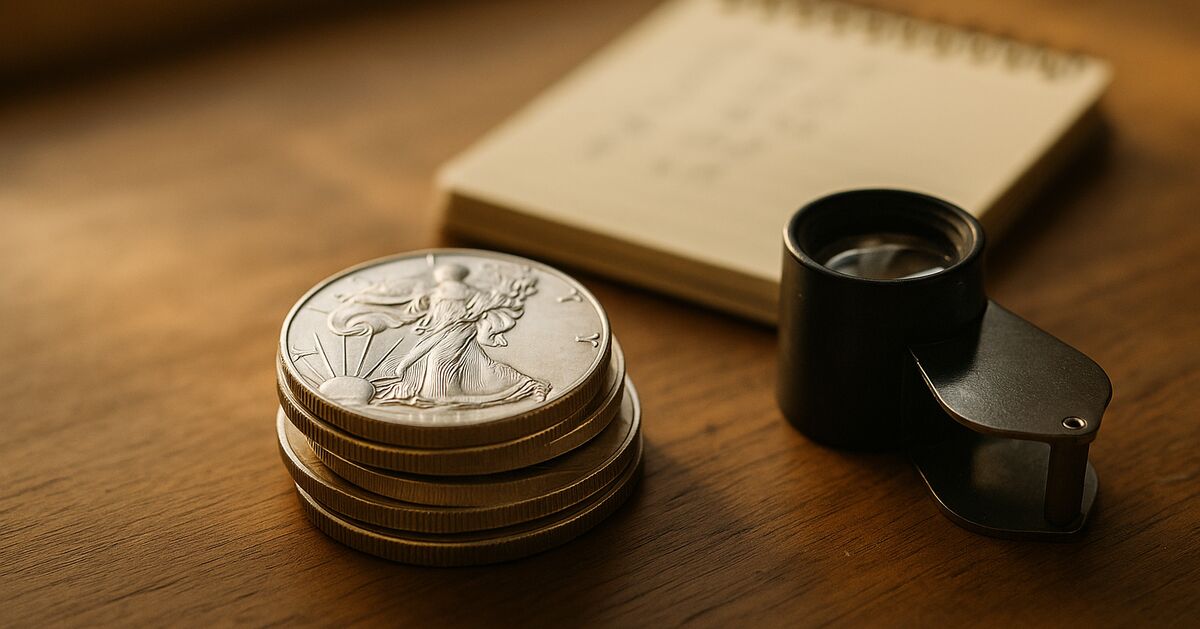
Silver Eagles are the purest silver coins the U.S. Mint has ever produced, and they are also among the easiest bullion coins to sell quickly and at a fair price. That said, "easy to sell" does not automatically mean "easy to get full value for." There are real differences between buyers, real premiums that come and go, and a handful of traps that catch sellers every year. This guide walks through all of it in plain language.
What a Silver Eagle actually is
The American Silver Eagle launched in 1986 under the American Eagle Bullion Program, and it has been struck continuously ever since. The obverse carries Adolph Weinman's Walking Liberty design, originally used on the Walking Liberty Half Dollar from 1916 to 1947. The reverse has gone through two versions: the original heraldic eagle by John Mercanti, used from 1986 through 2021, and a redesigned reverse introduced in 2021 that shows an eagle landing on a branch.
Every standard Silver Eagle contains exactly one troy ounce of .999 fine silver. That is the highest purity the U.S. Mint has ever used for a circulating or bullion coin. The coins are legal tender at one dollar face value, though nobody would ever redeem them at face value because the silver content alone is worth far more.
Proof versions are also struck each year at the San Francisco Mint (and occasionally other facilities). Proofs have a mirrored field and frosted design, come in a velvet presentation box with a certificate, and carry a "W" or "S" mint mark. They matter because they behave differently in the resale market.
How the base value is calculated
The floor under every Silver Eagle is its melt value. That is simply the spot price of silver multiplied by one troy ounce. If spot silver is sitting at $28, the melt value of one coin is $28. Spot prices change during every trading session, so check a live feed on the day you plan to sell, not the day you decide to sell.
What you actually receive, though, is melt value minus whatever margin the buyer takes. Reputable bullion dealers often offer a percentage of spot for common-date Silver Eagles in quantity, though the exact range varies by dealer, so compare a few offers before selling. Smaller lots, fewer coins, or less common buyers may push that percentage lower. Understanding how spot price translates to an offer is something the frequently asked questions section of this site covers in useful detail.
The premium layer on top of melt
Here is what confuses sellers who are new to Silver Eagles: these coins trade at a premium above spot even when you are buying them new from a dealer. That premium exists because the U.S. Mint sells them to authorized purchasers at a price above spot, and those purchasers pass the markup along to retail buyers. Retail premiums on new Silver Eagles vary and can rise noticeably during periods of high demand, so check current listings before assuming a specific range.
When you go to sell, you are selling into the secondary market. Buyers pay you for the silver content and factor in their own margin. Whether any of that retail premium comes back to you depends on:
- How many coins you have. A single coin gets a worse percentage than a tube of 20 or a box of 500. Dealers can move larger lots more efficiently.
- The date and mint mark. Common dates from the 1990s and 2000s trade purely on silver content. Certain early-run dates (1986, 1987, and a handful of low-mintage issues) carry modest numismatic premiums that a knowledgeable buyer will honor.
- Proof versus bullion. Proof Eagles in their original packaging with the certificate of authenticity are worth more than bullion strikes. Without the box and paperwork, much of the proof premium evaporates.
- The current silver market premium environment. When retail premiums on new coins are high because supply is tight, secondary-market premiums tick up too. When the market is well-supplied, premiums compress.
When coin condition actually matters (and when it doesn't)
For standard bullion strikes, condition matters very little. A coin that has been handled, stored loose in a bag, or slid in and out of a tube dozens of times is still worth essentially the same as a pristine one to a bullion buyer. Both contain one troy ounce of .999 silver. The buyer is melting or reselling it as bullion either way.
Where condition does matter is the numismatic tier. If you suspect you have a genuinely uncirculated early-date coin that has never been touched, or a low-mintage date that collectors seek, it is worth getting an opinion from a coin dealer who handles certified coins before you sell to a bullion buyer. A coin professionally graded MS-70 by PCGS or NGC can sometimes bring a premium over melt, though this varies by coin and market demand. But the key word is "sometimes," and the grading process costs money and takes time, so the math only works for specific coins.
For most Silver Eagles that people are selling, particularly coins they have accumulated as a savings vehicle or inherited, treating them as one-ounce silver bullion is exactly right.
What not to do before you sell
Two mistakes come up repeatedly in seller forums, and both cost money.
Cleaning the coins. Rubbing or washing a Silver Eagle removes the original surface and can introduce tiny scratches that kill any numismatic premium stone dead. Even for purely bullion-grade coins, a cleaned coin looks tampered with and raises questions. Leave them alone. The guidance in our post on why you should never clean silver coins before selling explains this in more detail.
Separating coins from their packaging before understanding what you have. Original green mint tubes, presentation boxes for proofs, and sealed monster boxes from the Mint all add credibility and sometimes value. A proof in its original box is worth materially more than the same coin loose.
Where to sell Silver Eagle coins
You have four realistic options, and each has genuine trade-offs.
Local coin dealers. A good local dealer can weigh and assess your coins on the spot and hand you cash or a check the same day. The offer percentage varies widely by dealer, volume, and local competition. It is always worth getting two local quotes if you have a meaningful quantity. Look for dealers who post their buy prices publicly, because that signals they are competing on price rather than hoping you do not know the market.
Online bullion dealers and mail-in buyers. Several large bullion dealers actively buy back Silver Eagles and post live buy prices on their websites. These prices are usually competitive because the business is high-volume and the overhead is lower than a walk-in shop. The trade-off is that you ship the coins, which takes time, costs money for insurance (non-negotiable on anything valuable), and requires trust in the buyer's process. Stick to established names with long track records and clear payout timelines.
Auction platforms. eBay and similar platforms let you reach collectors directly, which matters if you have proof sets, early dates, or graded coins. Auction platform seller fees are a real cost, and the extra premium from a motivated collector may only partly offset them, so factor fees into your expected return. For common-date bullion Eagles, auction platforms rarely beat a competitive dealer offer after fees.
Peer-to-peer silver communities. Reddit's r/Pmsforsale and similar forums have active buyer communities who know exactly what Silver Eagles are worth and often pay closer to spot than a retail dealer would. Transactions require building trust through feedback history, and payment is usually PayPal Goods & Services or cash. Fine for small lots if you are comfortable with the process; riskier for large quantities with a stranger.
Our broader overview of how to sell silver coins covers vetting buyers in more depth, and it is worth reading before you commit to a channel.
How to research and verify a buyer
Before handing over anything, spend thirty minutes on due diligence. Search the buyer's name alongside words like "complaint," "scam," and "review." Check the Better Business Bureau profile. For mail-in buyers, look specifically for complaints about lowball offers after shipping, slow payment, or coins going missing. These do happen.
Legitimate buyers will tell you their offer before you commit to selling. They will also have a clear policy for what happens if you reject the offer after they have evaluated the coins, including how the coins get returned to you and who pays the return shipping. If a buyer is vague on any of these points, walk away.
For context, the same due diligence process applies whether you are selling Silver Eagles or any other precious metal. The home page of this site links to resources that can help you build a baseline understanding of what fair treatment from a buyer looks like.
Timing: does it matter when you sell?
Silver prices move every trading day and can swing several percent in a week. Watching the chart and trying to sell at the peak is tempting, but predicting short-term price direction is genuinely hard, even for professional traders. A more practical approach is to set a minimum acceptable price in your head (based on your own cost or needs) and sell when spot reaches it rather than trying to time the absolute top.
What does make a real difference is selling when buyer premiums are healthy. During periods of very high silver volatility, some buyers widen their spreads or temporarily pause buying because they cannot confidently hedge their inventory. Selling into a calm, rising market generally gets you a better percentage than selling into a panicked spike.
Proof Eagles and special editions: a closer look
Proof Silver Eagles deserve their own mention because they confuse a lot of sellers. Proofs are not simply "nicer" bullion coins. They are collectibles from the moment the Mint makes them. Their value has two components: the silver content (always one troy ounce) and the collector premium, which depends heavily on the year, the mint mark, whether they are graded, and whether they come in their original packaging.
West Point ("W") proofs, San Francisco ("S") proofs, and the more recent reverse proofs each have their own collector following. Before selling a proof, check completed eBay listings for that specific year and mint mark to see what collectors actually paid, not just what sellers are asking. A raw (ungraded) proof in original packaging from a common year typically brings only a modest amount above melt, so check recent completed listings for specifics. A graded PF-70 from a short-production year could be worth significantly more.
If you are dealing with a larger inherited collection that includes proofs alongside bullion coins, our guide to selling inherited or scrap silver has useful advice on how to approach a mixed lot without leaving money on the table.
Selling in quantity: what changes
Selling 5 coins is a different transaction than selling 500. For larger quantities, the dynamics shift in your favor in one way and against you in another.
In your favor: dealers often offer a higher percentage of spot for large lots than for a handful of coins, since per-coin handling costs drop and bulk lots resell more easily wholesale.
Against you: you have more money at risk during the transaction, so the due-diligence step matters even more. Insure any shipment for full replacement value, use a trackable carrier, and never ship before you have confirmed the buyer's payout terms in writing. For very large lots, meeting a local dealer in person, at a bank or other neutral location, is worth the inconvenience.
Putting it all together
Silver Eagles are genuinely one of the most liquid silver products you can sell. They are universally recognized, easy to weigh and verify, and in constant demand from both bullion buyers and collectors. Getting a fair price comes down to three things: knowing what the silver content is worth at today's spot price, understanding the premium landscape for your specific coins, and choosing a buyer who competes on price rather than counting on your ignorance of the market.
Check live spot prices before you talk to anyone. Get at least two offers. Do your homework on the buyer. And if you have proof sets or early dates, find out whether the coin side of the equation adds anything before selling purely on melt.
For anyone navigating a larger silver selling project that goes beyond coins, the practical guide to selling silver jewelry and the overview of selling junk silver coins are both worth a read. The fundamentals of knowing your weight, knowing your purity, and knowing your buyer apply across every category of silver you might sell.
Sources & further reading
- Better Business Bureau: finding accredited precious metals buyers (Better Business Bureau)
Revision history (2)
- Pre-publish editorial QA: clean; claim audit: 4 claims, 2 rewritten
- Pre-publish editorial QA: 1 flagged, 1 softened; claim audit: 4 claims, 4 rewritten
Claim-by-claim audit (4 checked)
- “Every standard Silver Eagle contains exactly one troy ounce of .999 fine silver.” (reasoning shown in the article)
- “A coin professionally graded MS-70 by PCGS or NGC can sometimes bring a premium over melt, though this varies by coin and market demand.” (rewritten to what the article can stand behind)
- “In your favor: dealers often offer a higher percentage of spot for large lots than for a handful of coins, since per-coin handling costs drop and bulk lots resell more easily whole…” (rewritten to what the article can stand behind)
- “During periods of very high silver volatility, some buyers widen their spreads or temporarily pause buying because they cannot confidently hedge their inventory.” (reasoning shown in the article)