
How to sell silver coins: identify, value, and pick the
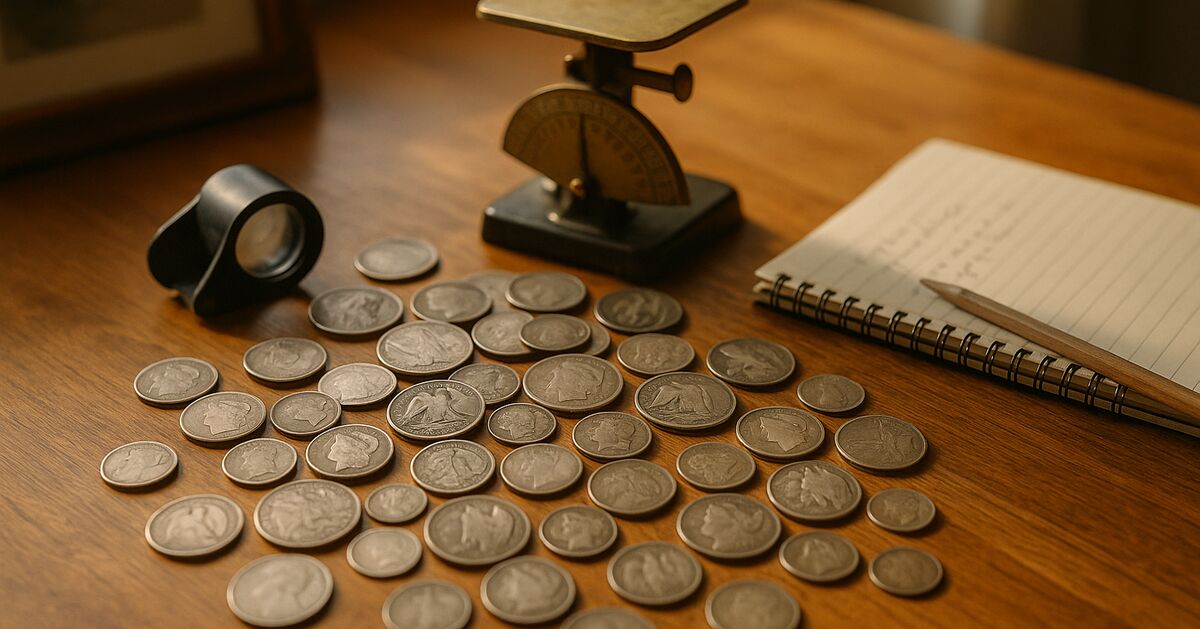
Selling a silver coin the right way starts before you ever contact a buyer - it starts with knowing exactly what you have in your hand.
That sounds obvious, but a staggering number of people walk into a coin shop or click "send" on a mail-in form without that knowledge, and they end up accepting whatever number they are given because they have nothing to compare it against. After eighteen years of buying silver and gold, that is the single pattern I saw most consistently. Not dishonest buyers (though those exist), not bad luck - just sellers who handed over the information advantage to the other side of the table.
This guide is about getting that advantage back.
Step one: figure out whether your coins are actually silver
Not every old coin is silver. In the United States, for example, the composition of most circulating coins changed dramatically in 1965 when the government moved away from silver. Coins that look identical to the untrained eye can be entirely different animals financially.
A few reliable ways to tell:
- The edge test. Genuine silver US coins have a solid edge with no visible copper stripe. Post-1965 clad coins show a reddish-copper band around the rim. Hold the coin at eye level and look at the edge directly.
- The ring test. Drop a silver coin flat onto a hard surface (or balance it on a fingertip and tap it with another coin). Silver rings with a clear, high-pitched tone. Clad coins sound dull and flat. This takes a little practice, but it works well once your ear is tuned.
- The magnet test. Silver is not magnetic. If a coin sticks to a strong magnet, it is not silver. This test eliminates obvious fakes, but it does not confirm silver on its own because many non-silver metals are also non-magnetic.
- The date. For US coins, dates are a strong guide. Dimes, quarters, and half dollars dated 1964 and earlier are 90% silver. Kennedy half dollars from 1965 to 1970 are 40% silver. War nickels (1942 to 1945 with a large mint mark above Monticello) are 35% silver. Any coin outside these windows is almost certainly not silver.
Foreign silver coins add another layer of complexity. British pre-decimal coins, Canadian dimes and quarters pre-1968, and many European pre-war coins are silver, but the exact purity varies by country and era. The standard "Red Book" (Yeoman's "A Guide Book of United States Coins") covers US coinage thoroughly. For foreign coins, a reference like the "Standard Catalog of World Coins" is worth borrowing from a library before you start making calls to buyers.
Step two: sort your coins into meaningful groups
Once you know what is silver, resist the temptation to treat everything as one pile. Buyers think in categories, and mixing them up in your own mind costs you money.
The main categories for silver coins:
Bullion or "junk" silver coins. These are common-date, circulated US 90% silver coins - the kind that trade almost entirely on their metal content. Buyers price them by the bag (a "$1,000 face value" bag is the traditional unit) or by the ounce of actual silver. The collector premium above melt is minimal. If you have a pile of well-worn Mercury dimes or quarters with nothing remarkable about them, this is your category. The post on selling junk silver coins: what they're worth and how to get a fair offer covers this in much more detail.
Semi-numismatic silver coins. These coins have a collector following and sometimes command a price above melt, but they are not rare enough to be treated purely as collector pieces. Common Morgan and Peace dollars fall here for many dates. The coin is worth more than its silver, but it is not so rare that you need a specialist auction house.
Numismatic (collector) silver coins. Rare dates, low mintages, and high-grade examples can be worth multiples of their melt value. These should never be sold purely on metal weight. A 1916-D Mercury dime or an 1895 Morgan dollar is a collector item, full stop.
Proof and commemorative issues. Modern proof sets and commemorative dollars minted since the 1980s are often 90% or 99.9% silver but have a complex market. Original packaging and certificates of authenticity matter.
Sorting into these groups before you pick up the phone saves you from accidentally selling a key-date coin as scrap.
Step three: work out the floor - the melt value
The melt value is the absolute minimum any honest buyer should pay for a bullion-grade coin. It is the weight of actual silver in the coin multiplied by the current spot price of silver.
For standard US 90% silver coins, a rough conversion worth memorising: one dollar of face value contains about 0.715 troy ounces of silver (accounting for the 10% copper alloy and historical wear). So a worn 1963 quarter contains roughly 0.179 troy ounces. Multiply that by today's spot price per troy ounce and you have your floor.
Spot price updates in real time on any number of financial data sites. Do not use a price you saw last week. Silver can move several percent in a single session. Check it on the morning you are planning to contact buyers, and check it again before you accept any offer.
For 40% Kennedy halves, the silver content per dollar of face value drops to about 0.295 troy ounces. For war nickels, each coin contains approximately 0.05626 troy ounces.
These conversions are the same arithmetic that every coin dealer, pawn broker, and mail-in buyer uses. Knowing them means you can spot immediately when an offer is absurdly low.
Step four: establish whether any coin has collector value above melt
This is where many sellers leave money on the table, and it is worth taking time over.
For US coins, the basic research process is:
- Identify the coin: denomination, date, and mint mark (the small letter that indicates where it was struck - P for Philadelphia, D for Denver, S for San Francisco, and so on).
- Look up that specific date and mint mark in a coin price guide. The Red Book gives retail collector values; Dealer buy prices are often well below retail guide values, though the relative rankings between coins are still useful.
- Look at the condition honestly. Coin grading runs from Poor (P-1) through Circulated grades up to Mint State (MS-60 through MS-70). A heavily worn coin in Good (G-4) condition is worth a fraction of the same coin in Fine (F-12) or Extremely Fine (EF-40). If you are not sure, describe what you see: is the design fully visible? Is there any luster on the high points?
- Cross-check on eBay's sold listings (not active listings - sold listings show what people actually paid).
If you believe a coin might be genuinely valuable - say, a potential key date Morgan dollar or a low-mintage commemorative in original packaging - it is worth paying for a professional grade from a third-party grading service like PCGS or NGC before selling. Slabbed and graded coins sell for more and sell faster because the buyer does not have to take your word for the condition. Grading fees vary by service, but they can pay for themselves on coins worth a couple of hundred dollars or more.
Step five: understand what buyers will actually offer
No buyer pays spot price. Every buyer takes a margin to cover their costs, risk, and profit. What varies enormously is how much of a margin they take.
The typical spread between what a buyer pays and spot price (or retail collector value) depends on:
- Their overhead. A coin dealer with a shop, staff, and a lease needs a larger margin than a specialist mail-in buyer with lower fixed costs.
- Their liquidity. A buyer who can turn your coin quickly pays more than one who will sit on it for months.
- The size of your lot. A single coin is less attractive than a coherent collection. Selling everything together often produces a better blended rate than selling piece by piece.
- Market volatility. When silver prices are moving sharply, buyers widen their spread to protect against the price moving against them between purchase and resale. This is not a scam; it is prudent risk management.
The practical implication: always get more than one offer. Three independent offers is a reasonable minimum. They will rarely be identical, and the spread between the lowest and highest can be surprising.
Where to sell: the realistic options
Local coin dealers. A good local coin dealer is often the best buyer for anything with genuine numismatic value. They can assess a coin in person, they understand the collector market, and a transaction can be completed the same day. The downside is that local markets vary. A dealer in a small market may not have the customer base to move certain coins quickly, and their offer will reflect that.
Pawn shops. Pawn shops are convenient and fast, but silver coins are rarely their core business. They tend to pay conservatively because they price in uncertainty. For purely bullion-grade coins, a pawn shop can make sense if you want cash today. For anything with collector value, it is usually worth going elsewhere first.
Coin shows. A regional or national coin show puts multiple dealers in one room. You can walk a coin from table to table in an afternoon and collect half a dozen offers without writing a single email. For semi-numismatic or numismatic material, this is one of the most efficient ways to sell.
Mail-in buyers. Established mail-in precious metal buyers are competitive for bullion-grade material, particularly for larger lots. The key due-diligence steps before sending anything: check their Better Business Bureau record, read independent reviews, confirm they offer insured and trackable shipping, and understand their return policy if you decline the offer. Our frequently asked questions page covers what to look for when vetting any buyer.
Online marketplaces (eBay, auction platforms). For coins with real collector demand, selling directly to collectors via auction often produces the best net price. The trade-off is time, effort, seller fees (eBay charges a percentage-based seller fee on the final sale price, so factor that into your net proceeds.), and the possibility of payment issues. For a rare date coin worth several hundred dollars, the extra work is usually worthwhile. For a bag of junk silver, it is probably not.
Mistakes that consistently cost sellers money
A few patterns that came up again and again over the years of running a buying business:
Cleaning the coins. This one deserves its own post (and has one on this site). Cleaned coins are worth less to collectors, not more. The original patina - even tarnish - is part of the coin's history and its grade. Never polish, dip, or scrub a silver coin before selling it. If a buyer points out that a coin "could use a clean," that is a red flag about their expertise or their intentions.
Treating everything as bullion. It takes twenty minutes to flip through a coin guide before you call a dealer. That twenty minutes can reveal that one coin in a roll of otherwise ordinary quarters is a low-mintage date worth several times melt. Do the research first.
Selling in a panic. Silver prices spike and dip regularly. Selling in a panic on a down day rarely makes sense if you have time on your side. If you are selling because you need cash, that is a legitimate reason. If you are selling because you are worried about where the price is going, take a breath first.
Accepting the first offer. Even when the first offer is fair, you have no way of knowing that without comparison. Get more offers.
Ignoring fees and shipping costs. When comparing offers from mail-in buyers, factor in who pays for insured shipping. Some buyers provide a prepaid insured label. Others expect you to ship at your own cost, which can meaningfully affect the net amount you receive, particularly for heavier lots.
Pulling it all together
Selling silver coins well is not complicated, but it does require doing the work in the right order: identify first, value second, compare buyers third, and accept the best offer fourth. Skip the first two steps and you are negotiating blind.
For coins that are clearly bullion-grade, the process is relatively quick. Get a current spot price, calculate the melt value using the conversion figures above, contact two or three buyers (local dealer, a reputable mail-in buyer, and ideally a coin show if one is convenient), and compare net offers.
For coins that might have collector value, invest more time in the research and consider professional grading before you sell.
If you are working through a larger inherited collection that includes not just coins but other silver pieces, it may also be worth reading about selling antique silver and selling sterling silver, since the valuation logic differs for flatware, hollowware, and jewelry versus coins.
And if you are not yet sure whether your coins are silver at all, the broader home page has a range of guides that can help you work through other types of silver you might have alongside the coins.
The information advantage is straightforward to build. The sellers who do best are simply the ones who build it before they start the conversation.
Sources & further reading
- Silver and other precious metals market data (Kitco Metals Inc.)
- BBB business reviews and scam alerts for precious metals buyers (Better Business Bureau)
Revision history (1)
- Pre-publish editorial QA: clean; claim audit: 12 claims, 3 rewritten
Claim-by-claim audit (12 checked)
- “In the United States, for example, the composition of most circulating coins changed dramatically in 1965 when the government moved away from silver.” (reasoning shown in the article)
- “Dimes, quarters, and half dollars dated 1964 and earlier are 90% silver.” (reasoning shown in the article)
- “Kennedy half dollars from 1965 to 1970 are 40% silver.” (reasoning shown in the article)
- “War nickels (1942 to 1945 with a large mint mark above Monticello) are 35% silver.” (reasoning shown in the article)
- “For standard US 90% silver coins, a rough conversion worth memorising: one dollar of face value contains about 0.715 troy ounces of silver (accounting for the 10% copper alloy and …” (reasoning shown in the article)
- “For 40% Kennedy halves, the silver content per dollar of face value drops to about 0.295 troy ounces.” (reasoning shown in the article)
- “For war nickels, each coin contains approximately 0.05626 troy ounces.” (reasoning shown in the article)
- “Dealer buy prices are often well below retail guide values, though the relative rankings between coins are still useful.” (rewritten to what the article can stand behind)
- “Grading fees vary by service, but they can pay for themselves on coins worth a couple of hundred dollars or more.” (rewritten to what the article can stand behind)
- “For a coin worth several hundred dollars, the extra work is usually worthwhile.” (reasoning shown in the article)
- “eBay charges a percentage-based seller fee on the final sale price, so factor that into your net proceeds.” (rewritten to what the article can stand behind)
- “Cleaned coins are worth less to collectors, not more.” (reasoning shown in the article)