
Why gold holds value: what every seller should understand
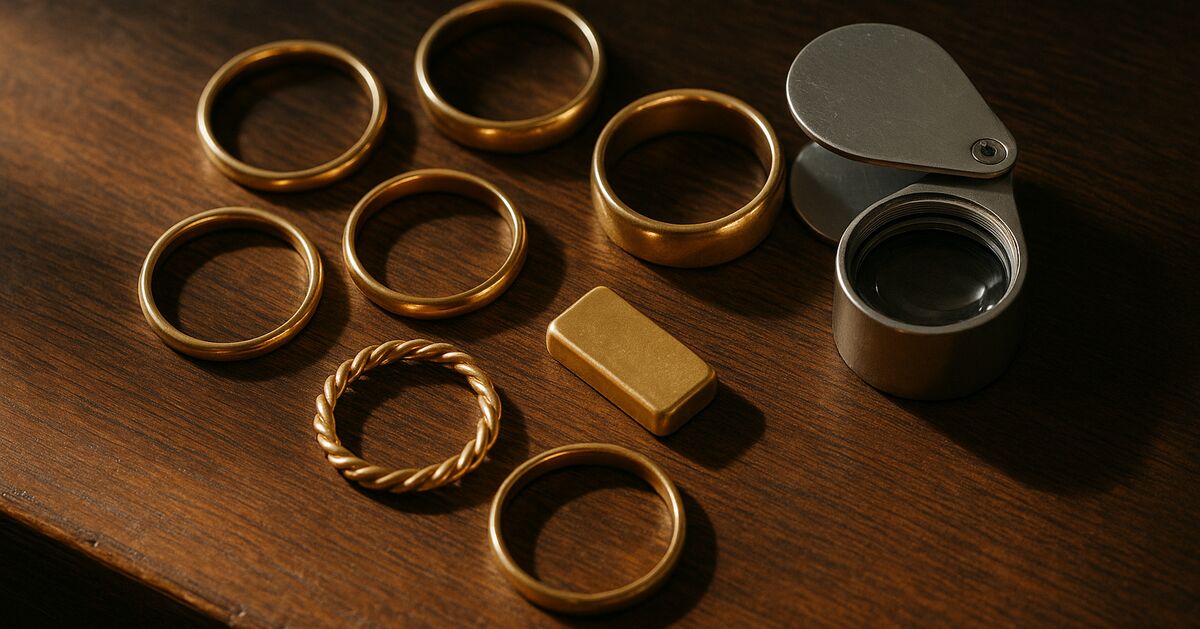
Gold sitting in a drawer is already doing something many people do not realize: it is quietly holding a store of value that paper assets cannot always match. If you are about to sell some gold, understanding why that is true will make you a sharper, calmer seller.
This is not an article trying to talk you out of selling. Selling is often the right call. But the sellers who get the fairest prices are often the ones who understand what they have and why buyers want it. So let's walk through the real reasons gold holds its value, and along the way, talk about what each reason means for you, practically, on the day you decide to part with yours.
Gold is nobody's liability
Every banknote, bond, or bank deposit is ultimately a promise from an institution. If that institution stumbles, the promise weakens. Gold carries no such counterparty risk. When you hold a gold coin or a gold ring, you hold something that does not depend on any bank, government, or corporation staying solvent.
This quality is sometimes called "intrinsic value," though the more precise description is that gold is a physical asset with no offsetting liability on someone else's balance sheet. Buyers and central banks alike understand this distinction, which is part of why demand for gold tends to rise during periods of financial stress. For a seller, this matters because it means you are not competing with a deteriorating asset. The gold you sell today is essentially the same gold it was fifty years ago.
The inflation hedge is real, but nuanced
You have probably heard that gold is a hedge against inflation. There is genuine historical truth to this, though the relationship is not a simple one-to-one lock-step. Over very long time horizons, gold has broadly kept pace with the purchasing power of currencies, even as individual currencies have lost value through inflation.
The practical point for sellers is this: if you bought gold years ago and you are selling now, a meaningful portion of any price gain you see may simply reflect the fact that the currency used to measure gold's price has lost some of its own purchasing power. That is not a loss on your gold; it is actually the hedge working as advertised. It is worth keeping in mind when you evaluate whether the price you are being offered is "good." Compare the offer to the spot price on the day you sell, not to what you paid years ago in older dollars.
For more background on the broader economics of precious metals before you finalize any decision, the home page at How To Sell Silver is a useful starting point.
Supply is genuinely constrained
Gold is not manufactured; it is mined, and mining is slow, expensive, and geologically limited. The World Gold Council and various geological surveys have long noted that annual mine production adds only a modest percentage to the total above-ground stock each year. Unlike a commodity that can be ramped up in a factory, there is no lever a producer can pull to flood the market with new gold overnight.
This supply constraint is one reason the gold price does not collapse even when sentiment turns negative. There is always a floor of sorts, because the cost of getting new gold out of the ground sets a rough baseline. For sellers, this is reassuring: you are not trying to offload something whose supply can be conjured from thin air by a competitor.
Demand comes from several directions at once
A stock is valued by one stream of expected future earnings. Gold is valued by demand from at least four distinct groups simultaneously: jewelry buyers, industrial users (gold is used in electronics and dentistry), central banks building reserves, and investors seeking a store of value or a portfolio hedge. When one source of demand softens, the others often compensate.
Central bank demand deserves a special mention because it is a factor many private sellers overlook. When central banks are net buyers of gold, as they have been in many recent years, they are absorbing a meaningful share of annual supply. That sustained institutional demand underpins the price floor in a way that purely speculative demand does not.
For sellers, the multi-source demand picture means you are unlikely to find a market with zero buyers. Even in a down period, someone wants what you have. The question is always whether you are finding the right buyer and getting a competitive offer. Our guide to common complaints when selling silver and gold covers what to watch for when buyers are not dealing straight with you.
Liquidity is one of gold's genuine strengths
Gold in recognizable form, whether a hallmarked piece of jewelry, a sovereign coin, or a small bar, is among the most liquid physical assets a private individual can own. You can convert it to cash in nearly every country in the world, through multiple buyer types, often within a single business day.
For sellers, this is simply good news. You are not trying to offload a specialized collectible that only a narrow audience will want. You are selling something that refiners, dealers, pawnbrokers, coin shops, and mail-in buyers all want. That competition among buyers is your friend, because it gives you genuine options and a reason to get more than one quote.
The catch is that liquidity does not automatically mean a fair price. A buyer who will give you cash in ten minutes is not necessarily giving you the best rate. Speed and convenience come at a cost, and it is your job to decide how much of that cost is acceptable. If you are not sure how different buyer types compare, our practical guide to finding and selling silver covers the same comparison framework for gold, since the buyer landscape is essentially the same.
Coins carry an extra layer of value that pure scrap does not
One thing I saw again and again over eighteen years of buying precious metals: people selling gold coins who had no idea that the coin itself might be worth more than its metal content. The melt value is the floor, not the ceiling. Collector demand, historical significance, mint year, and condition can all push a coin's market value well above what the gold alone would fetch.
This matters enormously for sellers. If you take a collectible gold coin to a scrap buyer and accept a melt-value offer, you may be leaving real money on the table. The right buyer for a collectible coin is a numismatic dealer or an auction house that understands the collector market, not a refinery that will simply melt it down.
If you are unsure whether your coins have collector value beyond melt, the silver coins guide on this site explains the distinction clearly, and the same principles apply directly to gold coins.
Gold's historical track record earns trust, but do not oversell it to yourself
Gold has been used as money and a store of value across thousands of years and dozens of civilizations. That record is real, and it is part of why gold commands a premium over commodities with shorter histories or narrower uses. There is a psychological dimension here: people trust gold partly because generations before them trusted gold. That self-reinforcing trust is itself a form of value.
But a seller should be clear-eyed about what this means in practical terms. The long-run track record does not guarantee that gold will be worth more next week than it is today. Short-term gold prices are volatile, driven by currency movements, interest rate expectations, geopolitical events, and market sentiment. The historical value argument is compelling over decades; it tells you very little about whether Tuesday or Thursday is a better day to sell.
If you want to understand the forces that actually move the price on any given day, our piece on six gold investing truths every seller needs to know first goes into that in useful detail.
What "good investment" actually means for someone who is now selling
Here is the honest reframe most investment articles skip entirely: the reasons gold is a good investment are also the reasons it is a good asset to sell. A liquid asset with genuine global demand and no single point of failure is exactly the kind of thing buyers will always show up for. You are in a strong position.
But strong position does not mean you should rush. The mistakes that cost sellers money are almost always about the process, not the metal itself:
- Accepting the first offer without getting a second or third quote
- Not knowing the spot price on the day of the sale, so you cannot calculate what percentage of melt value you are being offered
- Confusing karat stamps and selling 10k gold as if it were 14k, or vice versa
- Missing collector value in coins or antique pieces that deserve a specialist buyer
- Letting urgency override patience because a buyer creates a sense of pressure
Understanding why gold is valuable in the first place dissolves a lot of that anxiety. You do not have to accept a lowball offer from the first buyer who shows up, because you know there will be another buyer. The metal is not going anywhere. The demand is structural, not accidental.
The weight question is not trivial
One practical detail that trips up sellers who are new to this: gold is weighed and priced in troy ounces, not the standard avoirdupois ounces used for everyday items. A troy ounce is 31.1 grams; a standard ounce is 28.35 grams. Buyers will always weigh in troy, and if you are calculating what your gold is worth before walking in the door, you need to use the same unit.
Getting this wrong by even a small margin can make an honest offer look like a rip-off, or make a lowball offer look fair. Our guide to weight units for silver and gold sellers walks through the arithmetic in plain language.
Purity is the other half of the value equation
The spot price of gold refers to pure, 24-karat gold. Most jewelry is not 24 karat. A 14k piece is roughly 58.3% gold; an 18k piece is 75%; a 9k piece (common in British and Australian jewelry) is 37.5%. The buyer will always assay or at minimum test your piece to determine purity before making an offer.
Knowing the karat of your gold before you walk into any negotiation puts you on equal footing with the buyer. Stamps are not always reliable, which is why some buyers test regardless. If you want to understand what testing actually involves and what you can do at home before you go, take a look at how to test silver and gold at home.
Timing a sale: the question everyone asks and nobody can answer perfectly
Because gold prices move daily, sellers naturally want to know if now is a good time. The honest answer is that nobody can predict short-term price movements reliably, including professional traders who do this full time. What you can do is:
- Check the live spot price on the day you plan to sell
- Get multiple quotes and calculate what percentage of spot each buyer is offering
- Accept that waiting for a higher price also carries the risk of a lower one
- Weigh the certain value of cash today against the uncertain value of gold tomorrow
If you are selling because you need the funds, have inherited something you do not want, or are simply rationalizing a financial decision that already makes sense, the current spot price is the benchmark, and getting a competitive percentage of it is the goal.
A note on recycling and the bigger picture
When you sell gold, you are participating in a genuine recycling loop. The metal gets refined, re-alloyed, and re-enters the economy, whether as new jewelry, industrial components, or investment bars. No gold is truly wasted. If that framing helps you feel better about letting go of a sentimental piece, it is not a stretch. For a fuller look at how that cycle works, our guide to recycling precious metals covers the refining side in plain terms.
The bottom line
Gold holds its value because of a combination of factors that genuinely reinforce one another: constrained supply, multi-source demand, no counterparty risk, a long track record of trust, and real-world utility. Those are not marketing talking points; they are the reasons serious investors, central banks, and ordinary people alike keep buying the stuff.
For you as a seller, the takeaway is straightforward. You have something that people want. The market for it is deep and global. Your job is to find a buyer who will pay a fair percentage of its current value, and to walk in knowing your metal's weight, purity, and approximate worth before the conversation starts. That preparation, more than any timing strategy, is what separates sellers who feel good about the outcome from sellers who do not.
Sources & further reading
- Gold demand trends and central bank buying data (World Gold Council)
- Gold supply and mine production statistics (U.S. Geological Survey)
- Troy weight and precious metals measurement standards (National Institute of Standards and Technology (NIST))
Revision history (1)
- Pre-publish editorial QA: 2 flagged, 2 softened; claim audit: 5 claims, 0 rewritten
Claim-by-claim audit (5 checked)
- “Buyers and central banks alike understand this distinction, which is part of why demand for gold tends to rise during periods of financial stress.” (reasoning shown in the article)
- “The World Gold Council and various geological surveys have long noted that annual mine production adds only a modest percentage to the total above-ground stock each year.” (cited → usgs.gov)
- “Central bank demand deserves a special mention because it is a factor many private sellers overlook. When central banks are net buyers of gold, as they have been in many recent yea…” (cited → gold.org)
- “A troy ounce is 31.1 grams; a standard ounce is 28.35 grams.” (cited → nist.gov)
- “A 14k piece is roughly 58.3% gold; an 18k piece is 75%; a 9k piece (common in British and Australian jewelry) is 37.5%.” (reasoning shown in the article)