
Finding and selling silver: a practical field guide for new
Silver worth real money turns up in the most ordinary places, and many people have no idea it is sitting there until the moment they need to sell it. Whether you have just cleared a relative's house, rummaged through a junk drawer, or spotted a hall table covered in old flatware at a church sale, the same practical rules apply. This guide covers where to look, how to identify what you have, how to size up its value, and how to find a buyer who will treat you fairly.
Where silver actually hides
The single biggest mistake new sellers make is assuming silver only comes in obvious forms. It does not. Over the past century, silver was used in a surprisingly wide range of everyday objects, and a lot of those objects are now sitting forgotten in attics, barns, storage units, and the backs of kitchen cupboards.
Jewelry is the category that shows up most often in an inherited collection. Rings, necklaces, bracelets, earrings, brooches, and watch chains were routinely made in sterling silver throughout the twentieth century. Quality pieces were also made in higher purities for certain markets. The challenge with jewelry is that it spans an enormous price range, from a handful of dollars for a thin bangle to several hundred for a substantial, well-made piece with additional gemstones. Never guess at value before you have at least checked the hallmarks.
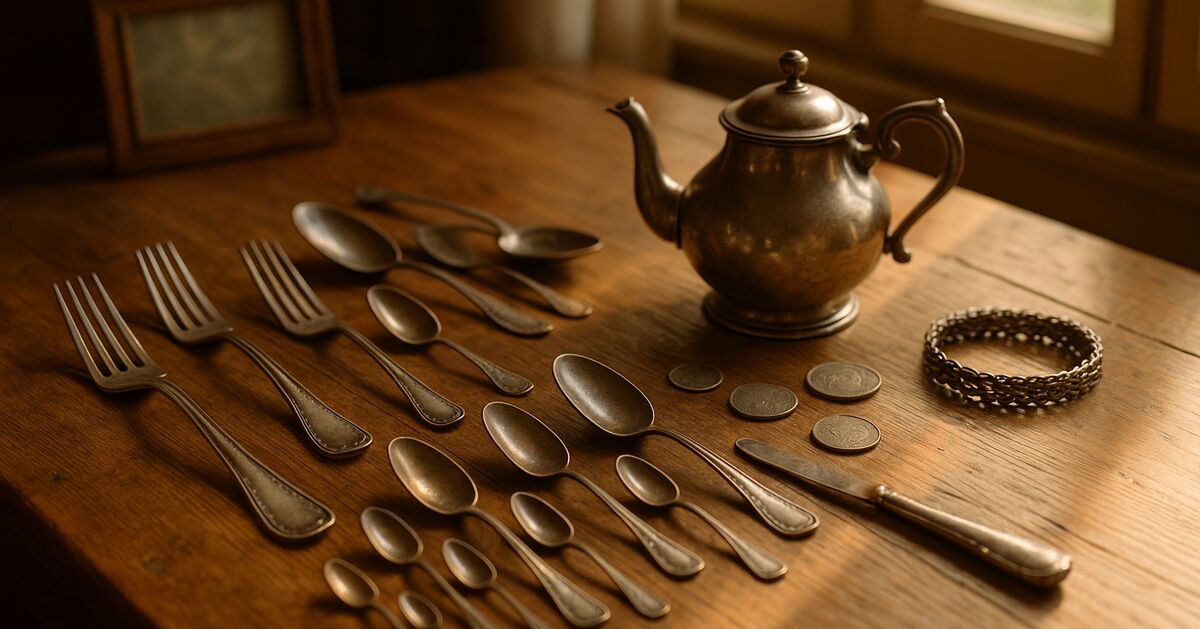
Flatware and serving pieces are the next most common category. Sets of silver spoons, forks, knives, serving spoons, ladles, sugar tongs, butter knives, and cake slices were considered essential household possessions for much of the nineteenth and twentieth centuries. Complete sets in their original canteen boxes can be surprisingly heavy, which means meaningful melt value even before you consider any collector or antique premium. Individual loose pieces are also worth checking.
Hollowware is the catch-all term for silver bowls, jugs, teapots, coffee pots, creamers, sugar bowls, toast racks, and similar items. These were popular gifts for weddings and anniversaries and were often stored carefully, which means they turn up in good condition. A full tea service in sterling can represent a substantial amount of silver by weight.
Coins are easy to overlook in a general household clear-out because they tend to get mixed in with common change. Pre-1965 US dimes, quarters, half-dollars, and dollars are generally understood to contain about 90% silver. British coins minted before 1947 are commonly around 50% silver, and those minted before 1920 are typically around 92.5% silver. If you have a jar of old coins or an inherited collection, it is worth checking dates carefully before assuming the contents are worth only face value.
Less obvious places include older barns and outbuildings attached to rural properties, where tools, flasks, frames, and miscellaneous household goods were sometimes stored for decades. Antique shops, flea markets, estate sales, and charity shops can also yield silver pieces that have been mispriced because the seller did not recognize what they had. If you enjoy hunting for pieces to resell, those are productive places to spend a Saturday morning.
How to identify real silver
Before you can price anything, you need to know whether it is actually silver. The most reliable method is reading the hallmarks, and for a thorough explanation of what those symbols mean on British pieces, the post on sterling silver hallmarks covers the four-mark system in plain English. Here is the short version for everyday use.
On sterling silver, look for the number 925 or the word Sterling. These are the two marks used most commonly on American pieces. On British pieces, look for the lion passant (a walking lion), which has long been used to indicate sterling, often accompanied by an assay office mark and a date letter.
On older European pieces, you may see marks like 800, 830, or 84 (a Russian standard), each indicating a different silver purity. These are still genuine silver, just at a lower purity than sterling.
If a piece has no marks at all, or carries marks like EPNS (electroplated nickel silver), A1, or silver-plated, it is not solid silver. It has a base-metal core with a thin silver coating. Silver-plated pieces do have some resale value, but they are not worth the same as solid sterling, and a buyer who pays sterling prices for plated goods is either making an error or doing you a favor. Do not assume a plating is worth nothing, but do not price it as sterling either.
If you want to go beyond hallmarks and do some hands-on testing before visiting a buyer, the guide on testing silver and gold at home walks through the methods that genuinely work and the ones that are mostly myths.
Understanding what drives the price
Silver has two distinct components of value, and confusing them leads to sellers either overpricing or, more often, underpricing what they have.
Melt value is the baseline. It is calculated from the weight of the piece, its silver purity, and the live spot price of silver per troy ounce. A buyer will never pay more than melt value for a piece going to a refiner, and in practice they pay somewhat less, because they need a margin to cover their operating costs and the refining process. The home page has a live price chart that lets you follow the spot price, which fluctuates daily with commodity markets.
Collector or antique value is a separate question entirely. A Georgian silver sugar caster from a notable maker can be worth many times its melt value to the right buyer, because the craftsmanship, age, maker's mark, and historical interest matter to collectors and auction houses. The same logic applies to rare coins, which is why it is worth having any old coins identified by someone who knows the series before you sell them by weight. For context on how coin premiums work in practice, the post on 90% silver dimes goes into useful detail.
The condition of a piece affects both types of value. For scrap purposes, condition is largely irrelevant because the silver content is what matters. For antique or collector value, a piece that has been cleaned incorrectly, repaired badly, or damaged can lose most of its premium. If in doubt about whether a piece has collector value, get an opinion before you clean it or sell it by weight.
Weight units are another source of confusion. Silver is priced and weighed in troy ounces, not the avoirdupois ounces used for everyday goods. A troy ounce is about 31.1 grams, compared to the 28.35 grams of a standard ounce. The post on weight units for silver sellers explains the difference and includes a simple conversion guide so you can check a buyer's calculations yourself.
Finding a buyer you can trust
This is the part of the process where things can go wrong, and it is worth taking it seriously. There are honest, professional buyers across every channel, and there are also buyers who rely on sellers not knowing what they have. The gap between a fair offer and an exploitative one can be hundreds of dollars on a moderately sized collection.
Do your research before you commit. Check whether a buyer is accredited with the Better Business Bureau or has a verifiable track record of reviews. Ask people in your local community who they have used. Online forums and social media groups for coin collectors or estate sale enthusiasts are good places to find candid recommendations. A professional buyer will welcome your questions and give you clear answers about how they calculate offers.
Get more than one quote. This is the most effective single protection you have. If you take your silver to three buyers and get three offers, you will immediately understand whether you are being offered a fair price or a low one. A buyer who offers significantly less than two others, without a clear explanation, is a buyer worth walking away from.
Understand the offer before you accept it. A reputable buyer will tell you the weight, the purity they are assigning to each piece, the spot price they are using, and the percentage of spot they are paying. If a buyer simply names a number without explaining the calculation, ask them to break it down. You are entitled to that information. For a fuller list of the right questions to ask, the post on common complaints when selling silver covers the warning signs and how to protect yourself.
For online or mail-in buyers, read customer reviews carefully before shipping anything. Find out exactly what happens if your package is lost in transit, and confirm whether the buyer provides tracked, insured shipping labels or whether that cost falls on you. Reputable mail-in buyers will provide a prepaid insured label and send you a detailed assessment with the weight and test results before asking you to accept or decline. Never ship silver without insurance. If a buyer does not offer any insurance option, that is a serious red flag.
Coins deserve special attention
It is worth repeating, because it comes up again and again: coins should never be sold by weight without first checking whether any of them carry a collector premium. A common-date pre-1965 quarter is worth its silver content and not much more. A key-date coin in the same series might be worth ten times that or considerably more to a collector, entirely independent of the silver spot price.
If you have inherited a coin collection, resist the urge to sort it quickly and sell the lot in bulk. Take the time to look up the dates and mint marks on anything old. Coin dealers and professional numismatists can give you a free assessment for coins that might have collector value, and a good one will tell you honestly when a coin is common and only worth melt. The post on silver coins as a hobby and investment gives a useful overview of how to think about coins that sit at the intersection of collecting and selling.
A practical checklist before you sell
Working through a collection in a structured way saves time and helps you avoid errors. Here is the sequence that tends to produce the best results.
- Separate by category. Keep jewelry, flatware, coins, and hollowware in separate piles. Each category attracts different buyers and has different valuation logic.
- Check every piece for hallmarks. Anything marked 925 or Sterling is solid silver. Anything marked EPNS, silver-plate, or A1 is plated. Set unmarked pieces aside for further testing.
- Weigh sterling pieces together by category. Use a digital kitchen scale for a rough estimate and note the total weight in grams. Divide by 31.1 to convert to troy ounces.
- Check coin dates before anything else. US coins pre-1965 and British coins pre-1947 are worth checking for both silver content and collector value.
- Look up today's spot price. The spot price changes daily. Check it on the day you plan to sell, not the day before.
- Get at least two quotes. Preferably three. Note the calculation each buyer uses, not just the final number.
- Ask about fees. For online sales, ask about shipping costs, insurance, and any handling or processing fees before you commit.
If you have questions about the process that this guide does not answer, the frequently asked questions page and the post on selling precious metal: your toughest questions answered cover a broad range of scenarios from sellers in all kinds of situations.
One last thing: patience pays
A lot of people sell inherited silver in a hurry because the whole process feels unfamiliar and a little stressful. That is completely understandable. But rushing tends to cost money. Taking an extra week to research your pieces, check a few hallmarks, get two or three quotes, and read some buyer reviews will often result in a better outcome than taking the first offer you receive.
The silver has likely been sitting somewhere for years. Another week is not going to change its value. Your time spent understanding what you have very well might.
Sources & further reading
- Silver and silver alloys: commodity overview (U.S. Geological Survey)
- BBB accreditation standards for businesses (Better Business Bureau)
Revision history (1)
- Pre-publish editorial QA: 2 flagged, 2 softened; claim audit: 5 claims, 3 rewritten
Claim-by-claim audit (5 checked)
- “Pre-1965 US dimes, quarters, half-dollars, and dollars are generally understood to contain about 90% silver.” (rewritten to what the article can stand behind)
- “British coins minted before 1947 are commonly around 50% silver, and those minted before 1920 are typically around 92.5% silver.” (rewritten to what the article can stand behind)
- “On British pieces, look for the lion passant (a walking lion), which has long been used to indicate sterling, often accompanied by an assay office mark and a date letter.” (rewritten to what the article can stand behind)
- “A troy ounce is about 31.1 grams, compared to the 28.35 grams of a standard ounce.” (reasoning shown in the article)
- “A buyer will never pay more than melt value for a piece going to a refiner, and in practice they pay somewhat less, because they need a margin to cover their operating costs and th…” (reasoning shown in the article)