
Testing silver and gold at home: what actually works
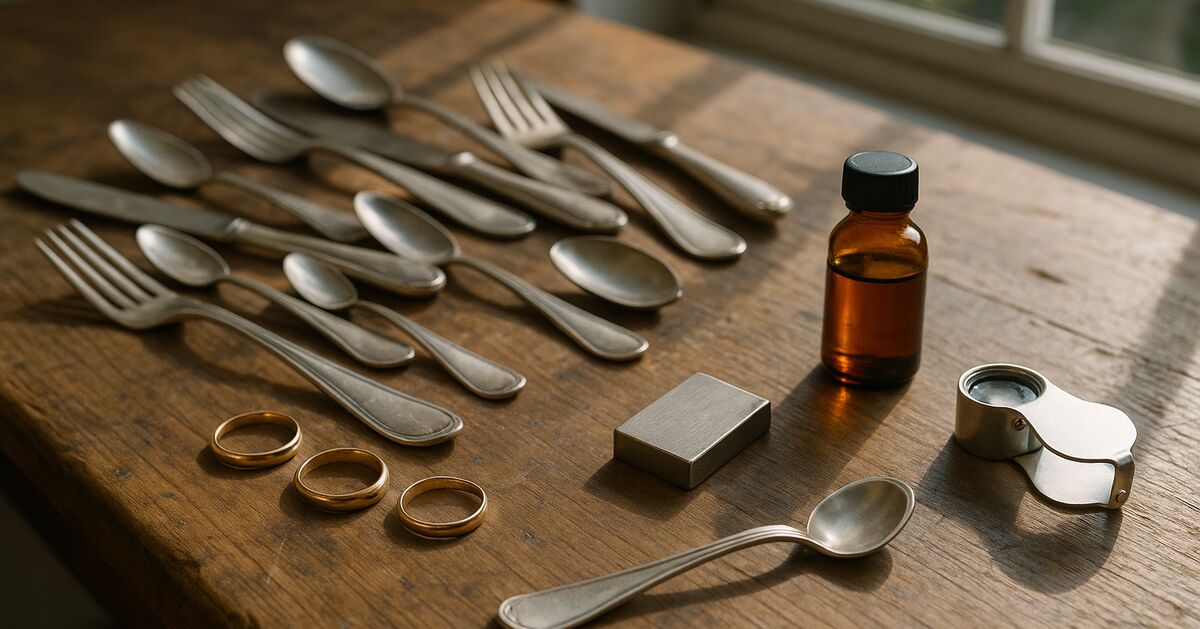
Scrap silver or gold is only worth what it actually is, and finding that out before you accept an offer is one of the smartest moves a seller can make. If you walk in knowing your metal is genuine and knowing its approximate purity, you negotiate from a position of knowledge rather than hope.
This guide covers the testing methods a private seller can realistically use at home or at a buyer's counter, what each one tells you, what it cannot tell you, and how to put the results together into a confident picture before you sell.
Why testing matters before you sell
Buyers test everything they receive. That is not a sign of bad faith - it is just how the trade works. The problem for sellers is that a buyer who tests and finds a result you were not expecting has all the power in that moment. You are standing at a counter, the offer has changed, and you feel pressure to accept.
Running your own checks in advance does two things. First, it tells you roughly what you have, so there are no surprises. Second, if a buyer's result differs wildly from yours, that is a useful signal worth investigating before you walk away with less than you expected.
For a broader look at how the selling process fits together, the guide to selling inherited or scrap precious metal is worth reading alongside this one.
Start with the hallmarks
Before any chemical or physical test, look at the marks. British sterling silver carries a set of four stamped marks - the lion passant for sterling, the assay office mark, the date letter, and the maker's mark. A fineness number such as 925, 800, or 830 will appear on continental European silver. Gold is usually marked by karat (9K, 14K, 18K, 22K, 24K) or by fineness (375, 585, 750, 916, 999).
Hallmarks are not infallible. Plate can be stamped with misleading numbers, stamps can be faked on very high-value pieces, and old pieces may have worn marks that are hard to read. But for the overwhelming run of everyday inherited silver and gold, the hallmark is accurate and is exactly where you should start.
A loupe - a small magnifying glass available cheaply from any jeweler's supplier - makes worn marks much easier to read. Hold the piece under a strong directional light and look at the flattest part of the surface near a seam or the back of a clasp.
The magnet test
This is the simplest and cheapest test available, and it is worth doing first.
Silver and gold are not magnetic. Neither is platinum or copper. Steel, iron, nickel-iron alloys and some pot metals are magnetic. A strong neodymium magnet (the small powerful ones sold for hobby use) will snap firmly to a steel or iron item.
What this tells you: if your piece is strongly attracted to a magnet, it is either a base-metal fake or has significant steel or iron content - a few antique pieces have iron cores. It is not silver or gold.
What it does not tell you: a non-magnetic result does not confirm silver or gold. Lead, tin, zinc, aluminum and brass are all non-magnetic, and none of them are precious metals. So the magnet test is a filter, not a confirmation.
The acid test for silver
The silver acid test uses nitric acid, which reacts with base metals but does not react with fine or sterling silver in the same way. Test kits are sold by jewelers' suppliers and some coin dealers, and they are not expensive.
How to do it safely. Nitric acid is corrosive - it will burn skin and damage surfaces. Work outdoors or in a very well ventilated space. Wear nitrile gloves and safety glasses. Keep water nearby. Do not let the acid touch fabric, wood, or painted surfaces.
The procedure. The standard method is to make a small scratch on an inconspicuous part of the piece - the inside of a ring shank, or the back of a pendant - to expose fresh metal beneath any surface plating. Place the scratch face-up and add one small drop of acid.
- Sterling or fine silver produces a creamy or cloudy white reaction.
- Silver plate over copper or brass produces a green reaction, because the acid quickly eats through the thin silver layer and reaches the base metal beneath.
- Base metal with no silver content reacts strongly green or bubbles aggressively.
- No reaction on a dull gray metal may indicate lead, which is dangerous to handle in quantity.
The acid test is genuinely useful for distinguishing sterling from plate, and that distinction matters a great deal when you are sorting an inherited canteen or a box of mixed flatware. Plate has little or no scrap metal value, while sterling is worth real money per gram.
Nitric acid should be stored in a sealed, acid-resistant container away from heat and organic materials, and spills should be neutralised with baking soda and rinsed with water.
The acid test for gold
Gold acid testing works on a similar principle. A set of test acids is formulated for different karats - typically 9K, 10K, 14K, 18K, and 22K. The acids are progressively stronger, and the idea is to find the lowest karat acid that does not dissolve the gold streaked from your piece.
Touchstone method. The most common approach in a trade setting is to rub the gold item firmly across a black basalt or slate touchstone, leaving a visible streak of metal. A drop of the appropriate test acid is then placed on the streak and observed.
- If the streak survives the acid for that karat, the gold is at least that purity.
- If the streak dissolves or discolours, the gold is lower than that karat.
You work down through the acids until you find the one that just dissolves the streak, which identifies the karat range.
Acid kit method. Some kits include a test plate with a series of marked reference samples. You place a drop of acid on both your gold streak and the reference, and compare the speed and color of the reaction.
A note on aqua regia: the only acid mixture that dissolves fine gold is aqua regia, a combination of concentrated nitric and hydrochloric acid. This is not a household test and is not part of any standard consumer kit. Mention of it here is for completeness - it is a refinery and laboratory tool.
Limitations of gold acid testing. Gold-filled and gold-plated items can fool an acid test if the plating is thick enough, because the acid reacts only with the surface layer. A buyer worth dealing with will always cross-section or XRF-test anything that looks suspicious. If you are selling a piece that is genuinely heavy gold, a professional XRF scan at a coin dealer or refiner will give you far more confidence than a scratch test alone.
Electronic gold testers
Battery-powered electronic testers work by measuring electrical conductivity. Gold at different karats has a slightly different conductivity profile, and the tester uses that to estimate karat.
These devices are widely available and are used by some pawnbrokers and smaller coin dealers. They are quick, leave no mark, and require no acid.
The trade-off is accuracy. Electronic testers are less precise than acid tests or XRF on plated items, and some alloys fool them. They work best as a fast triage tool in a busy shop rather than as a definitive assay. For a seller, if a buyer shows you a result from a handheld electronic tester, it is worth asking whether they also have XRF or send items for assay before final settlement.
XRF: the professional standard
X-ray fluorescence (XRF) scanning is the method that most serious refiners and larger coin dealers now use. A handheld XRF gun bounces X-rays off the surface of the metal and reads the spectrum of fluorescence returned, which is unique to each element. The result shows a percentage breakdown of every metal present, accurate to fractions of a percent.
XRF is non-destructive, leaves no mark, and is typically fast to perform. And it reads through most surface coatings, which means a gold-plated brass item will come back showing predominantly zinc and copper, not gold.
As a seller, you generally cannot perform XRF yourself, but many coin dealers and refiners will scan your items for free if you are considering selling to them. It is worth asking. If a buyer is quoting a price on a significant piece - a heavy gold chain, a collection of silver bars - getting an XRF result first removes any ambiguity about what you are selling.
Other informal tests and what they are worth
Ice test. Pure silver has exceptionally high thermal conductivity - higher than any other metal. If you place an ice cube on a piece of flat sterling silver, it melts noticeably faster than it would on a piece of aluminum or stainless steel of similar mass. This is a real physical property, but the test is qualitative, not quantitative, and it tells you nothing about karat or purity beyond "probably silver."
Bleach test. A drop of household bleach on sterling silver causes rapid, dark tarnishing. This happens because silver reacts with chlorine compounds. Base metals may react differently or not at all. This test is destructive to the surface, stains badly, and provides far less useful information than an acid test. It is mentioned in online discussions but is not a method that professional buyers use.
Specific gravity test. This involves weighing a piece in air and then weighing it suspended in water, and using the ratio to calculate density. Fine silver has a specific gravity of about 10.49 and gold of about 19.3, which are distinctive enough to rule out most fakes. The method requires a precise scale with a suspension hook and a container of water, and it becomes less reliable on hollow items or pieces with mixed materials. It is a legitimate physics-based test used by serious collectors for coins and bars.
For coins specifically, the guide to 90% silver dimes covers how melt value is calculated once you know your coins are genuine.
Putting it all together before you get quotes
A practical home sequence for a box of inherited silver and gold might look like this:
- Sort by hallmark first. Set aside anything clearly stamped 925, 800, or a recognized karat for gold.
- Run the magnet over everything. Remove anything that sticks.
- Acid test suspect or unmarked pieces. Pay particular attention to flatware that might be plate, and to gold that has no clear stamp.
- Weigh everything by category. Sterling in one group, 9K gold in another, plate in a third. A decent kitchen scale accurate to one gram is sufficient for an initial estimate.
Once you have a rough picture, you can look up the current spot price and calculate approximate melt value. That gives you a realistic floor before you approach any buyer. If you are unsure about pressure tactics used by some buyers, knowing your approximate figures in advance is the best protection.
For context on how different buyer types price metal and what margins to expect, comparing buyer types for scrap gold lays out the landscape clearly.
What buyers are testing when you hand things over
Understanding what a buyer does when they test your metal helps you interpret their behavior at the counter.
Most coin dealers and bullion shops start with a visual check of the hallmark, then run an XRF on anything above a certain value. Smaller pawnbrokers may rely on touchstone acid testing and an electronic tester. Refiners generally rely on XRF and then fire assay (actually melting a small sample and cupelling it) for large batches.
The common complaints when selling silver and gold covers situations where sellers felt the testing process was used unfairly - for example, a buyer claiming lower purity than the hallmark suggests without showing the test result. You are entitled to ask to see the result and to ask what method was used.
A word on having items professionally assayed
For a large estate or a single very valuable piece, a professional assay from an independent laboratory is money well spent. The cost is modest relative to the value at stake, and a written certificate of fineness is useful both when you sell and if you decide to insure before selling.
The frequently asked questions page covers questions about assay costs and what to expect from the process.
Final thoughts
Testing before you sell is not about catching buyers out - it is about arriving prepared. The seller who knows what they have, knows approximately what it is worth, and understands the difference between sterling and plate is the seller who gets a fair price and does not leave money on the table.
None of the home tests described here are perfect, and none replace a professional XRF or assay for high-value items. But used together, they give you a reliable enough picture to compare quotes with confidence. That confidence is worth more than any single test result.
For more guidance on the selling process from start to finish, the home page and the blog index are good places to keep exploring.
Sources & further reading
- Properties of silver and thermal conductivity data (National Institute of Standards and Technology (NIST))
- Gold and silver physical properties reference data (Royal Society of Chemistry)
- Assay Office hallmarking standards for precious metals in the UK (London Assay Office)
Revision history (1)
- Pre-publish editorial QA: clean; claim audit: 6 claims, 2 rewritten
Claim-by-claim audit (6 checked)
- “Nitric acid should be stored in a sealed, acid-resistant container away from heat and organic materials, and spills should be neutralised with baking soda and rinsed with water.” (rewritten to what the article can stand behind)
- “Fine silver has a specific gravity of about 10.49 and gold of about 19.3, which are distinctive enough to rule out most fakes.” (cited → rsc.org)
- “Pure silver has exceptionally high thermal conductivity - higher than any other metal.” (cited → nist.gov)
- “British sterling silver carries a set of four stamped marks - the lion passant for sterling, the assay office mark, the date letter, and the maker's mark.” (cited → assayofficelondon.co.uk)
- “The only acid mixture that dissolves fine gold is aqua regia, a combination of concentrated nitric and hydrochloric acid.” (reasoning shown in the article)
- “XRF is non-destructive, leaves no mark, and is typically fast to perform.” (rewritten to what the article can stand behind)