
90% silver dimes: a practical guide to selling them fairly
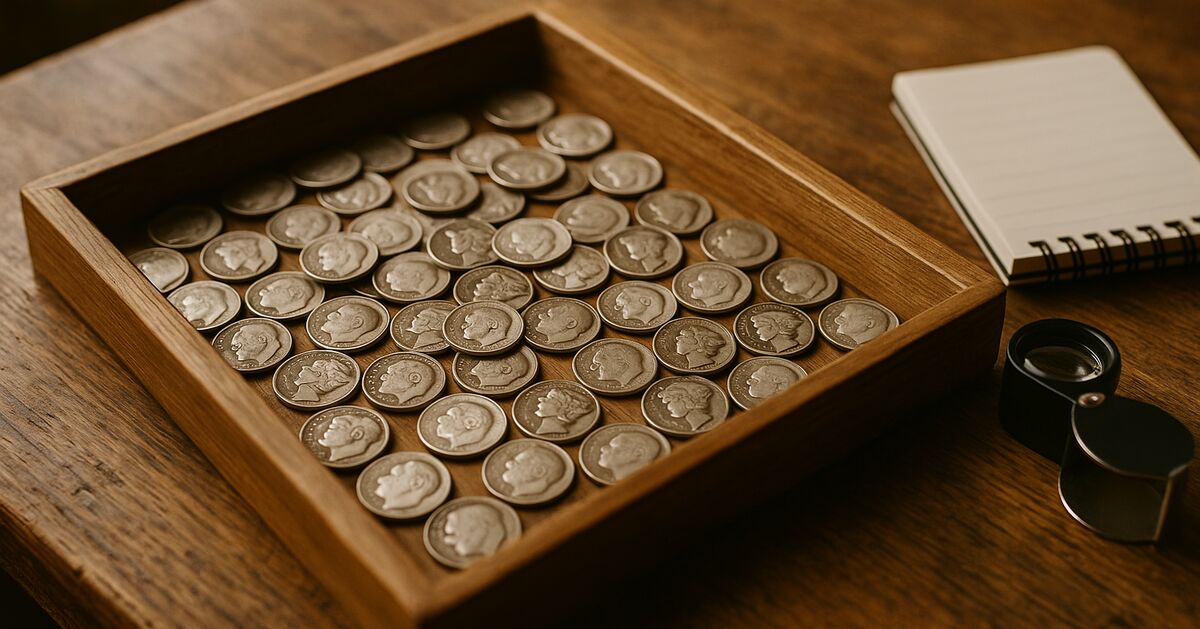
Ninety-percent silver dimes are one of the easiest forms of inherited or scrap silver to sell, and yet people leave money on the table with them every day. The math is straightforward, the buyers are plentiful, and the pitfalls are predictable, which means a little preparation goes a long way.
This guide covers everything from identifying which dimes are actually silver, to understanding what drives the price, to picking the right buyer and avoiding the traps that catch people off guard.
Which dimes are 90% silver?
Every Roosevelt dime struck from 1946 through 1964 is 90% silver. Every Mercury dime (minted 1916 to 1945) is 90% silver. Every Barber dime (1892 to 1916) is 90% silver. In 1965, the U.S. Mint switched to a copper-nickel clad composition, and that change happened mid-year, so the date is the first thing to check.
The quickest way to sort a mixed pile: look at the edge of each coin. A genuine silver dime shows a clean, uniform silver edge. A clad dime shows a thin copper stripe sandwiched between two white layers. You can see it clearly in good light with no magnification. Once you have seen it, you cannot unsee it, and sorting goes quickly.
If a coin is so corroded that the edge is unclear, check the date. Anything 1964 or earlier is worth testing further. Anything 1965 or later is almost certainly clad, though proof and commemorative issues exist, so set obvious outliers aside for a separate look.
What a 90% silver dime actually contains
Each pre-1965 U.S. dime weighs 2.5 grams and is 90% silver by weight. That works out to 2.25 grams of pure silver per coin, or 0.07234 troy ounces. That number matters because silver prices are always quoted in troy ounces (one troy ounce is 31.1 grams, not the 28.35 grams of an avoirdupois ounce).
If you have a face-value dollar in dimes, that is 10 coins, containing 0.7234 troy ounces of silver in total. Multiply that figure by the current spot price of silver and you have the raw melt value. Buyers commonly use roughly 0.715 troy ounces per face-value dollar as a standard estimate, since worn coins average slightly less silver than the theoretical maximum. Buyers use 0.715 as the standard multiplier per face-value dollar for worn circulated 90% silver coin.
So if silver is trading at, say, $28 per troy ounce, one face-value dollar in circulated 90% silver dimes carries a melt value of roughly $20. Scale that up: $10 face value yields about $200 in melt value at that price, $100 face value yields about $2,000, and so on.
You can check the current spot price on any reputable commodity pricing site or financial data provider. The price moves throughout the trading day, so when comparing buyer offers, try to compare them against the same spot price at roughly the same time.
Why numismatic (collector) value usually does not apply
For most 90% silver dimes, the collector market has largely moved on. The coins were minted by the billions. Roosevelt dimes especially are abundant in circulated grades, and even Mercury dimes are common in lower circulated grades. The realistic premium over melt for a worn circulated example is slim to none when selling in quantity.
There are exceptions. High-grade uncirculated examples, certain key dates, and coins with full bands (a specific Mercury dime grading criterion) can carry meaningful premiums. But those coins are identifiable, and if you have one, it will stand out from the pile: no wear on the high points, original luster, sharp strike. If you suspect you have something special, spend twenty minutes with a basic coin reference before lumping it in with the scrap pile.
Key dates worth checking before you sell any Mercury dimes as bulk silver: the 1916-D, the 1921, and the 1921-D are genuinely rare. A circulated 1916-D is a recognized key date that can be worth significantly more than its melt value even in poor condition, so it's worth checking before selling in bulk. The 1931-S, 1926-S, and a few other semi-keys are also worth noting. For Roosevelt dimes, date-and-mintmark combinations are far less dramatic, but it costs nothing to look.
Barber dimes are often worth checking individually, since many circulated examples may carry collector value above scrap silver value due to their age and relative scarcity. Set them aside entirely and get them assessed separately.
As a general rule: sort first, then sell. Bulk all clearly common circulated dates together, and handle anything unusual individually. This is one of the core lessons in our broader guide to selling inherited or scrap precious metal.
How buyers price 90% silver dimes
Buyers express their offers as a percentage of melt value, or sometimes as a fixed dollar amount per face-value dollar of coins. Both expressions are equivalent; just make sure you are comparing them on the same basis.
Offers in the wholesale coin and bullion market often fall somewhere between 90% and 97% of melt, though this varies by buyer type, quantity, and market conditions. Buyers who deal heavily in junk silver (the trade term for 90% U.S. coinage) often pay at the higher end because they have an efficient pipeline for moving it to refiners or other dealers. Pawn shops and general-purpose cash-for-gold stores often pay at the lower end, because junk silver is a secondary category for them.
A few specific factors move the offer up or down:
- Quantity. Buyers get better economics on larger lots. A single roll of 50 dimes may fetch a slightly lower percentage than a $100 face-value bag.
- Condition. Heavily worn coins reduce the actual silver content slightly (worn away metal), though the standard 0.715 multiplier already accounts for average wear.
- Market volatility. When silver is moving sharply in either direction, some buyers widen their spread to protect themselves. You can read more about why buyers tighten up when markets are volatile in a separate post on this site.
- Buyer type. Online bullion dealers and mail-in refiners often pay more than local shops because they operate at higher volume and lower overhead.
Buyer types and what each tends to pay
Coin dealers who specialize in U.S. silver coinage are often the best local option. They know exactly what they are looking at, they buy in bulk regularly, and their margins on common junk silver are thinner than a general jeweler's. Many post their current buy prices openly.
Online bullion dealers and mail-in buyers can be competitive because their overhead is low and their volume is high. The trade-off is shipping time, the need to pack carefully, and a degree of trust that the process will go smoothly. If you use a mail-in buyer, confirm their testing and payment process in writing before you ship.
Pawn shops vary enormously. A pawn shop that does a lot of coin business may surprise you with a fair offer. One that rarely sees silver coins may low-ball simply from unfamiliarity. Always ask what percentage of melt they are paying, not just the dollar figure, so you can compare properly.
Estate sale companies and auction houses can work well for larger collections that include mixed coins, jewelry, and flatware, because they handle the sorting and marketing. For a modest quantity of pure junk silver, the commission structure may not favor you.
For a fuller breakdown of how these buyer types compare across different silver categories, the guide at where to sell silver: comparing buyer types and what each pays goes into detail.
Getting multiple quotes: the practical method
Silver dimes are easy to quote by phone or email because the product is completely standardized. You can describe your lot in a few words: "I have approximately $50 face value in pre-1965 Roosevelt and Mercury dimes, all circulated." Any serious buyer will give you a price per face-value dollar immediately, because the math is identical regardless of which specific dates are in the lot (with the exceptions noted above).
Get at least three quotes, and get them close together in time so you are comparing against the same market price. Ask each buyer: "What percentage of melt are you paying?" or "What is your price per face-value dollar?" Either question gets you to the same number.
If a buyer hedges, talks about needing to see the coins first before naming any figure, or quotes you a price per coin rather than per face-value dollar, that is not necessarily a red flag for dimes, but it does make comparison harder. Press for a percentage of melt and you can compare apples to apples. The tactics that some buyers use to complicate this comparison are worth understanding; the post on pressure tactics used by silver buyers and how to beat them is a useful companion read.
Calculating your own melt value: a worked example
Say you find a coffee can containing a mixed pile of old dimes. You sort out 87 coins dated 1964 or earlier. Step by step:
- Count the coins: 87 dimes.
- Calculate face value: 87 x $0.10 = $8.70 face value.
- Apply the 0.715 multiplier: $8.70 x 0.715 = 6.22 troy ounces of silver.
- Look up the current spot price. If it is $28.00 per troy ounce: 6.22 x $28.00 = $174.16 melt value.
- A fair buyer offer might be 90% to 95% of that, so $156 to $165 is a reasonable range to expect.
That is your baseline. Any offer meaningfully below 85% of melt is worth pushing back on or walking away from, unless you have a compelling reason to value convenience above price.
Common mistakes that cost sellers money
Selling without sorting. If you hand a buyer a mixed jar of dimes without separating silver from clad, some buyers will calculate the lot conservatively, assuming a higher proportion of clad than actually exists. Sort first, always.
Accepting the first offer from the first buyer. This comes up repeatedly in conversations among sellers. The difference between a 80% of melt offer and a 95% of melt offer is real money, and it costs nothing but a few phone calls to find it.
Overlooking key dates. As described above, a single 1916-D Mercury dime in average circulated condition can be worth far more than its melt. Scan every coin briefly before selling in bulk.
Cleaning the coins. Washing or polishing silver coins does not increase their value and can reduce collector appeal for any coin that might otherwise have attracted collector interest. Leave them as you found them. This applies equally to other silver items, and there is a full explanation of why in our post on why you should never clean silver coins before selling.
Selling during a sharp price drop without waiting. If silver has fallen 10% in a week, buyers may be cautious. If you are not in a hurry, waiting for the market to stabilize can recover some of that ground. There is no guarantee prices will recover on any schedule, but the decision is worth making consciously rather than by default.
When face value matters (rarely, but it does)
The face value of a dime is ten cents. No bank will pay you more than that, and no buyer for silver will pay you less, but the face value floor is essentially irrelevant because the silver content of these coins is worth many times face value at current market prices. The floor matters more for borderline silver items (like some older foreign coins) where the silver content is uncertain. For pre-1965 U.S. dimes, you are firmly in melt-value territory.
Putting it all together
Pre-1965 U.S. silver dimes are one of the most liquid and easily valued forms of scrap silver a person can own. The silver content is fixed and well-documented, the buyer market is deep, and the math is simple enough to verify yourself in a few minutes. The main work is sorting, doing a basic key-date check, gathering a few competing quotes, and choosing the buyer who treats you most transparently.
If your dimes are part of a larger inherited collection that includes other silver items, flatware, jewelry, or mixed coins, it often makes sense to sort and value the components separately before deciding whether to sell together or separately. The broader context of handling that kind of situation is covered in our guide to getting cash for silver: what buyers pay and how to compare quotes.
The short version: know what you have, know what it is worth, get three quotes, and take the best one. That process works reliably for 90% silver dimes, and it does not require any special expertise to execute.
Sources & further reading
- Silver prices and commodity data (Kitco Metals)
- Troy weight and precious metals measurement standards (National Institute of Standards and Technology (NIST))
- Consumer protection guidance for selling precious metals (Federal Trade Commission)
Revision history (1)
- Pre-publish editorial QA: clean; claim audit: 7 claims, 4 rewritten
Claim-by-claim audit (7 checked)
- “Each pre-1965 U.S. dime weighs 2.5 grams and is 90% silver by weight.” (reasoning shown in the article)
- “That number matters because silver prices are always quoted in troy ounces (one troy ounce is 31.1 grams, not the 28.35 grams of an avoirdupois ounce).” (cited → nist.gov)
- “Buyers commonly use roughly 0.715 troy ounces per face-value dollar as a standard estimate, since worn coins average slightly less silver than the theoretical maximum.” (rewritten to what the article can stand behind)
- “Offers in the wholesale coin and bullion market often fall somewhere between 90% and 97% of melt, though this varies by buyer type, quantity, and market conditions.” (rewritten to what the article can stand behind)
- “A circulated 1916-D is a recognized key date that can be worth significantly more than its melt value even in poor condition, so it's worth checking before selling in bulk.” (rewritten to what the article can stand behind)
- “Barber dimes are often worth checking individually, since many circulated examples may carry collector value above scrap silver value due to their age and relative scarcity.” (rewritten to what the article can stand behind)
- “Cleaning the coins... does not increase their value and can reduce collector appeal for any coin that might otherwise have attracted collector interest.” (reasoning shown in the article)