
Getting cash for silver: what buyers pay and how to compare
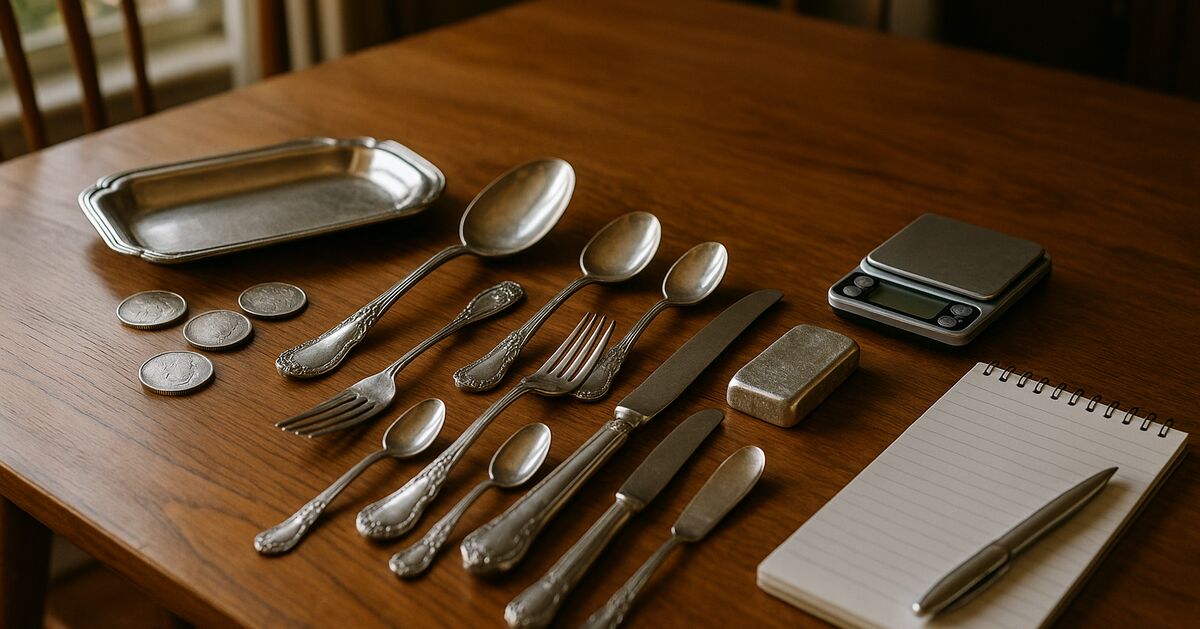
Silver sitting in a drawer is not an asset until someone actually hands you money for it. The gap between "this is probably worth something" and "I have cash in hand" is where a lot of sellers lose ground, simply because the offer calculation is never explained to them. Let's fix that.
What counts as sellable silver (and what does not)
Before any math happens, a buyer has to decide whether your item is even silver in the first place. This is the first thing a reputable buyer will sort out, and it is worth understanding the line yourself before you send anything anywhere.
Genuine silver items break into a few broad categories:
- Sterling silver - an alloy of 92.5% silver and 7.5% copper. Marked ".925", "Sterling", or "Ster" on most American and British pieces.
- 800 silver and 830 silver - Continental European alloys common in German, Scandinavian, and Italian flatware and hollowware. Lower silver content than sterling, but still genuinely silver.
- Coin silver - an old American alloy typically running around 90% silver, found in early spoons and small hollowware.
- Fine silver and silver bullion - .999 or .9999 purity, used in bullion bars and modern investment coins.
- Pre-1965 US "junk silver" coins - 90% silver dimes, quarters, half dollars, and dollars.
What buyers will not pay melt price for is silver-plated items. Plating is a microscopically thin layer of silver over a base metal (usually brass or steel). The silver content is so low that recovering it costs more than it is worth. A buyer who offers you full sterling price on a plated piece is either confused or dishonest. If you are not sure which category your items fall into, the frequently asked questions page on this site covers some quick home tests worth trying first.
Hollowware is its own sub-category worth knowing about. Trays, tea services, goblets, and figurines are often genuine sterling, but some pieces have weighted bases filled with pitch or resin to give them stability. That filler adds weight without adding silver. A good buyer will flag this and weigh only the silver shell. Some candlestick sets are heavily loaded with filler, so the quoted weight can drop significantly once the non-silver parts are accounted for.
How the offer is actually calculated
Every legitimate cash-for-silver offer starts in the same place: the spot price of silver. Spot is the real-time market price for one troy ounce of .999 fine silver, traded on commodities exchanges worldwide. You can look it up any time on financial data sites. It moves every few seconds during market hours and can shift meaningfully over the course of a day, which is why reputable buyers refresh their posted rates frequently.
From spot, the buyer works through a short chain of arithmetic:
1. Determine the silver weight. Your item is weighed in grams, pennyweights, or troy ounces. These are not the same as kitchen ounces (avoirdupois). One troy ounce equals 31.1035 grams. One pennyweight (dwt) equals 1.555 grams. Sellers who do not know this conversion sometimes feel shortchanged when the number seems low, but the units are just different.
2. Convert to fine silver weight. If your flatware is sterling (.925), only 92.5% of its weight is silver. If it is 800 silver, only 80% is. The buyer multiplies your total weight by the purity percentage to get the "fine silver weight," which is the only part that has melt value.
3. Apply a buyback percentage. No buyer pays 100% of spot. They cannot. They have to refine the metal, absorb market risk while it sits in inventory, cover operating costs, and turn a profit. The percentage of spot a buyer pays is the single most important number to compare across quotes. Typical ranges in the broader market vary by item type. Bullion bars and recognized bullion coins tend to attract the highest percentages because they require almost no testing and are easy to resell. Scrap flatware and mixed hollowware tend to attract lower percentages because refining takes time and labor. Understanding this structure is covered in more depth in the practical guide to selling silver online.
4. Deduct any fees (or confirm there are none). Some buyers charge for shipping, insurance, or assay testing. Others build those costs into their buyback percentage. Either approach is fair as long as it is disclosed upfront. What is not fair is a quote that looks great until fees are revealed after the fact.
The final number is the offer. Written out simply: Offer = (Weight in troy oz) x (Purity %) x (Spot price) x (Buyback % of spot).
If someone quotes you a rate per gram, per pennyweight, or per troy ounce without specifying the purity adjustment, ask for clarification. The per-troy-ounce rate only makes sense if it already reflects purity.
What moves your offer up or down
Spot price is the biggest single variable, but it is the same for every buyer on a given day. The factors that differ between buyers are:
Purity and alloy type. Sterling gets a higher per-gram rate than 800 silver because it contains more silver per gram. Buyers who handle Continental European silver regularly will properly identify 800 pieces; buyers who do not may misidentify them or lowball them.
Item type and refinability. Clean bullion bars are easiest to refine. Flatware with hard epoxy handles, pieces with solder repairs, or heavily alloyed items take more processing. That friction is usually reflected in a slightly lower buyback percentage.
Weight. Larger shipments sometimes (not always) attract slightly better percentages because the fixed costs of processing are spread over more metal. This is not a universal rule, but it is worth asking about if you have a substantial quantity.
Market timing. Some buyers may widen their spread during fast-moving markets, though this varies by buyer, so ask each one how they handle volatile pricing. When the market is calm, spreads tend to tighten. This is one reason why a buyer's offer on a volatile day can feel lower than expected even when spot is high.
Coin premiums. Some silver coins carry value beyond their melt weight. Rare dates, low-mintage issues, and high-grade examples may be worth more to a coin collector than to a refiner. A buyer who only pays melt may be the wrong buyer for a numismatically valuable coin. The guide to selling gold online discusses a similar dynamic for gold coins, and the principle applies equally to silver.
How to compare quotes properly
Getting multiple quotes is the single most reliable way to protect yourself, but only if you compare them correctly. Here is where sellers often slip up.
Use the same spot price reference point. If you get one quote on a Tuesday and another on a Thursday, the spot price may have moved. A quote that looks worse might simply reflect a lower spot, not a worse buyback percentage. To compare fairly, get both quotes on the same day or ask each buyer what spot price they used in their calculation.
Ask for the percentage of spot, not just the dollar figure. If Buyer A offers you $180 and Buyer B offers you $195, Buyer B looks better. But if Buyer A is working from a spot price of $25 and Buyer B is working from a spot price of $30 on the same item, Buyer A is actually offering a better percentage. The dollar figure alone is not a fair comparison.
Clarify what is included. Does the quote include free insured shipping? Who pays if something is lost in transit? Is the weight and purity assessment done at the buyer's facility or by an independent lab? Mail-in buyers often arrange prepaid insured labels; local buyers let you watch the scale. Neither is inherently superior, but the terms should be clear before you commit.
Understand the acceptance window. Buyers often hold an offer for a limited time because spot moves. Know how long you have to decide, and what happens if spot changes dramatically before you accept.
Check the return policy. Look for buyers who state in writing that they will return your items at no charge if you decline the offer, as recommended in consumer guidance on selling precious metals. This is a meaningful protection. If a buyer does not commit to this in writing, treat it as a warning sign.
If you are also considering selling gold items alongside silver, the combined logistics can be worth thinking through together. The guide to selling gold and silver together walks through how to handle a mixed lot without losing track of what each metal is worth individually.
Local buyers versus mail-in buyers
Both channels have genuine advantages. Local coin dealers, pawn shops, and jewelry buyers let you get paid the same day, watch the weighing process in person, and walk away with cash. That immediacy has real value. The trade-off is that local buyers often have smaller operating margins and higher overhead, which can mean lower buyback percentages on lower-value items.
Mail-in buyers often serve a national customer base and process higher volumes, which can sometimes translate into better buyback percentages, but this varies and should be confirmed per buyer. The trade-off is that you are parting with your silver before you see the final offer. This feels uncomfortable to many sellers, and reasonably so. Protections to look for: insured tracked shipping (ideally arranged by the buyer), an independent weighing and testing step, a written offer delivered before payment is sent, and a clear no-hassle return policy if you decline.
Neither channel is automatically better. The right choice depends on how much silver you have, how quickly you need the money, and how comfortable you are with the logistics involved.
For sellers in specific cities, local dynamics matter a lot. If you happen to be in the Dallas area, the local guide to selling gold and silver in Dallas covers how to evaluate buyers in that market specifically.
The paperwork and logistics side
A step that is easy to overlook: document what you are sending before it leaves your hands. Photograph every item from multiple angles. Note any hallmarks, weights if you have a scale, and any distinguishing features. Keep a written list. This protects you in a dispute and helps you cross-reference the buyer's description against your own when the offer arrives.
Insurance matters. Silver has enough value by weight that a lost or damaged parcel is a real financial problem. Carriers have their own caps on standard insurance, and declared-value coverage for precious metals can require specific packaging and documentation. Ask the buyer what their policy is and get it in writing. If you are arranging your own shipping, check the carrier's terms carefully.
If you have a mixed box that includes items you are not sure about, such as a combination of sterling flatware, some plated pieces, and a few old coins, it is fine to send the whole lot for evaluation as long as you understand the buyer will set aside anything that does not meet their minimum silver content threshold. You will get back what they cannot use, or it simply will not be included in the offer.
A note on realistic expectations
Cash-for-silver offers will always feel lower than the retail replacement cost of an item and will often feel lower than the spot price you see quoted online. That gap is real and it is not a trick. Retail prices include design, labor, brand, and markup. Spot prices are for .999 fine silver in large wholesale quantities. Your sterling flatware is not .999 fine and it is not being sold wholesale. The buyback percentage applied by a buyer is the practical reality of the secondary precious metals market.
That said, there is real variation between buyers, and the difference between a fair offer and a poor one on a meaningful quantity of silver is absolutely worth the effort of comparison. Getting two or three quotes costs you nothing except time, and on a set of flatware or a collection of coins, the spread can easily be hundreds of dollars.
For a broader look at how this site thinks about the silver-selling process from start to finish, the home page lays out the full picture. And if you have questions that this post does not answer, the contact page is the right place to bring them.
The calculation is not complicated once you see it written out. Spot price, times purity, times weight in troy ounces, times the buyback percentage. Everything else is just knowing which buyers apply which percentages honestly, and how to compare them on the same terms.
Sources & further reading
- Silver commodity spot price data and market information (U.S. Commodity Futures Trading Commission)
- Precious metals definitions and troy weight standards (National Institute of Standards and Technology (NIST))
- Consumer guidance on selling precious metals and avoiding fraud (U.S. Federal Trade Commission)
- Precious metals refining and silver purity standards overview (U.S. Environmental Protection Agency)
- Postal regulations and insurance for shipping valuables (United States Postal Service)
Revision history (1)
- Pre-publish editorial QA: 1 flagged, 1 softened; claim audit: 6 claims, 3 rewritten
Claim-by-claim audit (6 checked)
- “Some buyers may widen their spread during fast-moving markets, though this varies by buyer, so ask each one how they handle volatile pricing.” (rewritten to what the article can stand behind)
- “Mail-in buyers often serve a national customer base and process higher volumes, which can sometimes translate into better buyback percentages, but this varies and should be confirm…” (rewritten to what the article can stand behind)
- “Look for buyers who state in writing that they will return your items at no charge if you decline the offer, as recommended in consumer guidance on selling precious metals.” (rewritten to what the article can stand behind)
- “Carriers have their own caps on standard insurance, and declared-value coverage for precious metals can require specific packaging and documentation.” (cited → usps.com)
- “One troy ounce equals 31.1035 grams.” (cited → nist.gov)
- “Sterling silver - an alloy of 92.5% silver and 7.5% copper.” (cited → nist.gov)