
Selling gold and silver together: a practical end-to-end
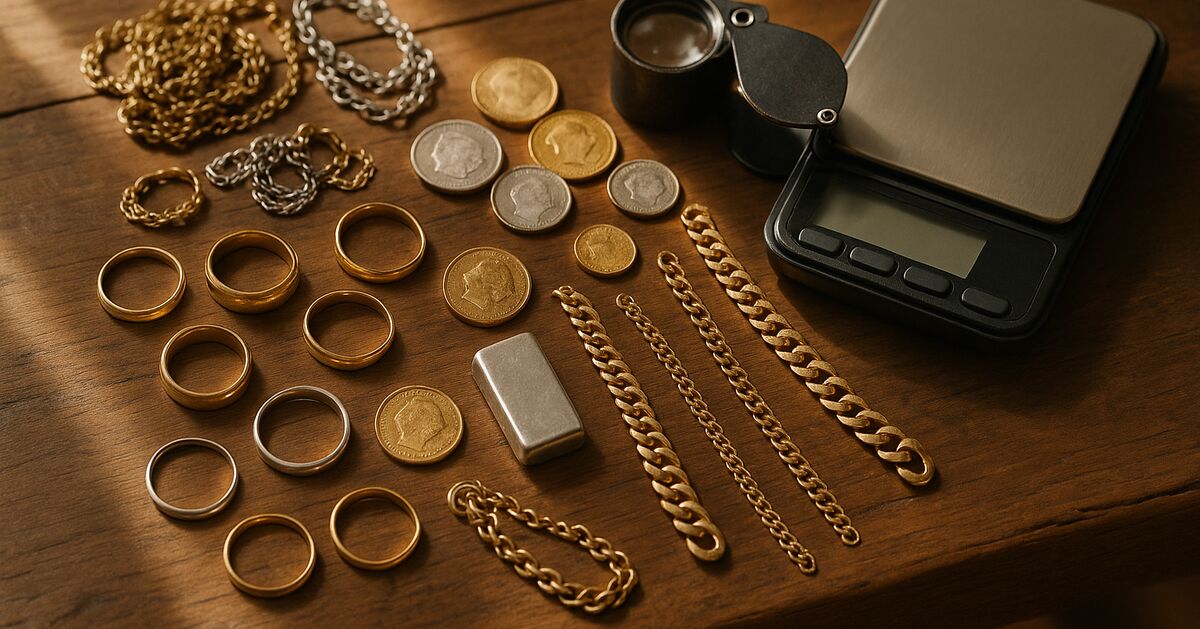
Selling a box of mixed gold and silver feels straightforward until you are actually standing at a buyer's counter, or filling out an online form, wondering whether you are about to be paid fairly or politely robbed. Having bought precious metals from the public for the better part of two decades, I watched that uncertainty play out thousands of times. This guide is everything I wish sellers had known before they walked in the door.
Why gold and silver get valued differently, even in the same transaction
Gold and silver are both precious metals, but they behave like different markets. The spot price of gold tends to move in larger dollar swings per troy ounce, while silver moves in smaller dollar increments but often larger percentage swings. When you sell both at the same time, a reputable buyer will quote each separately, applying that day's spot price to each metal's weight and purity. If a buyer quotes you a single blended "offer" without breaking it down, that is a flag worth noticing.
The London Bullion Market Association (LBMA) publishes twice-daily benchmark prices for both metals that many professional buyers reference as their starting point. The LBMA gold price and silver price are freely published and easy to look up before any appointment or shipment. Knowing today's number gives you a baseline, even if you never turn it into a precise calculation.
The single biggest thing that moves your offer: purity
Every item you sell has two numbers attached to it: weight and purity. Both matter equally.
Gold purity is expressed in karats (sometimes spelled carats outside the US). Pure gold is 24 karat. The common alloys you will find in jewelry are:
- 24k: 99.9% gold (rare in jewelry, common in bars and coins)
- 22k: 91.7% gold (sovereign coins, some fine jewelry)
- 18k: 75.0% gold (European jewelry, high-end pieces)
- 14k: 58.5% gold (the standard for American jewelry)
- 10k: 41.7% gold (the US legal minimum to be called gold)
- 9k: 37.5% gold (common in UK and Australian jewelry)
Silver purity is usually stamped as a three-digit millesimal fineness or a word mark:
- 999 or .999: fine silver (bars, rounds, some coins)
- 925 or "sterling": 92.5% silver (flatware, jewelry, hollowware)
- 900: 90% silver (pre-1965 US dimes, quarters, half dollars, dollars)
- 800: 80% silver (common in Continental European flatware)
- 835: 83.5% silver (German and Scandinavian items)
A buyer will test everything before making an offer. If your items are already stamped with a legible hallmark, testing is faster and smoother. If the stamps are worn or absent, expect the buyer to use acid testing or an X-ray fluorescence (XRF) analyzer. XRF is a widely used method for quick, non-destructive purity analysis at many professional buyers. The results are precise to a fraction of a percent.
For a deeper look at how purity affects what you are actually paid, the practical guide to selling silver online walks through the arithmetic in plain terms.
How weight is measured, and why it matters more than you think
Precious metals are sold by the troy ounce, not the avoirdupois ounce used for food and household goods. One troy ounce equals 31.1 grams. One regular ounce is only 28.35 grams. The difference is about 10%, which is meaningful when the buyer is calculating your offer on a calculator and you are watching.
A kitchen scale is not accurate enough for this transaction. Professional buyers use calibrated scales that read to 0.01 grams. If you want a rough sense of what you have before getting quotes, a decent jewelry scale (available for under $20) will get you close enough to understand the offers you receive.
Coins are weighed as a group by type: all 90% silver quarters together, all Morgan dollars together, all 14k gold chains together. Mixing purities in the same weighing is a sign of a sloppy buyer, not an efficient one.
What a fair offer actually looks like
No buyer pays 100% of spot. Every professional buyer operates on a margin that covers testing, refining, overhead, and a reasonable profit. The real question is not "will they pay less than spot?" but "how much less is reasonable?"
For scrap silver jewelry or flatware, sellers often report offers somewhere below full melt value from reputable mail-in and online buyers, though exact ranges vary by buyer. Local coin shops and pawn shops vary widely. For scrap gold jewelry, established buyers typically pay less than full melt value, with the exact percentage depending on volume and market conditions.
Bullion coins and bars are a different story. A Silver Eagle, a Gold Eagle, a Maple Leaf, or a Krugerrand carries a premium over raw melt value because the market treats it as a near-liquid asset. Selling a Silver Eagle as if it were scrap silver is leaving real money on the table. A coin dealer or a bullion exchange will typically pay much closer to the spot price for recognizable government-minted coins, and sometimes a premium on top of spot if demand is high.
The same logic applies to collectible coins with numismatic value. A Morgan dollar in high grade is worth considerably more than its silver content. For a thorough breakdown of that topic, the guide on how to sell silver dollars covers identification and grading in detail.
Common mistakes that cost sellers money
A pattern that came up again and again when buying from the public involved a handful of avoidable errors. Here are the ones worth knowing before you start.
Mixing everything together and accepting a single offer. A drawer full of 10k gold, 14k gold, sterling flatware, silver-plated items, and coins should never be quoted as one pile. Insist on a line-by-line breakdown. Silver plate has little to no melt value and should not be counted against your sterling.
Selling bullion coins for scrap prices. A buyer who offers you the silver melt value of a Silver Eagle is either making a mistake or taking advantage. Recognize your coins before you sell them. A quick search of the coin's name and "current price" will tell you whether it trades above melt.
Cleaning coins before selling. This one applies to coins with potential collector value. Cleaning removes the original surface patina and typically reduces numismatic value, sometimes dramatically. Leave coins exactly as you found them.
Accepting the first offer. Getting two or three quotes costs almost nothing and takes very little time. Mail-in buyers typically provide a free, insured shipping label. A local coin dealer quote is usually free. There is no reason to accept the first number you hear.
Not separating gold-filled and gold-plated items. Gold-filled (stamped GF, 1/20 14K, or similar) and gold-plated pieces contain a thin layer of gold over a base metal. They are worth very little as scrap and are usually not worth submitting to a precious metals buyer. A good buyer will identify these and pull them out. A less careful one may quote your lot lower because of them, or simply include them and pay you nothing for the base metal content.
Sorting your items before getting quotes
A bit of preparation before you approach any buyer makes a meaningful difference in how smooth the process goes and how confident you feel about the offers you receive.
Start by separating everything into broad categories:
- Gold jewelry (sort by karat if you can read the stamps)
- Silver jewelry and hollowware (check for 925 or "sterling" stamps)
- Silver coins (separate by denomination and date range if you can)
- Gold coins and bullion
- Anything you are unsure about
If you have inherited items and are not sure what is sterling versus silver-plated, the article on selling inherited or scrap gold has practical identification tips that apply equally to silver. A magnet is the first quick test: real silver and gold are not magnetic. Silver-plated steel will stick; sterling and fine silver will not.
Photograph everything before it leaves your hands, especially if you are using a mail-in service. A clear photo record of what you sent protects you in any dispute.
Choosing the right type of buyer
Different buyers suit different situations, and the "best" buyer depends on what you are selling.
Online and mail-in buyers tend to offer competitive prices for scrap jewelry and smaller quantities of bullion because their overhead is lower than a storefront. They work at volume and can afford tighter margins. The trade-off is that you ship first and get the offer afterward, which is why it matters to choose a buyer with a clear return policy: if you decline the offer, your items should come back to you fully insured at no cost.
Coin dealers are generally the right choice for numismatic coins, certified coins, and bullion. They understand the premium market and will pay for it. A coin dealer who also handles jewelry and flatware is often a one-stop shop for a mixed estate.
Pawn shops vary enormously. A well-run pawn shop with a trained buyer can be competitive, but the category as a whole has a reputation for wide margins. It is worth getting a quote for comparison, but do not treat it as your only option.
Local jewelers sometimes buy gold but rarely silver scrap, and their offers for gold are often oriented toward their own retail resale needs, which means they may only want pieces in very good condition.
If you are outside the United States, the buyer landscape looks somewhat different. The guide to selling silver and gold in Canada covers the Canadian market specifically.
What to expect from the mail-in process
For sellers who are not near a reputable local dealer, or who simply prefer the convenience of doing this from home, the mail-in route is well-established and safe when done with the right buyer. The general process works like this:
- Request a free, prepaid shipping label from the buyer. Good buyers provide insured, trackable Priority Mail or equivalent.
- Package your items carefully. Use a padded envelope or small box. Do not rattle coins loose in a thin envelope.
- Send the package and track it.
- The buyer weighs and tests everything on receipt, then sends you an itemized offer.
- You accept or decline. If you decline, your items are returned insured.
- Payment is issued by check, bank transfer, PayPal, or another method the buyer supports.
The whole cycle from shipping to payment in hand often takes roughly one to two weeks, though timing varies by buyer. If a buyer cannot give you a clear answer about their return policy or how your items are insured in transit, that is a reason to keep looking.
A note on taxes and reporting
In the United States, the IRS treats precious metals as collectibles. Selling silver or gold at a profit is generally a taxable event, with the gain subject to capital gains tax. The rate depends on how long you held the metal (short-term versus long-term) and your overall income. The IRS publishes guidance on collectibles under Publication 544.
For someone selling a small quantity of inherited jewelry or a jar of old coins, the practical tax impact is often modest, especially if the original cost basis is unknown and the estate value was below the applicable threshold. But it is worth being aware of the rule, particularly for larger sales. A tax professional who handles investment assets can give you accurate guidance for your specific situation.
Selling designer or high-end pieces separately
If you have pieces by a named designer or luxury house, the melt value may be the floor, not the ceiling. Pieces by Tiffany, Cartier, Georg Jensen, or comparable makers can command significant premiums in the secondary jewelry market over their raw metal content. Submitting a Tiffany sterling bracelet to a scrap buyer is the equivalent of selling a signed painting for the canvas and paint alone. The guide to selling designer jewelry online covers how to identify and market those pieces to the right audience.
Similarly, if your gold item happens to be a watch, the movement may be worth more than the case. See the practical guide to selling watches for how to approach that category.
Pulling it all together
Selling gold and silver well is not complicated, but it does require a little preparation. Know your metal: read the stamps, separate the categories, identify any coins that might carry a numismatic premium. Know the market: look up today's spot price before you engage with any buyer. Know what a fair margin looks like: 70 to 90 percent of calculated melt value for scrap, and close to spot for bullion coins. Get more than one quote. And never let anyone rush you.
The metal has already waited this long. A few extra days of due diligence usually pays for itself.
For more practical guidance on selling precious metals, browse the full archive on the blog or start with the frequently asked questions if you have a specific question that is not covered here.
Sources & further reading
- LBMA Gold and Silver Price benchmarks (London Bullion Market Association)
- IRS Publication 544: Sales and Other Dispositions of Assets (collectibles guidance) (U.S. Internal Revenue Service)
- Troy weight and precious metals measurement standards (National Institute of Standards and Technology (NIST))
- USPS Priority Mail shipping and insurance options (United States Postal Service)
Revision history (1)
- Pre-publish editorial QA: 4 flagged, 4 softened; claim audit: 8 claims, 4 rewritten
Claim-by-claim audit (8 checked)
- “For scrap silver jewelry or flatware, sellers often report offers somewhere below full melt value from reputable mail-in and online buyers, though exact ranges vary by buyer.” (rewritten to what the article can stand behind)
- “For scrap gold jewelry, established buyers typically pay less than full melt value, with the exact percentage depending on volume and market conditions.” (rewritten to what the article can stand behind)
- “A coin dealer or a bullion exchange will typically pay much closer to the spot price for recognizable government-minted coins, and sometimes a premium on top of spot if demand is h…” (reasoning shown in the article)
- “XRF is a widely used method for quick, non-destructive purity analysis at many professional buyers.” (rewritten to what the article can stand behind)
- “In the United States, the IRS treats precious metals as collectibles.” (cited → irs.gov)
- “Selling silver or gold at a profit is generally a taxable event, with the gain subject to capital gains tax.” (cited → irs.gov)
- “The whole cycle from shipping to payment in hand often takes roughly one to two weeks, though timing varies by buyer.” (rewritten to what the article can stand behind)
- “Cleaning removes the original surface patina and typically reduces numismatic value, sometimes dramatically.” (reasoning shown in the article)