
Selling silver and gold in Canada: what it's worth and how
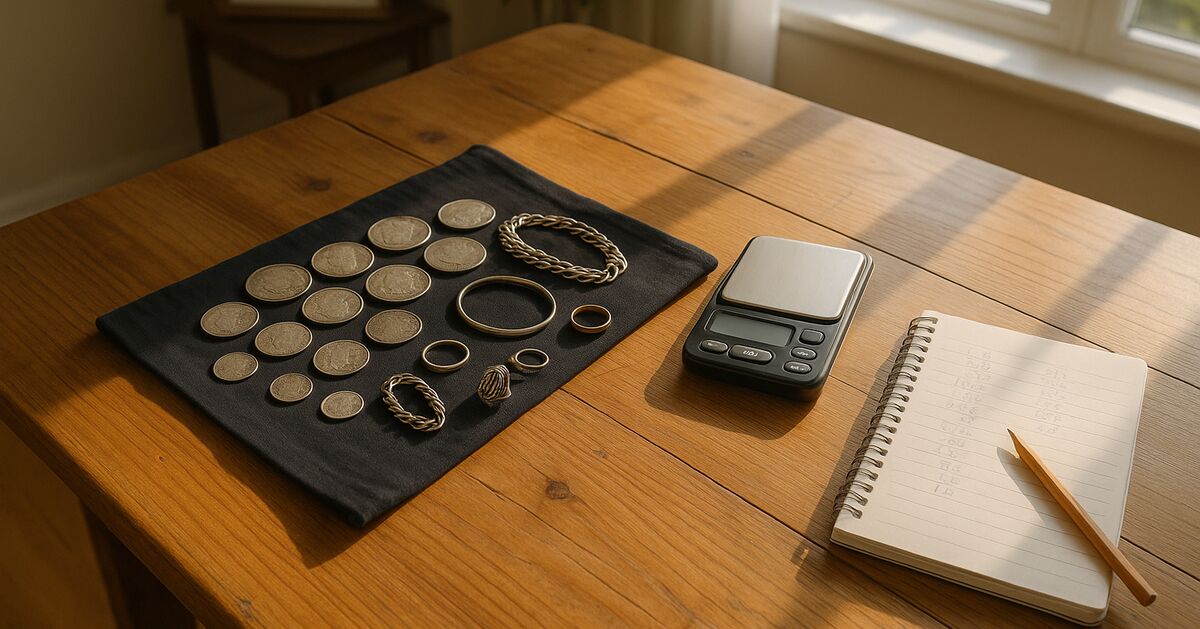
Selling silver or gold in Canada is not complicated, but it is different enough from selling in the United States that walking in unprepared will cost you money. The buyer pool is smaller, the currency math trips people up, and the provincial rules around precious metals dealers vary just enough to matter. Having run a precious metals buying business for eighteen years, I saw Canadian sellers make the same avoidable mistakes over and over. This guide covers what your metal is actually worth in Canadian terms, what moves that number up or down, and how to find a buyer who will treat you fairly.
The spot price and the CAD conversion: the first thing to understand
Every silver and gold price you see quoted in the news, on a bullion site, or on a live price chart is denominated in US dollars per troy ounce. That is the London Bullion Market Association fix, and it is the global benchmark. When you sell in Canada, that figure has to travel through the USD/CAD exchange rate before it means anything in your wallet.
That step costs you something. Buyers in Canada pay you in Canadian dollars, but they hedge their inventory and sell refined metal into a USD-denominated wholesale market. The spread they build into their offer reflects that currency risk. On a quiet day with a stable exchange rate, the impact is modest. On a day when the loonie is swinging, buyers widen their margins to protect themselves, and your offer narrows accordingly.
The practical takeaway: check the spot price in USD, then check the current USD/CAD rate, and do the arithmetic yourself before you walk into any conversation. If spot silver is $30 USD and the exchange rate is 1.36, raw spot in Canadian dollars is roughly $40.80 CAD per troy ounce. Whatever a buyer offers you should be a reasonable percentage of that number, not a mystery figure pulled from thin air.
What actually determines how much you get paid
Spot price and exchange rate set the ceiling. Everything below that ceiling is determined by a handful of factors that are worth understanding before you sell.
Purity and weight
Silver items are not all the same purity. Sterling silver is 92.5% pure silver (stamped .925). Britannia silver is 95.8%. Old Canadian silver coins minted before 1968 are 80% silver (not 92.5% like many people assume). Coins minted from 1920 to 1967 are generally cited as 80% silver, while coins from 1968 onward may be 50% silver or nickel depending on year and denomination; verify specific dates before valuing.
Knowing those percentages matters because buyers calculate your payout on the fine silver content, not the total weight. A stack of pre-1968 Canadian dimes weighs more than you might think, but only 80% of that weight is payable silver. If you go in expecting sterling rates, you will be confused and possibly suspicious of a legitimate offer.
Weight is measured in troy ounces. One troy ounce is 31.1 grams, not the 28.35 grams of an avoirdupois ounce used on kitchen scales. Buyers always use troy weight. If you weigh something at home on a postal scale, divide the gram weight by 31.1 to get troy ounces before you do any math.
The buyer's margin
No buyer pays 100% of spot. They can't. They have operating costs, testing costs, shipping, insurance, refining fees, and currency risk. Buyers vary widely in what they pay relative to spot, depending on volume, form factor, and liquidity, so compare multiple offers rather than assuming a fixed range. Bullion coins and recognized bars sit at the high end because they are easy to resell. Odd-lot scrap jewelry sits lower because it needs refining. Pre-1968 Canadian coins fall somewhere in the middle.
That range is not a rip-off. It is the economics of the trade. What you are trying to avoid is the buyer who pays 30 to 50 cents on the dollar and counts on you not knowing any better.
Form factor: coins, jewelry, bullion, and scrap
The form your silver or gold takes affects both the buyer's appetite and the offer percentage. A Royal Canadian Mint silver Maple Leaf is immediately recognizable, weighs exactly one troy ounce of .9999 fine silver, and can be resold to a collector or stacker without any further processing. Buyers pay close to spot for those because their resale path is simple.
A tangle of old silver chains has to be tested, sorted, melted, and refined before it has a clean value. That process costs money, so the offer reflects it. The same is true of gold: a gold ring with a stone has the stone's removal cost baked in, and the karat stamp (10K, 14K, 18K) determines how much actual gold is present. Canadian jewelry is commonly stamped 10K (41.7% pure gold) rather than 18K, so check the hallmark before assuming a higher purity.
For a deeper look at how coin form factor affects value, the post on how to sell silver coins: identify, value, and pick the right buyer is worth reading before you sell any coin collection.
Canadian pre-1968 silver coins: a category worth knowing well
This is the area where Canadian sellers most often leave money on the table or get confused. Pre-1968 Canadian dimes, quarters, half-dollars, and dollars are generally understood to contain 80% silver, different from the 90% silver content typically cited for pre-1965 US coins, so confirm the composition before selling. Buyers who deal primarily in US junk silver sometimes apply the wrong multiplier if you do not flag the difference.
The formula for pre-1968 Canadian silver coins is straightforward. Take the face value of your coins, multiply by the appropriate factor for the denomination and year, and you get the approximate fine silver weight. There are published melt-value calculators for Canadian coins online, and they are worth bookmarking. Use them before any conversation with a buyer.
One more wrinkle: the 1968 Canadian quarter and dime were issued in both 50% silver and pure nickel versions, and they look almost identical. A magnet will not distinguish them because neither is magnetic, but a scale and specific gravity test will. Any honest buyer will test before making an offer. If a buyer skips testing, that is a warning sign in either direction.
For context on how junk silver pricing works more broadly, the guide on selling junk silver coins: what they're worth and how to get a fair offer lays out the mechanics clearly, even though it focuses on US coinage.
Where to sell silver and gold in Canada
The Canadian market is geographically concentrated. Toronto, Vancouver, Calgary, Montreal, and Ottawa have active coin dealers and precious metals buyers. Smaller cities have fewer options, which means less competition and, often, lower offers.
Local coin and bullion dealers
A reputable coin shop is the first stop for most sellers. The Canadian numismatic community is well-organized, and dealers who belong to associations like the Royal Canadian Numismatic Association (RCNA) or are members of recognized industry bodies have reputational skin in the game. That does not guarantee the best price, but it does provide a baseline of accountability.
Get at least two local quotes. Do not accept the first offer on anything worth more than a few hundred dollars. Dealers know their competition, and a polite mention that you are shopping around often improves an offer without any confrontation.
Mail-in buyers
Mail-in buyers open up the national market, which matters if you are in a smaller city with limited local competition. A seller in Fredericton or Thunder Bay who limits themselves to local buyers is working with a thin market. Reputable mail-in services test your metal at an independent lab, send you a written offer, and return your items at no cost if you decline.
The risks of mail-in are real but manageable. Ship with Canada Post Xpresspost with declared value, keep your tracking number, and photograph everything before it goes in the envelope. Do your research on any mail-in buyer before you send anything: look for a physical address, a verifiable history, and reviews from real sellers, not just testimonials on their own website. The FAQ page has more on how to evaluate a buyer's legitimacy.
Online platforms and auctions
For collectible coins with numismatic value above melt, platforms like eBay Canada, specialized Canadian auction houses, or collector forums can yield better results than any bullion buyer. The trade-off is effort: you need to photograph, list, pack, ship, handle payment, and manage disputes. For a single valuable coin, that effort is worthwhile. For a bag of pre-1968 dimes, it usually is not.
Pawn shops
Pawn shops in Canada are regulated at the provincial level, and rules vary. Some provinces require dealers to hold purchased items for a set period before resale, which affects their pricing model. Pawn shops generally pay the least of any buyer category because they serve a general market and carry inventory risk across many categories. They are a convenience option, not a best-price option.
Provincial rules and what they mean for sellers
Unlike the United States, where precious metals dealers are regulated inconsistently at the state level, Canadian provinces have their own secondhand dealer and pawnbroker regulations. Several provinces, including Ontario, British Columbia, Alberta, and Quebec, are understood to have licensing requirements for secondhand goods buyers, but confirm current rules with your provincial regulator. Provincial rules commonly require buyers to record ID and hold purchased goods for a short period before resale, but requirements vary, so check your province's specific regulations.
For sellers, this means you should expect to show government-issued ID when selling to a licensed dealer. It is not a red flag; it is required by law. If a buyer does not ask for ID, that can actually be a warning sign that they are operating outside the regulatory framework.
Canada generally does not offer a blanket capital gains exemption for personal-use silver or gold, so confirm your tax situation with a professional rather than assuming an exemption applies. Tax treatment of precious metals gains in Canada can vary between income and capital gains depending on your activity, so consult a tax professional to determine your situation. If you are selling a small amount of inherited jewelry, the practical tax impact is likely negligible. If you are selling a significant collection built as an investment, talk to a tax professional before you sell. This is not an area to guess about.
Getting a fair offer: the practical checklist
After years of watching sellers walk away with less than they deserved, a handful of habits separate the sellers who do well from those who do not.
- Know your weight in troy ounces before any conversation. Weigh at home in grams, divide by 31.1.
- Know the purity of what you have. Check hallmarks, research coin dates, and do not assume.
- Check spot price and the USD/CAD rate on the day you sell. Both move daily.
- Calculate your own floor. Decide the minimum percentage of spot you will accept before you walk in. If an offer falls below that, walk out.
- Get multiple offers. Three quotes take an afternoon and can improve your return substantially.
- Ask how the buyer tests. X-ray fluorescence (XRF) guns are now common and give accurate purity readings in seconds. A buyer who relies only on a magnet and a visual check is not doing enough.
- Understand what you are selling. A coin with numismatic value above its melt value is worth more to a coin collector than to a bullion buyer. Know which category your item falls into.
The home page has a broader overview of how the selling process works if you want to orient yourself before diving into specific categories.
Gold in Canada: the same framework, different numbers
Everything above applies to gold with the same logic. Canadian gold jewelry is commonly 10K (41.7% pure), 14K (58.3%), or 18K (75%). The karat stamp is the starting point, but any serious buyer will test with XRF because stamps can be wrong, especially on imported jewelry.
Gold bullion coins from the Royal Canadian Mint, including the Maple Leaf series, are widely described as .9999 fine gold and tend to command offers close to spot, but confirm purity on the coin itself. British sovereigns circulated in Canada before 1933 are commonly cited as 22K gold with both melt and collector value, so verify before selling to a scrap buyer. Do not sell those to a scrap buyer without first checking the numismatic premium.
For a fuller treatment of the gold side of this, the guide on selling gold: what it is worth and how to get a fair offer covers the universal principles in detail. The Canada-specific layer on top of that is the currency conversion and the karat distribution of Canadian jewelry, which skews lower than US jewelry.
If you have a mix of silver and gold to sell, read up on selling silver and gold jewelry together because the sequencing and negotiation strategy is different when you have both in the same pile.
A word on avoiding the bad actors
The "cash for gold" storefront with no online presence, no reviews, and no posted price chart is not automatically dishonest, but it is a reason to be careful. The Canadian marketplace has seen its share of short-lived operations that pay a fraction of value and rely on seller ignorance. The protective habits are the same everywhere: know your value before you walk in, get multiple offers, and never feel pressured to accept on the spot.
If something feels wrong, it probably is. A buyer who rushes you, quotes prices you cannot verify, or refuses to explain their calculation is not earning your business. There are enough reputable dealers in Canada that you do not need to sell to anyone who makes you uncomfortable. The contact page is a good place to ask questions if you are unsure how to evaluate a specific situation.
Selling silver or gold in Canada is ultimately a math problem with a research component. The math is simple once you know the inputs. The research is an afternoon's work. Together, they are worth doing.
Sources & further reading
- Royal Canadian Numismatic Association - dealer standards and membership (Royal Canadian Numismatic Association)
- London Bullion Market Association - global spot price benchmark (London Bullion Market Association)
- Bank of Canada - USD/CAD exchange rate data (Bank of Canada)
Revision history (1)
- Pre-publish editorial QA: clean; claim audit: 11 claims, 10 rewritten
Claim-by-claim audit (11 checked)
- “Buyers vary widely in what they pay relative to spot, depending on volume, form factor, and liquidity, so compare multiple offers rather than assuming a fixed range.” (rewritten to what the article can stand behind)
- “Pre-1968 Canadian dimes, quarters, half-dollars, and dollars are generally understood to contain 80% silver, different from the 90% silver content typically cited for pre-1965 US c…” (rewritten to what the article can stand behind)
- “Coins minted from 1920 to 1967 are generally cited as 80% silver, while coins from 1968 onward may be 50% silver or nickel depending on year and denomination; verify specific dates…” (rewritten to what the article can stand behind)
- “Canadian jewelry is commonly stamped 10K (41.7% pure gold) rather than 18K, so check the hallmark before assuming a higher purity.” (rewritten to what the article can stand behind)
- “Canada generally does not offer a blanket capital gains exemption for personal-use silver or gold, so confirm your tax situation with a professional rather than assuming an exempti…” (rewritten to what the article can stand behind)
- “Tax treatment of precious metals gains in Canada can vary between income and capital gains depending on your activity, so consult a tax professional to determine your situation.” (rewritten to what the article can stand behind)
- “Several provinces, including Ontario, British Columbia, Alberta, and Quebec, are understood to have licensing requirements for secondhand goods buyers, but confirm current rules wi…” (rewritten to what the article can stand behind)
- “Provincial rules commonly require buyers to record ID and hold purchased goods for a short period before resale, but requirements vary, so check your province's specific regulation…” (rewritten to what the article can stand behind)
- “Pawn shops generally pay the least of any buyer category because they serve a general market and carry inventory risk across many categories.” (reasoning shown in the article)
- “Gold bullion coins from the Royal Canadian Mint, including the Maple Leaf series, are widely described as .9999 fine gold and tend to command offers close to spot, but confirm puri…” (rewritten to what the article can stand behind)
- “British sovereigns circulated in Canada before 1933 are commonly cited as 22K gold with both melt and collector value, so verify before selling to a scrap buyer.” (rewritten to what the article can stand behind)