
Selling inherited or scrap precious metal: a consumer guide
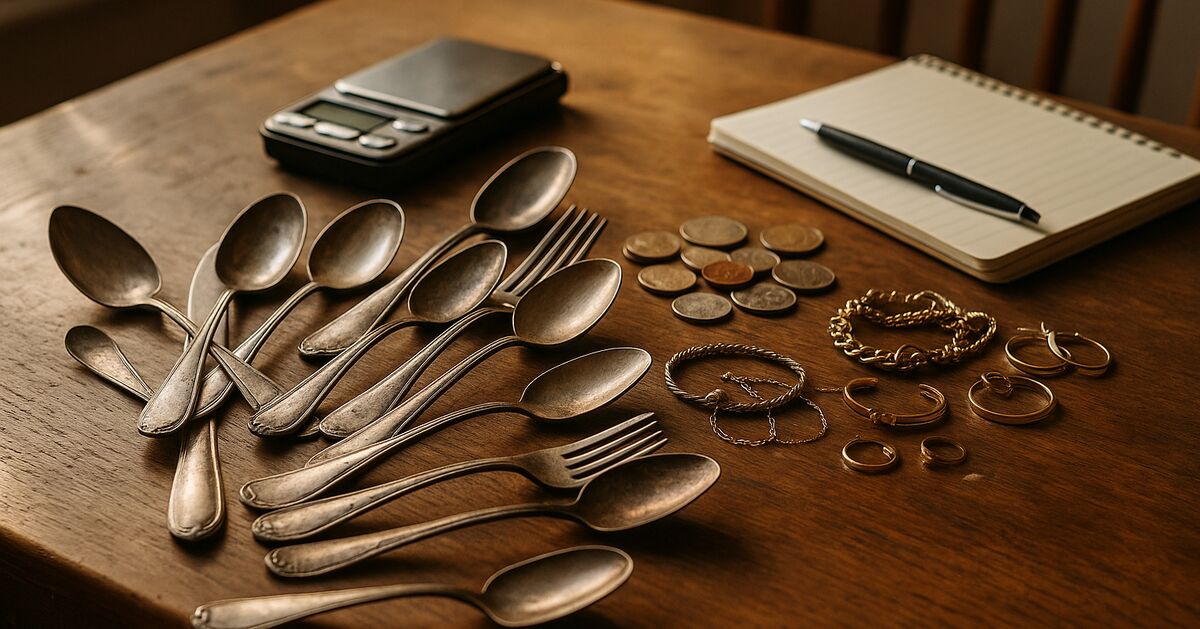
A dusty box of old jewelry can hide serious money, or almost none at all, and the difference usually comes down to knowing what you have before anyone makes you an offer.
This guide is written for people who have come into precious metal unexpectedly, whether through an estate, a house clearance, or years of accumulation, and who want to sell it without getting taken advantage of. The advice here comes from eighteen years running a mail-in precious metals buying business. The business is closed now, but the trade knowledge is still just as relevant.
Start by sorting before you talk to anyone
The single most useful thing you can do before approaching any buyer is to separate your items by metal type and probable purity. Buyers price different materials on completely different scales, and lumping everything together in one box makes it nearly impossible for you to verify whether an offer is fair.
A basic sort might look like this:
- Sterling silver (flatware, hollowware, jewelry marked 925 or "sterling")
- Coin silver (older American pieces often marked 900 or 800)
- Gold jewelry sorted by karat stamp (10K, 14K, 18K, 22K, 24K)
- Silver-plated items (marked EPNS, silverplate, or with no silver hallmark at all)
- Coins separated into pre-1965 US silver coins, world silver coins, and base-metal coins
- Unmarked or unknown items kept aside for testing
Silver plate is a category that trips a lot of sellers up. The plating is a microscopically thin layer of silver over a base metal, and it contributes almost nothing to melt value. A matched canteen of silver-plated cutlery can look impressive and be worth very little at scrap, though antique pieces in good condition sometimes have collector value that exceeds any scrap calculation. The point is that plated items need to be understood on their own terms and should never be lumped in with solid sterling.
Understanding what "spot price" actually means for you
Every buyer you talk to will reference the spot price of silver or gold, which is the real-time global trading price for a troy ounce of pure metal. That number matters, but it is only the starting point for what you will be offered, not the ceiling.
Here is why the offer is always below spot:
Refining cost. Your scrap has to be melted, assayed, and processed before it becomes tradeable metal. That costs money, and the buyer factors it in.
Buyer's margin. Anyone in business needs to make more than they pay. A buyer who offers you 100 percent of spot has no room to operate.
Purity discount. Sterling silver is 92.5 percent pure silver. The other 7.5 percent is base metal with no value. So even a generous offer is applied to 92.5 percent of the weight, not 100 percent.
Weight vs. troy weight. Silver and gold are priced by the troy ounce, which is 31.1 grams. Kitchen scales and postal scales often display grams or avoirdupois ounces (28.35 grams). Getting these confused will throw your math off significantly.
In practice, offers for clean sterling scrap can vary widely, so compare several quotes rather than assuming a fixed range. Coin silver, old silverware with elaborate ornamentation, or items that need extra processing may attract lower percentages. Freshly sorted, clearly hallmarked sterling in good condition tends to attract the better end of the range. Understanding this arithmetic means you can check any offer yourself rather than trusting a buyer's word.
The FAQ page on this site covers the spot-to-offer math in more detail if you want to run your own numbers before getting quotes.
How buyers are priced and why they vary so much
Not every buyer prices the same way, and the gap between the best and worst offer for identical material can be surprisingly wide.
Pawn shops are typically the lowest tier for precious metal. They deal in many categories and often apply a blanket low percentage because their staff may not be specialist valuers. They are convenient and pay cash immediately, but convenience has a price.
Coin shops and local jewelers vary enormously. A coin dealer who specializes in silver often pays very well for numismatic pieces but may be less competitive on plain scrap. A jeweler is more likely to value well-made wearable pieces at above-melt prices. Neither is a universal best choice; it depends on what you are selling.
Mail-in buyers can pay competitively because their overhead is lower than a storefront, and they handle volume. The trade-off is that you are shipping your metal to someone you cannot see. This is not inherently risky if you choose a reputable buyer, use insured and tracked shipping, and understand the process before you send anything. The guide to getting cash for silver has a useful breakdown of how to compare mail-in quotes against local offers.
Refiners sometimes buy directly from the public, but many require minimum quantities (often several troy ounces) and expect material to be pre-sorted and clearly identified. If you have a large estate lot, getting a refiner quote is worth the effort.
Online marketplaces (selling directly to collectors or buyers on platforms like eBay) can return the highest prices for the right items, particularly coins, vintage jewelry, or antique silver with maker's marks. The trade-off is time, effort, and fees.
The comparison between buyer types is covered in depth at where to sell silver: comparing buyer types and what each pays, which is worth reading before you commit to any single channel.
Red flags to watch for when selling precious metals
The consumer protection angle of precious metals selling deserves its own section, because predatory practices are genuinely common in this market. Here are the patterns that come up again and again among sellers who report bad experiences.
The "free appraisal" that turns into a pressure sale. A buyer invites you to bring in your items, examines them, and then makes a lowball offer with an implicit or explicit sense of urgency. "I can only hold this price for today." "Silver is about to drop." "My manager won't let me go higher." These are pressure tactics, not facts, and any honest buyer will let you walk out the door with your metal if you want to think about it.
Weighing all metals together. A buyer who places all your items on a single scale without separating by karat or purity, then makes one blended offer, is either cutting corners or deliberately obscuring the calculation. Ask to see each category weighed separately.
Vague or verbal-only offers. If a buyer cannot or will not give you a written offer that specifies weight, purity, and price per unit, you have no way to verify the arithmetic. Legitimate buyers can show their work.
Buying in cash without documentation. A cash transaction with no receipt leaves you with no recourse if something goes wrong, and no record for tax purposes. Some jurisdictions may require documentation for larger precious metal purchases, so ask the buyer about their record-keeping practices. A buyer who insists on no paperwork at all is a buyer to avoid.
The "acid test theater" scam. A buyer applies acid to a piece in front of you, describes the reaction in a way that sounds damning, and uses it to justify a lower offer. Acid testing is a real technique, but it is easy to misrepresent to a layperson. If you are unsure, get a second opinion before accepting.
The post on pressure tactics used by silver buyers and how to beat them goes into much more detail on specific scripts buyers use and exactly how to respond.
Checking a buyer's credibility
Before you hand over or ship any metal, spend twenty minutes verifying the buyer's reputation.
- Search the company name plus "review," "complaint," and "BBB." The Better Business Bureau maintains public complaint histories that can reveal patterns.
- Check that the business has a physical address you can verify and a phone number that reaches a real person.
- For mail-in buyers, read the terms carefully before shipping: how long do they hold your metal before making an offer? What happens if you decline the offer? Who pays return shipping? These details matter.
- Ask specifically about their testing method. A reputable buyer uses XRF (X-ray fluorescence) spectrometry or fire assay, both of which are non-destructive or at least industry-standard. Either way, they should be able to explain the process clearly.
- Ask how long they have been in business and whether they can provide references. Long-established buyers have a track record you can check; newer operations have more risk.
Special cases: coins, antiques, and maker's marks
Not everything in an inherited lot should go straight to scrap. A few situations where melt value undersells what you have:
Pre-1965 US silver coins. Dimes, quarters, half-dollars, and dollars minted before 1965 contain 90 percent silver. They have melt value, but many also carry collector premiums that exceed melt value, sometimes significantly. Some Morgan dollars in good condition may be worth more to collectors than their silver content alone, so get a coin-specific opinion before selling. Get a coin-specific opinion before melting.
Antique silver with maker's marks. A piece of Georgian or Victorian silver with clear hallmarks and a recognized maker can be worth multiples of its melt value to antique dealers or collectors. British hallmarks in particular encode the year, assay office, maker, and standard, and a piece by a notable silversmith is not just metal.
Jewelry with gemstones. A buyer purchasing for melt value will ignore or discount the stones. If your pieces have diamonds, colored gemstones, or even well-set paste, a jeweler or auction house may return a better overall price because they value the complete object.
Branded or designer pieces. Signed jewelry from recognized houses carries significant premiums in the secondary market. A sterling silver bangle with a Tiffany hallmark is not a scrap item.
The general principle is this: always ask what you have before you decide where to sell it. A quick consultation with a specialist appraiser costs little, or sometimes nothing, and can save you from selling a collector piece at scrap weight.
Preparing your items for sale
A few practical steps before you get quotes:
Do not clean anything. This is particularly true for coins and antique silver. Cleaning removes the patina that collectors and dealers use to assess age and authenticity, and it can cause surface damage that reduces value. A tarnished Morgan dollar is often worth more than a polished one.
Photograph everything. Before any item leaves your hands, photograph it from multiple angles, including any hallmarks, maker's stamps, or engravings. This creates a record for insurance purposes and gives you something to reference if a question arises about condition.
Weigh what you can. A basic digital kitchen scale that reads in grams will let you do a rough check on offers. Remember to convert to troy ounces (divide grams by 31.1) before comparing against the spot price.
Get at least three quotes. The spread between offers can be significant. There is no rule that says you have to accept the first offer or the most convenient one.
Understand your tax position. In the United States, the IRS treats precious metals as collectibles. Gains on inherited metal are generally subject to capital gains tax, and the cost basis for inherited property is typically the fair market value at the date of the original owner's death, not what you receive when you sell. This is worth discussing with a tax professional before you complete a large transaction.
Where to go from here
If you are still in the early stages of figuring out what you have, the home page has links to guides organized by metal type and item category. For gold specifically, where to sell gold: comparing buyer types and what each pays covers the same buyer landscape with gold-specific pricing context.
Selling precious metal should not feel like a game where only the buyer knows the rules. The spot price is public. The math is arithmetic. The buyer types and their typical offer ranges are documented. Anyone who treats those facts as secrets is a buyer worth walking away from.
Take your time, sort carefully, get multiple quotes, and trust your instincts if something feels off. The metal will still be worth what it is worth next week, and no reputable buyer will punish you for thinking it over.
Sources & further reading
- Precious Metals as Collectibles: IRS Publication 550 Investment Income and Expenses (U.S. Internal Revenue Service)
- Weights and Measures: troy ounce definition and conversion standards (National Institute of Standards and Technology (NIST))
- BBB tips: how to check a business before you buy or sell (Better Business Bureau)
- Capital gains, basis, and inherited property (U.S. Internal Revenue Service)
Revision history (1)
- Pre-publish editorial QA: 1 flagged, 1 softened; claim audit: 8 claims, 3 rewritten
Claim-by-claim audit (8 checked)
- “Sterling silver is 92.5 percent pure silver.” (reasoning shown in the article)
- “Silver and gold are priced by the troy ounce, which is 31.1 grams.” (cited → nist.gov)
- “In practice, offers for clean sterling scrap can vary widely, so compare several quotes rather than assuming a fixed range.” (rewritten to what the article can stand behind)
- “Some jurisdictions may require documentation for larger precious metal purchases, so ask the buyer about their record-keeping practices.” (rewritten to what the article can stand behind)
- “Pre-1965 US silver coins... contain 90 percent silver.” (reasoning shown in the article)
- “Some Morgan dollars in good condition may be worth more to collectors than their silver content alone, so get a coin-specific opinion before selling.” (rewritten to what the article can stand behind)
- “In the United States, the IRS treats precious metals as collectibles.” (cited → irs.gov)
- “Gains on inherited metal are generally subject to capital gains tax, and the cost basis for inherited property is typically the fair market value at the date of the original owner'…” (cited → irs.gov)