
Selling precious metal: your toughest questions answered
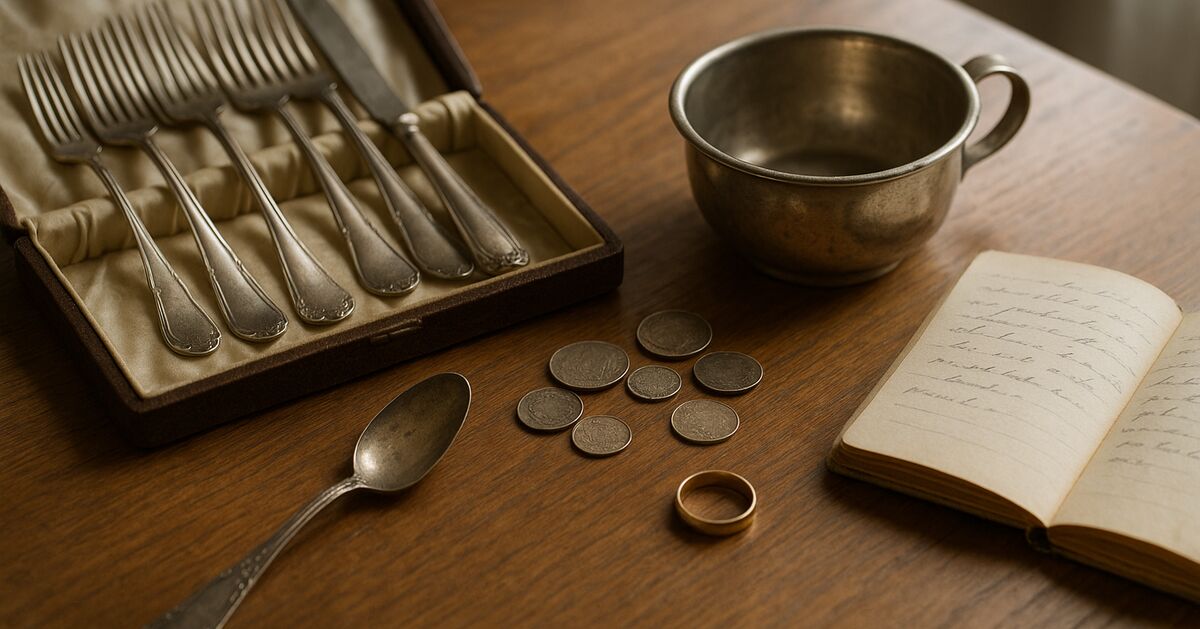
Staring at a box of inherited silver and gold and not knowing where to start is one of the most common situations sellers face. Over eighteen years of buying precious metal from the public, I fielded the same practical questions again and again, from people sorting through an estate, clearing a drawer, or just trying to figure out whether something is worth bothering with. What follows are plain, honest answers to the questions that came up most, grouped by theme so you can jump to whatever is relevant to you today.
Is it really silver? Telling sterling from silver plate
This comes up often, and it matters a great deal because sterling silver has real melt value while silver plate has almost none.
Look for the hallmark first. Genuine sterling silver sold in the United States is required to be marked 925, STERLING, or .925. British sterling carries a lion passant and other assay marks. If you see either of those, you almost certainly have the real thing.
What silver plate looks like. Plate is a base metal (usually brass or copper) with a thin layer of silver applied by electroplating. Common markings include EPNS (electroplated nickel silver), EPBM (electroplated Britannia metal), A1, or a brand name like "King Edward" followed by "silver plate." If a piece says "silver plate" anywhere on it, that is your answer. It is not sterling.
One question that comes up often involves a piece that says something like "sterling reinforced" or "sterling re-enforced .550." This phrasing usually describes a silver-plated item with a heavier silver deposit than standard plate, not solid sterling. The metal value is negligible.
The "King Edward" bowl question. A piece marked "King Edward / Silver Plate" with a KES emblem is silverplate, full stop. The tarnishing you see is normal for both sterling and plate, so tarnish alone tells you nothing about purity. A sterling baby spoon from the same set would be marked STERLING or 925 somewhere on the bowl or handle.
At-home tests. A strong magnet is a quick first filter: sterling silver is not magnetic, so if a piece is attracted firmly to a magnet it is almost certainly base metal. Beyond that, a jeweller's loupe to read hallmarks clearly goes a long way. Acid test kits are sold by jewelry supply companies and scratch the surface of the metal onto a test stone, then apply a drop of nitric acid; the color change indicates the silver content. They are inexpensive and reasonably reliable for a layperson. For any piece of meaningful value, though, a professional XRF (X-ray fluorescence) test at a coin shop or refiner gives you an accurate reading without damaging the piece.
Flatware sets, baby spoons, and weighted handles
Flatware sets. Named patterns from American makers like Gorham, Reed and Barton, Towle, and Wallace are reliably sterling if the piece is marked STERLING. A "Gorham Melrose" place setting or a "Rambler Rose" set from Whiting carries real silver value. The price you will receive is typically based on the actual troy-ounce weight of silver in the pieces, calculated from the known sterling alloy (92.5% silver). A buyer multiplies the total weight of sterling pieces by 0.925, then by whatever silver spot price is current, and then applies their margin. You can do this arithmetic yourself once you have a kitchen scale that reads in grams and know the current spot price.
Serving pieces marked "Italy." Italy is a country of origin mark, not a silver purity mark. Two large salad servers that say only "Italy" are almost certainly silver plate. If they were sterling, Italian law would require them to be marked 925 or 800 (Italy uses 800 for its lower-grade sterling equivalent). Without a numeric purity mark, assume plate.
Weighted handles. Hollow or weighted handles are common on butter knives and some serving pieces. The handles are typically filled with pitch, plaster, or cement to give them heft. A buyer cannot melt a weighted handle as if it were solid silver, so the value is calculated only on the sterling weight of the shell. Some pieces can be disassembled to remove the filler; some cannot without destroying them. Either way, expect the price to reflect only the actual silver content of the outer shell, not the total weight of the piece.
Does sterling need to be polished before selling? No. Tarnish is silver sulfide, a thin surface layer. It does not reduce the silver content in any meaningful way. Buyers who are buying for melt do not care about polish. Do not spend time or money cleaning flatware before getting quotes. (For coins, cleaning is actively harmful to collector value, as any coin dealer will tell you.)
Coins and bullion: what sells, what does not, and what is tax-relevant
Eisenhower dollars (1971-1978) and Bicentennial issues. Standard Eisenhower dollars minted for circulation contain no silver. The exceptions are the 1971-S, 1972-S, 1973-S, 1974-S, and 1776-1976-S (Bicentennial) issues in 40% silver, sold as collector sets. If your coins have an S mint mark and came in a blue or brown government box, they may be 40% silver. Circulation strikes with no mint mark, or with D or P, are clad copper-nickel with no silver value beyond face. The same logic applies to 1776-1976 Bicentennial quarters: the circulation version is clad, not silver.
Kennedy half dollars. 1964 halves are 90% silver. 1965-1969 halves are 40% silver. 1970-S is a 40% proof; all other 1970 and later halves in circulation are clad. So a batch of Kennedy halves from 1967 through 1998 will be a mix: some 40% silver (1967-1969), some clad (1971 onward). Sorting them by year matters before you price the lot.
40% silver halves. Yes, reputable buyers purchase 40% halves. The silver content per coin is lower than a 90% coin, so the price per coin is lower, but they absolutely have melt value worth capturing.
Silver Eagles and painted or colored rounds. A US Silver Eagle is 1 troy ounce of .999 fine silver and carries a legal tender face value of one dollar. A painted or colorized Silver Eagle has been altered after minting. The US Mint does not produce colorized coins; those are done by private companies or individuals after purchase. Collector premiums on colorized coins are generally lower than on unaltered examples, and many coin dealers pay only melt for them. If you have high-grade uncirculated Silver Eagles alongside colorized ones, keep them separate and mention the distinction when getting quotes.
One-ounce .999 rounds and bars. These are priced almost purely on silver spot. Generic silver rounds carry a smaller premium than US Mint Silver Eagles because they have no legal tender status and lower collector demand. For selling purposes, your spot calculation is straightforward: total troy ounces times spot price, minus the buyer's margin.
Black Hills gold rings and 12k gold. A ring marked "12k" contains 50% pure gold (12 parts gold out of 24). Black Hills gold jewelry is typically 10k or 12k gold with characteristic multi-tone gold leaf decoration. It has real gold value. The melt value is calculated by weight times purity (0.50 for 12k) times spot. A buyer who handles gold jewelry will buy it; the styling does not diminish the gold content.
10-dollar gold coins. These are most commonly pre-1933 US gold coins, either the Liberty Head ($10 Eagle) or the Indian Head ($10 Eagle), both of which contain 0.48375 troy ounces of pure gold. If your coins are dated before 1933 and in good shape, always get a coin dealer's opinion before treating them as pure scrap: collector premiums can be meaningful. If they are later commemoratives or replicas, the situation is different. Check the date and have them assessed.
For a broader look at how buyer types compare, the guide on where to sell silver: comparing buyer types and what each pays covers the landscape well, and the same thinking applies to gold coins.
Gemstones, diamonds, and stones in gold or silver
Does a buyer want the stones? Most scrap metal buyers do not purchase gemstones along with the metal. They are paying for gold or silver content, and stones add complexity rather than value to the transaction.
Do you need to remove them? For most sales, no. A buyer who is purchasing for melt will either remove the stones themselves or factor out their weight. What matters is that you do not receive silver or gold value for the weight of the stones. Ask any buyer how they handle set stones so you understand exactly what you are being paid for.
Are the stones worth anything separately? That depends entirely on the stone. A certified natural diamond in a desirable cut and clarity can have real resale value. Synthetic stones, cubic zirconia, paste, or common semi-precious stones typically have negligible resale value in the secondary market. If a piece has what looks like a significant diamond, get it assessed by a gemologist before selling the metal at scrap. For everything else, assume the buyer is not paying for the stones.
Cubic zirconia specifically. No need to remove CZ stones before selling the gold or silver setting. They will not be purchased separately, and many buyers will simply push them aside when weighing the metal.
For context on selling pieces that combine diamonds and precious metal, the post on selling inherited or scrap precious metal: a consumer guide walks through the decision-making process from start to finish.
Testing, karat disputes, and items that turn out not to be precious metal
"I was told my 14k bracelet isn't real." This happens. Imported jewelry, particularly from certain markets, is sometimes stamped with a karat mark that does not accurately reflect the metal. A buyer who will not explain their test method is a red flag. Reputable buyers use acid testing or XRF testing and should be willing to show you the result. XRF in particular is non-destructive and gives a percentage readout you can see for yourself.
Testing it yourself. An acid test kit from a jewelry supply retailer costs very little and comes with instructions. You scratch the metal on a stone, apply the acid for the karat you are testing (10k, 14k, 18k acids are sold separately), and read the color. It is not as precise as XRF but will tell you whether a piece is gold, gold-filled, or base metal. Gold-filled pieces have a very thin layer of karat gold bonded to brass; they read as gold on a superficial scratch but the layer is too thin to yield meaningful scrap value.
What happens if you accidentally send a non-precious item? A responsible buyer returns non-precious items to you, often at their cost if the item arrived as part of a larger shipment they were expecting. Always ask a mail-in buyer about their policy for non-precious items before shipping anything. You should never have to wonder whether your non-silver item was discarded.
Tax questions: what the IRS expects when you sell silver or gold
Precious metals are classified as collectibles by the IRS. If you sell silver or gold for more than you paid for it, the profit is a capital gain. Short-term gains (held under one year) are taxed at ordinary income rates. Long-term gains (held over one year) are taxed at the collectibles capital gains rate, which is currently capped at 28% for federal purposes, though your actual rate depends on your income bracket.
To use the example that comes up often: if you bought 100 troy ounces of silver bars for $2,000 and later sold them for $2,500, the $500 profit is a taxable capital gain. You report it on Schedule D of your federal return. You are responsible for tracking your own cost basis (what you paid, including any purchase premiums or shipping costs at the time of buying).
What does a buyer report to the IRS? This depends on the type of transaction. Buyers are required to file a Form 1099-B for certain reportable transactions involving specific precious metal products above defined quantity thresholds. The reporting rules are set by the IRS and have changed over the years; a buyer should be able to tell you whether your specific transaction triggers a 1099-B. If you are selling inherited silver for which you have no original purchase price, the cost basis is generally the fair market value at the date of the original owner's death, which a probate attorney or CPA can help you document.
The tax side of selling is worth understanding before you sell, not after. A brief conversation with a tax professional is money well spent if you are selling a significant quantity.
Necklaces, pendants, and jewelry marked .925
A necklace or pendant marked .925 is sterling silver. The .925 stamp is the international decimal equivalent of the STERLING mark used on US pieces. If the fastener on a pair of earrings is marked .925, the fastener is sterling. Whether the decorative beads are sterling depends on whether they carry their own .925 or 925 mark. If they do not, the safest assumption for a buyer's purposes is that they are a different material. The weight of unmarks beads would typically be excluded from the sterling calculation, or the buyer would verify the beads separately with a test.
For a piece described as "a silver necklace pendant made in Italy," the same rule applies: look for a numeric purity mark. If it says 925 or 800, it has silver value. If it has no purity mark, treat it as unknown until tested.
Flutes stamped "solid silver," belts with sterling conchos, and other specific items
Flutes stamped "solid silver." Musical instrument flutes are sometimes stamped "solid silver" by their manufacturers, but the meaning is not the same as sterling. Many student flutes are silver-plated or made of nickel silver (which contains no silver at all). Professional flutes can be made from sterling (92.5%) or from higher-purity silver alloys, but the stamp "solid silver" alone is not a legal guarantee of sterling content. Have the metal tested before assuming it has scrap value.
Sterling silver belt conchos on leather. You do not need to detach the conchos before getting a quote. A reputable buyer can assess them in place or will handle the separation. That said, if conchos are easily removable without damaging them or the leather, it often makes weighing more straightforward. Ask the buyer what they prefer.
14k white gold. White gold contains the same gold content as yellow gold at the same karat: a 14k white gold ring is 58.3% pure gold. The white color comes from alloying with metals like palladium or nickel, sometimes with a rhodium plating on top. Buyers pay for the gold content, not the color. A 14k white gold high school ring is bought and sold the same way as any other 14k piece.
How buyers make money, and what to expect from the process
A metal buyer makes money by paying you slightly less than the value they will eventually recover when the metal is refined and sold. That margin covers their operating costs, the time value of money while the metal is in transit and processing, and their profit. The margin varies by buyer type: a local coin dealer has high overhead; a mail-in buyer has lower overhead but shipping and insurance costs; a refiner has the lowest margin but typically deals in volume and may not be practical for small lots.
A question that comes up often is: "what percentage do you keep?" Honest buyers will explain this, and you should expect them to. The useful number is not what percentage they keep but what percentage of spot you will receive. As a general guideline, offers well below spot price tend to be poor, while offers in the mid-to-high percentage range of spot are more typical for small retail quantities of common scrap, though you should compare multiple buyers.
For a worked example of how to compare offers across buyer types, the post on where to sell scrap gold: comparing buyer types and what each pays is a good companion read. The same methodology applies to silver.
Coins you send for quotes: what happens if you decline the offer
A question worth addressing directly: if you send coins to a mail-in buyer and decline their offer, you receive your exact coins back, not equivalent coins, not a check for face value. This should be guaranteed in writing by the buyer's terms before you ship anything. If a buyer's terms do not commit to returning your specific coins, that is a warning sign. The frequently asked questions page on this site covers how to evaluate a mail-in buyer's terms before committing.
The broader lesson, which runs through many of the questions above, is that selling precious metal rewards the person who asks questions before shipping or handing anything over. The more you understand about what you have and how the pricing works, the less likely you are to accept an offer that does not reflect the real value of your metal.
If you are early in the process and trying to make sense of what a buyer even does with your scrap once they have it, the how to sell silver consumer guide is a good place to start. And if you have ever felt rushed or pressured by a buyer, it is worth reading about the pressure tactics used by silver buyers and how to beat them before your next transaction. Going in informed is the single best thing you can do for your outcome.
Sources & further reading
- IRS Publication 544: Sales and Other Dispositions of Assets (collectibles capital gains) (U.S. Internal Revenue Service)
- IRS Schedule D instructions: reporting capital gains and losses (U.S. Internal Revenue Service)
- IRS Form 1099-B: Proceeds from Broker and Barter Exchange Transactions (U.S. Internal Revenue Service)
- USGS Mineral Resources Program: Silver commodity summary (U.S. Geological Survey)
Revision history (1)
- Pre-publish editorial QA: 4 flagged, 4 softened; claim audit: 8 claims, 1 rewritten
Claim-by-claim audit (8 checked)
- “Long-term gains (held over one year) are taxed at the collectibles capital gains rate, which is currently capped at 28% for federal purposes, though your actual rate depends on you…” (cited → irs.gov)
- “You report it on Schedule D of your federal return.” (cited → irs.gov)
- “Buyers are required to file a Form 1099-B for certain reportable transactions involving specific precious metal products above defined quantity thresholds.” (cited → irs.gov)
- “If you are selling inherited silver for which you have no original purchase price, the cost basis is generally the fair market value at the date of the original owner's death, whic…” (reasoning shown in the article)
- “Standard Eisenhower dollars minted for circulation contain no silver.” (reasoning shown in the article)
- “1964 halves are 90% silver. 1965-1969 halves are 40% silver.” (reasoning shown in the article)
- “A US Silver Eagle is 1 troy ounce of .999 fine silver and carries a legal tender face value of one dollar.” (reasoning shown in the article)
- “As a general guideline, offers well below spot price tend to be poor, while offers in the mid-to-high percentage range of spot are more typical for small retail quantities of commo…” (rewritten to what the article can stand behind)