
What "as-found" silver means and why cleaning costs you
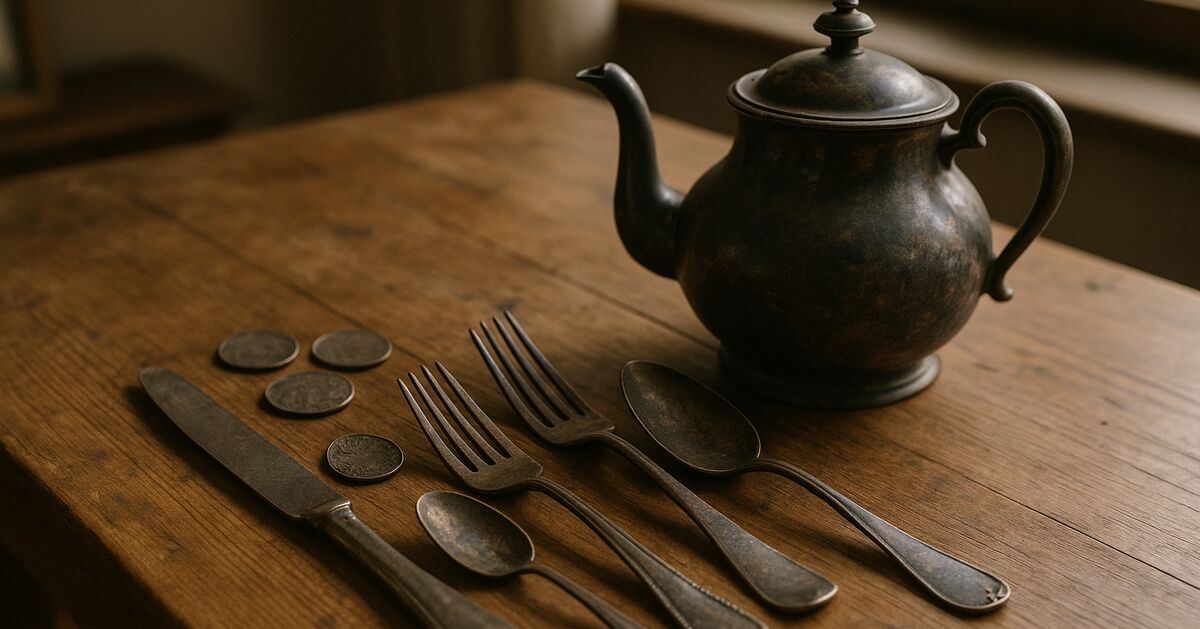
Tarnished silver looks like a problem. It is not. That dark, sometimes almost black coating sitting on a Victorian sugar bowl or a set of old coins is not damage, not dirt, and not something a buyer is going to dock you for. In fact, the moment you rub it away, you may have just wiped money off the table. This post explains exactly what "as-found" condition means in the silver trade, why experienced buyers use that phrase with purpose, and how to protect your payout by keeping your hands off the polish.
What "as-found" actually means
"As-found" is the trade's shorthand for exactly the condition in which an item was discovered, whether that is the back of a sideboard drawer, a box in a loft, or a probate house clearance. No cleaning, no polishing, no amateur repairs, and no attempts to make the piece more presentable.
When a coin dealer, bullion buyer, or antique silver specialist uses the phrase "as-found," they are signalling something important: they want to see the item the way time left it, because that is the most useful state for them. It tells them what the silver has been through, what the surface genuinely looks like under any patina, and, crucially for collectable or antique pieces, whether the originality of the surface is intact.
The phrase also protects you as a seller. When a buyer makes an offer on an as-found piece, they are taking the item's condition into account themselves. You are not being asked to prepare it, and you cannot inadvertently damage it before the offer is made. That is a meaningful distinction.
Why tarnish is not the enemy
Tarnish on silver is silver sulfide, a thin chemical layer that forms when silver reacts with sulfur compounds in the air or in certain materials like rubber, wool, and eggs. Tarnish forms naturally on fine and sterling silver and is chemically stable, according to standard conservation guidance. It does not eat into the metal the way rust eats iron. It sits on the surface.
For a scrap buyer, tarnish is entirely irrelevant. They are going to melt the piece. The silver content is what matters, and tarnish does not change the troy weight or the purity of the alloy underneath. Bringing a piece in covered in black tarnish gets you exactly the same melt offer as bringing in a gleaming one, because the buyer is working from the hallmark or assay, not the shine.
For an antique or collectable buyer, tarnish can actually be evidence of age and authenticity. A piece that has a naturally aged patina consistent with a Victorian or Edwardian date tells the buyer the surface has not been tampered with. It builds confidence. A mirror-bright piece that should be 150 years old raises a question immediately: why does it look like that?
What cleaning actually does to silver
This is the part that surprises sellers who grew up polishing the family silver for Christmas. Mechanical polishing, whether with a cloth, a paste, or an abrasive, removes a microscopic layer of silver every single time. Over decades of regular polishing, hallmarks can become shallow and hard to read. Engraved patterns soften and lose definition. And on coins, the effect is even more dramatic and more costly.
On collectable coins, the surface is called the "skin," and it has a reflective quality called luster or mint bloom that was applied once at the moment of striking and never again. Polishing destroys it permanently. A coin with original luster intact can often command more than spot price, depending on demand. A polished coin is often only worth melt value, since many numismatists avoid coins with disturbed surfaces. The downgrade from collectable to scrap can mean a noticeably lower price than the coin might otherwise fetch.
Even chemical dips, which look gentler than abrasive pastes, strip the surface chemically. On pieces with fine engraving, niello inlay, or applied decoration, a dip can pull the patina from recessed areas unevenly, leaving a blotchy, etched look that is worse than the tarnish was.
If you are wondering how to tell what you actually have before deciding anything, the guide to how to sort an inherited box of silver before getting quotes walks through a sensible triage process that does not require touching anything.
The coin problem explained in plain numbers
Imagine you have a pre-1920 British shilling. It contains 0.0842 troy ounces of sterling silver. At a silver price of £25 per troy ounce, the melt value is around £2.10. As a circulated but unpolished coin in original condition, a coin dealer might pay somewhat more than melt, depending on date and mint. As a coin with visible original luster in a good grade, that number could be higher still for certain dates.
Now you polish it. The luster is gone. The coin is no longer collectable grade. The offer goes to melt, or close to it. You have done irreversible work to reduce your payout.
Sellers sometimes present polished coins believing they have made them more desirable, only to be told the opposite. The understanding of why cleaning harms value is something dealers take for granted but sellers often encounter for the first time at exactly the wrong moment.
For a broader look at how buyers assess value in inherited or found metal, the practical guide to selling inherited or scrap precious metal covers how to approach the process without losing money in the preparation stage.
What about flatware and hollowware?
For sterling flatware, the calculus is slightly different. A set of Victorian fish knives that is destined for melt regardless of condition does not suffer from being polished, because the only value being extracted is the silver content. But you will not know in advance whether a piece has collectable value above melt without having it assessed, and polishing before that assessment removes the information a specialist needs.
Flatware with an identifiable maker, an interesting period design, or an unusual pattern may attract a premium from a specialist dealer or auction house. Holloware, meaning bowls, teapots, jugs, and the like, even more so. Cleaning before you know what you have is closing off better options in exchange for a shinier piece.
There is also the practical question of weighted pieces. Some canteen knives have handles filled with pitch or resin, which can add weight without adding silver value. Those handles are not silver, and a buyer will account for the non-silver content in any melt offer. If you are navigating that kind of mixed-material piece, the detailed breakdown of weighted knife handles and what they do to canteen value is worth reading before you approach any buyer.
What sellers should do instead of cleaning
The practical answer is simple: photograph and describe, do not scrub.
Good photographs taken in natural daylight, showing the piece from multiple angles, give any buyer enough visual information to make a preliminary assessment. If there is a hallmark, photograph it closely enough that the punches are legible. If there is a maker's mark, engraving, or any damage, photograph those too. Honest description and good images are your preparation, not a polishing cloth.
If you want to remove loose dust or surface debris, a very soft dry brush (the kind used for photographic lenses or watercolour painting) will shift loose particles without touching the silver itself. That is as far as preparation should go.
When you are comparing offers, present the same unaltered piece to every buyer so you are getting comparable assessments. Mixing cleaned and uncleaned pieces across different buyers makes it harder to judge who is offering fair value.
The home page at How To Sell Silver has a clear starting point for working through the selling process from identification to payout, and the frequently asked questions page covers many of the specific questions sellers have about what buyers look for.
Why buyers actually prefer as-found
A buyer who sees a tarnished, unpolished piece has full information. They can see the surface clearly enough to assess condition. They know the seller has not tried to mask damage. They know no metal has been removed. For a buyer assessing antique or collectable value, as-found is a positive signal about the seller's approach and the piece's integrity.
A buyer who sees a freshly polished piece has to wonder. Has buffing hidden surface scratches? Has a dip masked pitting? Has heavy polishing worn down a cartouche or softened a maker's mark? These are not paranoid questions. They are the professional experience of someone who has handled many pieces where cleaning was used, knowingly or unknowingly, to obscure problems.
This is one of the reasons experienced sellers of estate silver bring pieces in as-found and describe the condition verbally rather than presenting a polished piece and saying nothing. It signals competence and good faith, and that often influences the dynamic in your favor.
For a look at how the broader landscape of silver buyers operates and how each type approaches condition and value differently, the gold and silver exchange practical guide explains the spectrum from bullion dealers to specialist auction houses.
When cleaning might be neutral (and when it still is not)
There is one narrow circumstance where cleaning has no negative effect: a piece with no collectable potential whatsoever, with no hallmark or identifiable maker, that is going to be sold purely on weight to a bullion refiner. In that case, the metal is the metal. Polishing does not help but does no meaningful harm.
But here is the catch: you need to know in advance that a piece falls into that category, and knowing that requires the kind of assessment that is easier to do on an unaltered piece. The safer default in every situation is to leave it alone until someone who buys silver professionally has told you what it is and what it is worth.
The other candidate for cleaning is silver plate, which has no meaningful bullion value and is sold primarily on its appearance for reuse or decorative purposes. Even there, cleaning should be done carefully and with appropriate products, because plate can be worn through to the base metal by abrasive polishing, which reduces rather than increases appeal. The distinction between plate and sterling is worth understanding before you do anything, and there is a full breakdown in the guide to how to tell sterling silver from silver plate at home.
The short version
Tarnish is not a problem. Polishing is often a permanent, costly mistake. Buyers of both scrap silver and collectable silver prefer pieces presented as-found. Your job before selling is to photograph carefully, identify hallmarks, and get quotes, not to prepare the surface. Leave the polishing cloth in the drawer until after you have sold, and ideally forever.
If you want to go deeper on the mechanics of how buyers work and what drives their offers, the blog has a growing archive of practical guides covering everything from reading hallmarks to comparing buyer types. Good information before you sell is always worth more than a mirror finish.
Sources & further reading
- Care and handling of silver collections (Library of Congress Preservation)
- Caring for silver and metalwork (English Heritage)
Revision history (1)
- Pre-publish editorial QA: clean; claim audit: 7 claims, 7 rewritten
Claim-by-claim audit (7 checked)
- “Tarnish forms naturally on fine and sterling silver and is chemically stable, according to standard conservation guidance.” (rewritten to what the article can stand behind)
- “A coin with original luster intact can often command more than spot price, depending on demand.” (rewritten to what the article can stand behind)
- “A polished coin is often only worth melt value, since many numismatists avoid coins with disturbed surfaces.” (rewritten to what the article can stand behind)
- “The downgrade from collectable to scrap can mean a noticeably lower price than the coin might otherwise fetch.” (rewritten to what the article can stand behind)
- “As a circulated but unpolished coin in original condition, a coin dealer might pay somewhat more than melt, depending on date and mint.” (rewritten to what the article can stand behind)
- “Sellers sometimes present polished coins believing they have made them more desirable, only to be told the opposite.” (rewritten to what the article can stand behind)
- “Some canteen knives have handles filled with pitch or resin, which can add weight without adding silver value.” (rewritten to what the article can stand behind)