
Weighted knife handles and what they do to canteen value
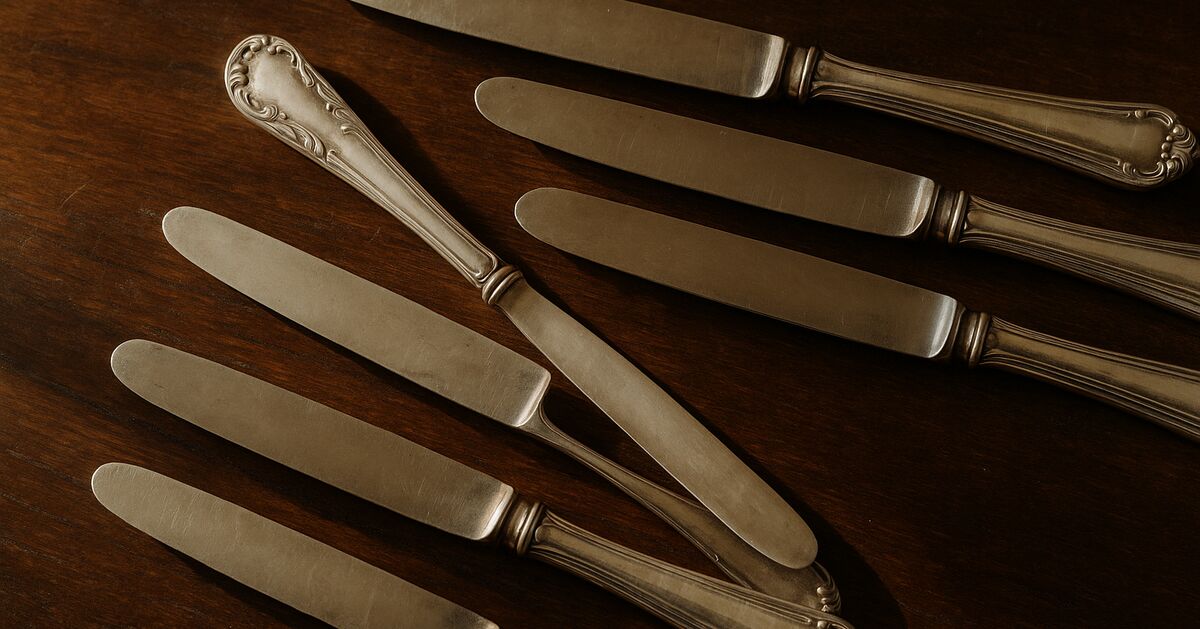
Weighted knife handles quietly destroy more silver canteen valuations than almost any other single factor - and sellers rarely see it coming. You bring a beautiful canteen to a dealer, the hallmarks are perfect, the pattern is desirable, and then the buyer picks up a dinner knife, tilts it, and the whole conversation changes.
Understanding why that happens, and what you can do about it, is the subject of this post.
What "weighted" actually means
A traditional British or European sterling dinner knife has a blade made from steel or stainless steel and a handle made from sterling silver. The two parts are joined, typically with a short tang running from the blade into the handle and secured with a resin or pitch compound. That compound also fills the hollow interior of the handle, giving the knife the weight and balance a diner expects when picking it up.
The filler is not silver. It is typically a pitch-based compound (a mixture of resin, chalk, and other inert materials), plaster, cement, or in older Victorian pieces sometimes a lead-based material. This practice was standard across the silversmithing trade because a handle made from solid sterling would be prohibitively expensive, disproportionately heavy at the wrong end, and structurally awkward to attach to a blade.
So when a buyer or catalog description says a canteen contains "weighted knife handles," it simply means the handles are hollow sterling shells filled with a non-silver compound. This is entirely normal and expected. The problem arises when people assume the weight of a knife equals silver content - or when the filler itself has degraded.
Why weighted handles matter to a silver buyer
When a dealer buys a canteen for its melt value, they are paying for the actual silver content. A weighted knife handle contains a sterling shell - often quite thin - surrounding a core of non-silver filler. The actual silver weight in a single dinner knife handle can vary considerably from the knife's total weight, since the filler compound adds no silver value.
This gap between apparent weight and true silver content is significant. A canteen of twelve place settings typically includes twelve dinner knives. If a buyer is not careful, those knives could mislead a rough calculation by a meaningful margin. An experienced buyer will either weigh the knives separately and apply a lower silver percentage, or simply quote conservatively to protect their margin.
The same logic applies if you are trying to work out what your canteen is worth before you sell. Our worked example post on what sterling flatware is actually worth walks through exactly this kind of calculation, and weighted handles are one of the adjustments you need to make.
The three conditions that affect value most
Not all weighted handles are equal. What matters practically is the condition of the weighting compound and the integrity of the sterling shell around it.
Intact and stable compound
If the filler is solid, the handle feels firm, and there is no evidence of cracking or movement, a buyer will treat the knife as a presentable flatware piece. The melt calculation is adjusted downward for the filler, but the piece is not damaged. For canteen buyers who care about the complete set for resale (rather than scrap), an intact weighted knife presents no real problem.
Cracked or shrunk compound
Pitch and resin compounds shrink slightly over decades. In a knife that has been through many dishwasher cycles or stored in a damp environment, the filler can pull away from the inner wall of the handle. You may be able to hear a faint rattle, or feel the handle flex very slightly. This is repairable by a silversmith, but it signals that the set has not been ideally stored. Buyers will note it.
Blown or leaking compound (the worst case)
Heat is the real enemy. Dishwashers, especially older high-temperature machines, can soften the pitch compound enough that it expands and then cracks the seam where the blade meets the handle. In severe cases the blade pulls loose entirely. A canteen with several loose or detached blades is a significant problem for a resale buyer - the repair cost per knife can exceed the resale value of the knife itself. For a scrap buyer, a detached blade simply means they have to handle the pieces separately, but the pricing will reflect the extra work.
If you are uncertain whether your canteen has been dishwashered heavily, check a few knives by pressing firmly where the blade meets the handle. Any movement at all is worth flagging honestly when you approach a buyer. Transparency here will save you a renegotiation at the point of sale.
How weighted handles interact with pattern and age
This is where it gets nuanced. For a canteen being sold as a usable, complete set rather than for scrap, the weighted handle issue is less about silver content and more about aesthetics and function.
Pre-war canteen sets from the Edwardian era and earlier were often made with exceptional care. The sterling shells on the handles are frequently thicker, the patterns more sharply struck, and the pitch compound more stable simply because it has never been near a dishwasher. These older knives, even with weighted handles, can be genuinely desirable to collectors and estate buyers.
Post-war production, particularly sets made in the 1950s and 1960s when silversmiths were cutting costs, sometimes features thinner sterling shells and a lower-quality filler. Pattern crispness can also vary. The handles may look fine from the outside but contain noticeably less silver per piece.
The practical takeaway: age alone does not tell you whether weighted handles help or hurt. You need to look at the shell quality, the pattern, and the condition of the joint.
It is also worth noting that some canteens mix handle types across the set. Fish knives and dessert knives in particular sometimes used a different construction than dinner knives. If you are reading hallmarks on individual pieces and something looks inconsistent, our post on sterling silver hallmarks explained covers what to look for and why different pieces in the same canteen can carry different date letters.
How to check what you actually have
You do not need specialist equipment to get a reasonable sense of the handle situation before you approach a buyer.
- Weigh the knives separately from the rest of the flatware. Note the total weight of all the knives. Experienced dealers typically apply a reduced silver percentage to weighted knife handles depending on style and era, so the true silver content is well below the total weight on the scale.
- Check the blade-to-handle joint on every knife. Press gently. Any give or wobble is a red flag.
- Listen for rattles. Hold each knife by the blade and tap the handle lightly on your palm. A slight hollow sound is normal. A rattling or clicking sound suggests the filler has shrunk or cracked.
- Look at the seam. On some designs the seam where blade meets handle is visible. Darkening, separation, or a gap suggests heat damage.
- Count the complete knives. A canteen sold with ten dinner knives out of twelve place settings is an incomplete set, which matters a great deal to resale buyers even if it means little to a scrap buyer.
If you are still unsure whether you are holding sterling or something plated, the how to tell sterling silver from silver plate at home guide covers the practical tests you can do without any lab equipment.
What dealers and auction houses do differently
A high-street silver dealer buying for resale will look at weighted knife handles very differently from a smelter or refiner buying for melt.
A resale dealer wants a complete, attractive, usable canteen. Weighted handles are not a problem if the knives present well and function correctly. The price they offer reflects the retail market for that pattern and the completeness of the set - not just the silver weight. In that context, three rattling knife handles could knock a meaningful amount off the offer because they represent repair cost or difficulty in reselling.
A scrap buyer, by contrast, is only interested in the silver content. They will weigh the knives, apply their standard percentage for weighted handles, and factor that into a per-troy-ounce offer. The condition of the filler matters less, though damaged pieces may involve extra processing.
Auction houses sit somewhere between the two. For a desirable pattern in a well-known canteen style, they may catalog the set with a note about the weighted handles and let the market decide. For a plainer set, they may lump it with other flatware lots where individual knife conditions matter less.
Understanding which type of buyer you are talking to, and what they are optimizing for, shapes how you present the canteen and which condition issues you raise upfront. The frequently asked questions section covers some of the most common points of confusion sellers encounter when approaching different buyer types.
A note on repairs and whether they are worth it
Silversmiths can re-pitch weighted knife handles. The blade is removed (carefully, using gentle heat), the old compound is cleaned out, new pitch is poured and set, and the blade is reseated. Done well, the result is a knife that functions as new.
The question is whether the cost of that repair adds more to the sale price than it costs. For a high-value canteen in a sought-after pattern - Hanoverian, King's, Old English, for instance - with otherwise excellent condition, a professional repair may make commercial sense, particularly if the canteen is being sold to a resale buyer rather than a smelter. For a plain post-war canteen of modest pattern, the repair cost is unlikely to be recovered.
Get a repair quote from a silversmith before you decide, and compare it honestly to the likely improvement in your sale price. If you are unsure whether your canteen is the kind of set worth investing in, the discussion in should I sell my grandmother's silver canteen or keep it may help you think through the wider question.
Putting it together: what to tell a buyer
When you contact a buyer about a canteen with weighted knife handles, you do not need to be defensive about it. Many complete canteen sets have weighted knife handles. It is the norm, not an exception.
What separates a smooth transaction from a frustrating renegotiation is coming in with accurate information:
- The total number of knives and whether all are present and complete.
- Whether you have checked for rattling handles and loose blades.
- Whether the set has been kept out of the dishwasher (and if not, roughly how often it was used in one).
- The approximate total weight of the knives separately from the rest of the flatware.
A buyer who gets this information upfront can make a confident offer. A buyer who discovers three loose blades after agreeing a price in principle will revise downward - and that revision tends to feel worse than if the issue had been on the table from the start.
Weighted handles are a structural feature, not a flaw. The real variable is condition, and condition is something you can assess, report honestly, and sometimes improve. That is where your attention is best spent before the sale.
For more practical guidance on canteens and flatware, the full blog archive covers a range of related topics from hallmark reading to understanding buyer pricing.
Sources & further reading
- Silver and silverware conservation guidance (Museums Association)
- Precious metals composition and assay standards (World Gold Council (covers precious metals standards broadly))
- Worshipful Company of Goldsmiths: hallmarking and standards (Goldsmiths' Company)
Revision history (1)
- Pre-publish editorial QA: 1 flagged, 1 softened; claim audit: 4 claims, 2 rewritten
Claim-by-claim audit (4 checked)
- “The actual silver weight in a single dinner knife handle can vary considerably from the knife's total weight, since the filler compound adds no silver value.” (rewritten to what the article can stand behind)
- “Experienced dealers typically apply a reduced silver percentage to weighted knife handles depending on style and era, so the true silver content is well below the total weight on t…” (rewritten to what the article can stand behind)
- “In severe cases the blade pulls loose entirely.” (reasoning shown in the article)
- “Pitch and resin compounds shrink slightly over decades.” (reasoning shown in the article)