
Sterling silver hallmarks explained: reading the four
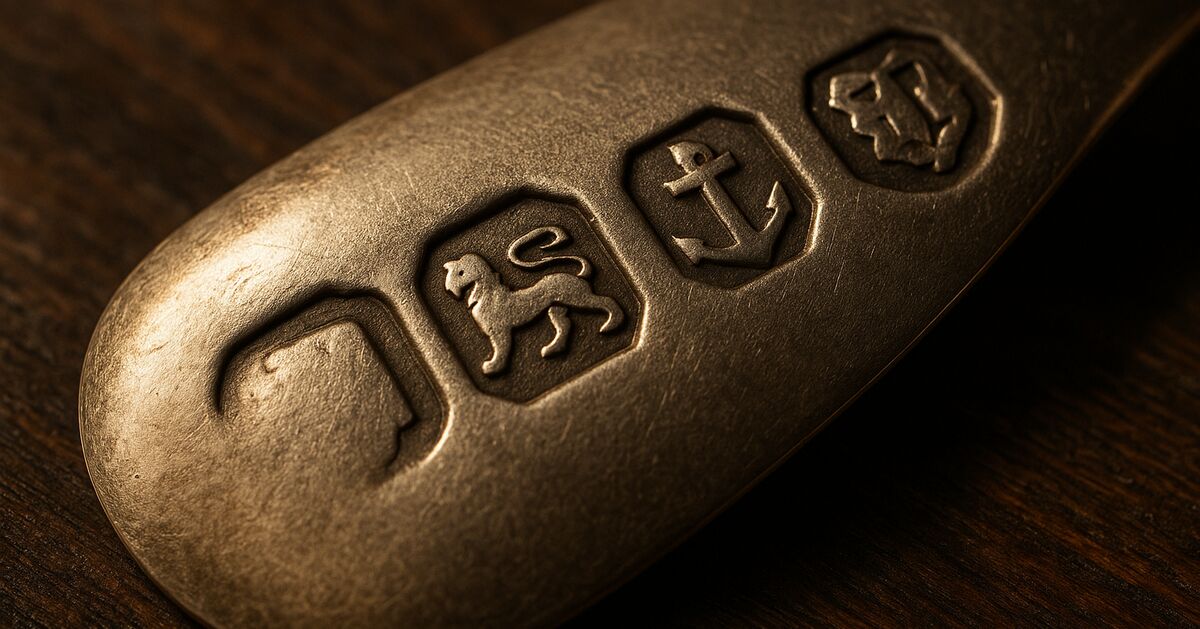
Four tiny punched symbols can tell you more about a piece of silver than any seller's story ever will. British hallmarks are among the oldest statutory consumer-protection systems for precious metals, and once you know what each mark means, a loupe and a bright light can help you read a piece more like a professional.
This guide walks through every component of the traditional British hallmark system, explains the history behind it, and shows you exactly how to use what you find to understand what you own.
Why Britain developed hallmarks in the first place
The word "hallmark" comes from Goldsmiths' Hall in London, where the Worshipful Company of Goldsmiths began testing and marking silver in 1300 under a statute of Edward I. The problem the system solved is the same one that plagues precious-metal buyers today: you cannot tell the purity of an alloy by looking at it. A dishonest silversmith could plate base metal, mix in cheap copper, or simply lie. Compulsory independent assaying - testing by a neutral authority - removed that temptation by making fraud traceable.
The Hallmarking Act 1973 modernised the system and is still the governing law in the United Kingdom. It requires that any article described as silver and weighing above certain thresholds must carry a hallmark from one of the UK's recognized assay offices before it can legally be sold. That legal weight is part of why hallmarks are so useful to sellers: they are not decorations, they are sworn statements of purity made by a body that staked its reputation on accuracy.
The four standard British marks
A fully hallmarked piece of British sterling will carry four distinct marks, usually struck in a row or clustered on an inconspicuous area (the back of a spoon bowl, the underside of a teapot base, the inside of a ring shank). Older pieces sometimes show the marks spread across different parts of the object. Here is what each one means.
1. The maker's mark (sponsor's mark)
The first mark identifies who was legally responsible for submitting the piece for assay. Before the nineteenth century this was usually a smith's initials inside a shaped cartouche (a shield, lozenge, or oval). After 1890 the cartouche shape became less regulated, but the initials or letters remained. Today it is called the "sponsor's mark" because it may represent a manufacturer, a retailer, or an importer rather than the person who physically made the object.
Reading a maker's mark takes a reference book or a search of the UK Assay Office's online sponsor's mark database. Well-known Georgian and Victorian smiths, such as Hester Bateman, Paul Storr, and Robert Garrard, are often associated with higher collector interest partly because their maker's marks are recognizable. Even an unfamiliar maker's mark matters, though: it confirms that a real, registered party submitted the piece and accepted liability for its stated purity.
2. The standard mark (fineness mark)
This is the mark that tells you the metal's purity. For sterling silver the standard mark is a lion passant - a lion walking to the left with its right forepaw raised. It has been used in England since 1544 and is one of the most iconic symbols in the decorative arts.
Sterling silver is defined as a minimum of 92.5 % pure silver, with the remainder (7.5 %) typically copper for hardness. The lion passant is shorthand for that 925 standard. Scotland used a different symbol historically (a thistle, and before that a lion rampant), while Ireland used a crowned harp. Since 2010 the UK has also accepted numeric fineness marks (925, 800, 999, etc.) from the International Convention on Hallmarks, so modern pieces may show "925" in place of or alongside the lion.
Two other British silver standards you may encounter:
- Britannia standard (958): Introduced in 1697 and marked with a seated figure of Britannia. This higher-purity alloy was mandatory for a period but is now optional and relatively rare. It is softer than sterling and was used for fine presentation pieces.
- Britannia 999 (fine silver): Marked with a different Britannia figure and the number 999. Uncommon in antique silverware but found in modern bullion flatware and commemorative pieces.
If you are still sorting out whether your piece is sterling at all rather than silver-plated, our post on how to tell sterling silver from silver plate at home covers the practical tests step by step before you even reach for a loupe.
3. The assay office mark (town mark)
This symbol identifies which office tested and struck the hallmark. Each office has used its own symbol for centuries:
- London: A leopard's head (technically a lion's head, but called a leopard's head in the trade since at least the 14th century). The crown above the head was dropped in 1821.
- Birmingham: An anchor - reputedly chosen because the Birmingham delegates arrived by boat at the meeting that established their office in 1773.
- Sheffield: A crown (a rose replaced the crown briefly in 1975 but the crown was restored in 1975 per the Hallmarking Act).
- Edinburgh: A triple-towered castle.
- Chester (closed 1962): Three wheat sheaves and a sword.
- Newcastle (closed 1884): Three castles.
- Exeter (closed 1883): A three-towered castle with a round arch.
- York (closed 1858): Five lions on a cross.
- Dublin (Irish, not technically British): A crowned harp, then Hibernia from 1730.
Knowing the assay office can help you date a piece and can also affect value. Birmingham and Sheffield offices handled enormous quantities of Victorian and Edwardian domestic silver, so their marks are common. Pieces from smaller or earlier offices in good condition tend to attract collector interest.
4. The date letter
The date letter is a single letter of the alphabet in a specific font and cartouche shape that changes every year (or every cycle, as some offices ran shorter cycles). It tells you the year the piece was assayed, not necessarily the year it was made (a smith might hold stock for a season before submitting it), but the two are usually within a year of each other.
Each assay office kept its own independent date-letter cycle, starting on different dates and using different typefaces, so the same letter in the same year looks different depending on the office. A lowercase "k" in an ornate shield from London means a different year than the same letter in a plain rectangle from Birmingham.
Reference books such as Jackson's Silver and Gold Marks (first published 1905 and updated in various modern editions) have full tables of date letters by office. Free online resources from the UK Assay Office and the website of the Silver Society also carry searchable date-letter charts. Dating your piece accurately is genuinely worth the ten minutes of research: a piece dated to a specific monarch's reign, or to a celebrated designer's active years, can carry a collector premium that a cash buyer of scrap silver will never volunteer to mention.
A fifth mark: the monarch's head (duty mark)
Between 1784 and 1890, a fifth mark appeared: a small incuse portrait of the reigning monarch's head. This was a duty mark, stamped to show that the excise tax on silver had been paid. It is not part of the current four-mark system, but its presence is extremely useful for dating because you can identify which monarch is depicted - George III, George IV, William IV, Victoria - and narrow the date of manufacture to a specific reign even without consulting date-letter tables.
From 1935 onward, a voluntary jubilee or commemorative mark has occasionally been available (1935, 1953, 1977, 2002, 2012, 2022), struck as an additional fifth mark to celebrate royal milestones. These are not duty marks, carry no tax significance, and simply add a decorative and dating note.
Where to find hallmarks on common objects
Knowing the marks is one thing; finding them is another. Assay offices typically required marks to be struck in a place that would not damage the piece in use but would survive normal wear. Common locations:
- Flatware (spoons, forks): Back of the bowl or tine end, sometimes the back of the handle near the junction.
- Hollow ware (teapots, jugs, bowls): Underside of the base, sometimes the inside lid rim.
- Candlesticks: Inside the foot rim, or on a removable nozzle.
- Boxes and cases: Inside the lid or base.
- Jewelry: Inside a ring shank, on the clasp of a bracelet, inside a locket.
- Larger composite pieces: Individual components (lid, body, handle collar) may each carry a partial or full set of marks.
On heavily used or cleaned pieces, marks can be worn. A strong 10x loupe and a raking light (light coming from the side at a low angle) will reveal faint marks that appear invisible under direct overhead light. If you own a piece of flatware with hallmarks you are still trying to read clearly, our worked example on sterling flatware value shows how to turn what you find into a realistic value estimate.
Reading marks on imported and foreign silver
The Hallmarking Act 1973 also allows silver from countries that are signatories to the International Convention on Hallmarks (the "Vienna Convention") to be sold in the UK bearing a Convention mark rather than a British assay mark. The Convention mark consists of a set of scales (the "common control mark") alongside a numeric fineness figure. You may also encounter:
- French silver: An owl (import mark) or a head-in-oval (domestic guarantee mark), with "950" or "800" fineness.
- German silver: "800" or "925" with a crescent-and-crown guarantee mark used until 1888, then individual maker/assay combinations.
- Scandinavian silver: Numeric fineness plus a date letter and town mark, often extremely legible.
- American silver: No mandatory hallmark system exists. Sterling is designated only by the word "STERLING" or "925" stamped by the maker. There is no independent assay office verification in U.S. domestic trade, which is one reason American pieces rely heavily on maker's reputation for authentication.
For context on how purity uncertainty affects what buyers offer, it is worth understanding why a silver buyer offers less when the market is volatile - purity questions feed directly into that calculation.
How hallmarks affect what your silver is worth
Hallmarks move value in two distinct directions.
Scrap value: A confirmed lion passant and a 925 fineness mark mean a buyer can calculate scrap value precisely. Unconfirmed purity means the buyer either tests it at their cost and risk, or discounts the offer to cover that uncertainty. A clear British hallmark is worth real money in that negotiation because it eliminates doubt.
Collector value: A legible date letter, a prestigious assay office mark, and a recognizable maker's mark can lift a piece well above its melt value. A Georgian silver tablespoon by Hester Bateman with a London leopard's head, a clear date letter for 1780, and a sharp lion passant is a different object commercially than the same weight of anonymous Victorian flatware. Dealers in antique silver price the information the marks carry, not just the metal.
The mistake that comes up again and again in collector forums is selling a piece for scrap weight when the hallmarks alone indicated significant additional collector value. A thirty-minute search of a date-letter table and a maker's-mark database is cheap insurance against that outcome.
Practical steps before you sell
- Clean gently. Do not polish aggressively before reading marks. Polishing can burnish fine detail into illegibility. A quick wipe with a soft cloth to remove surface grime is enough.
- Photograph under raking light. A phone camera at a low angle to a lamp will often capture mark details your naked eye misses.
- Identify the assay office first. The town mark is usually the most distinctive symbol and the easiest to match to a reference image. Once you know the office, you are using the right date-letter table.
- Note the cartouche shape of the date letter. The shape of the frame around the letter is as important as the letter itself for accurate dating.
- Cross-reference the maker's mark. The UK Assay Office's Antique Plate Committee maintains records, and Jackson's is widely available in public libraries. The Goldsmiths' Company's library in London holds the original assay office registers.
- Consider a specialist opinion for significant pieces. For anything that appears to be early Georgian, Britannia standard, or by a named maker, a specialist valuation from a member of the British Antique Dealers' Association (BADA) or the Silver Society costs little relative to the potential difference between melt price and collector price.
You can find more practical selling guidance across our blog, and if you have questions that are not covered in any article, the FAQ is a good next stop.
A quick reference summary
| Mark | Symbol | What it tells you | |---|---|---| | Maker's/Sponsor's mark | Initials in cartouche | Who submitted the piece for assay | | Standard mark | Lion passant (England) | 92.5 % silver (sterling) | | Assay office mark | Anchor, leopard's head, castle, etc. | Which office tested it | | Date letter | A single letter in a shaped frame | Year of assay | | Duty mark (1784-1890) | Monarch's head | Excise tax paid; useful for dating |
British hallmarks are not mysterious once you know what each component does. They are a logical, layered system designed to carry maximum verifiable information in minimum space. Read them correctly, and a piece of silver tells its own story, without you having to take anyone's word for anything.
For more background on this site and the approach behind every guide here, visit the about page.
Sources & further reading
- Hallmarking Act 1973 (UK legislation) (UK Parliament)
- UK Assay Offices: hallmarking guidance and sponsor's mark database (The Assay Office (Birmingham))
- Goldsmiths' Company: history of hallmarking (The Worshipful Company of Goldsmiths)
- International Convention on Hallmarks (Vienna Convention) (International Hallmarking Convention)
- British Antique Dealers' Association (BADA) silver guidance (British Antique Dealers' Association)
- The Silver Society: resources on British silver marks (The Silver Society)
Revision history (1)
- Pre-publish editorial QA: 1 flagged, 1 softened; claim audit: 15 claims, 2 rewritten
Claim-by-claim audit (15 checked)
- “British hallmarks are among the oldest statutory consumer-protection systems for precious metals, and once you know what each mark means, a loupe and a bright light can help you re…” (rewritten to what the article can stand behind)
- “The word "hallmark" comes from Goldsmiths' Hall in London, where the Worshipful Company of Goldsmiths began testing and marking silver in 1300 under a statute of Edward I.” (cited → thegoldsmiths.co.uk)
- “The Hallmarking Act 1973 modernised the system and is still the governing law in the United Kingdom.” (cited → legislation.gov.uk)
- “It requires that any article described as silver and weighing above certain thresholds must carry a hallmark from one of the UK's recognized assay offices before it can legally be …” (cited → legislation.gov.uk)
- “It has been used in England since 1544 and is one of the most iconic symbols in the decorative arts.” (cited → thegoldsmiths.co.uk)
- “Sterling silver is defined as a minimum of 92.5 % pure silver, with the remainder (7.5 %) typically copper for hardness.” (cited → theassayoffice.com)
- “Since 2010 the UK has also accepted numeric fineness marks (925, 800, 999, etc.) from the International Convention on Hallmarks, so modern pieces may show "925" in place of or alon…” (cited → hallmarkingconvention.org)
- “Britannia standard (958): Introduced in 1697 and marked with a seated figure of Britannia.” (cited → thegoldsmiths.co.uk)
- “Sheffield: A crown, historically used as the office's town mark for its assayed silver.” (rewritten to what the article can stand behind)
- “Birmingham: An anchor - reputedly chosen because the Birmingham delegates arrived by boat at the meeting that established their office in 1773.” (reasoning shown in the article)
- “Between 1784 and 1890, a fifth mark appeared: a small incuse portrait of the reigning monarch's head. This was a duty mark, stamped to show that the excise tax on silver had been p…” (cited → thegoldsmiths.co.uk)
- “The Hallmarking Act 1973 also allows silver from countries that are signatories to the International Convention on Hallmarks (the "Vienna Convention") to be sold in the UK bearing …” (cited → legislation.gov.uk)
- “American silver typically has no mandatory hallmark system; sterling is usually designated only by the word "STERLING" or "925" stamped by the maker, without independent assay veri…” (rewritten to what the article can stand behind)
- “A confirmed lion passant and a 925 fineness mark mean a buyer can calculate scrap value precisely.” (reasoning shown in the article)
- “Well-known Georgian and Victorian smiths, such as Hester Bateman, Paul Storr, and Robert Garrard, are often associated with higher collector interest partly because their maker's m…” (rewritten to what the article can stand behind)