
Should I sell my grandmother's silver canteen or keep it?
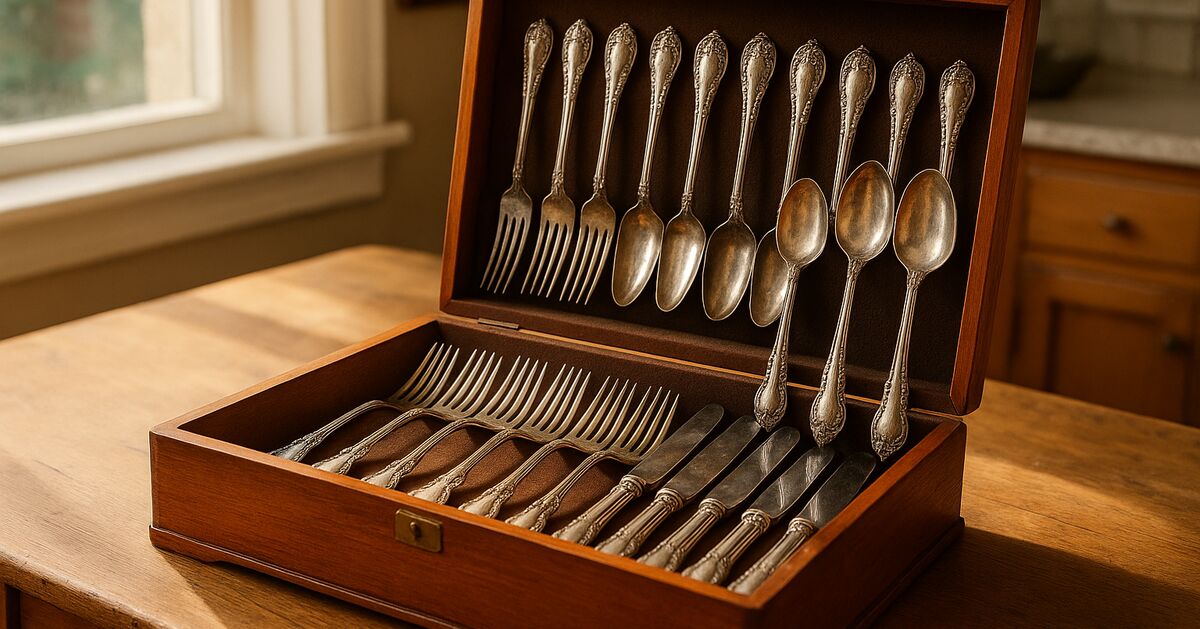
Selling a silver canteen that belonged to your grandmother is one of those decisions that sits right at the crossroads of money and memory. Get it wrong in either direction and you'll regret it, so it's worth slowing down and thinking it through properly before you do anything at all.
This guide walks you through every angle: what the canteen might actually be worth, the honest costs of keeping it, the factors that push value up or down, and the questions only you can answer. No pressure, no rush. Just the clearest picture possible.
First things first: find out what you actually have
Before you can weigh sentiment against money, you need to know whether you are holding sterling silver, silver plate, or something in between. The difference is enormous. A fully hallmarked sterling canteen for twelve settings can fetch anywhere from a few hundred to several thousand pounds depending on maker, date, and condition. An electroplated canteen of identical appearance might bring only scrap-metal prices at best, or a modest sum to a collector at most.
The fastest way to start is to look at the back of a spoon or fork for hallmarks. British sterling silver carries a series of up to five marks: the lion passant (the guarantee of 92.5% silver content), an assay office symbol, a date letter, and often a maker's mark. Our post on sterling silver hallmarks explained: reading the four British marks walks you through exactly what each one means and where to find them. If you see those marks, you are holding something genuinely valuable.
If you are not sure whether what you have is sterling or plate, that question deserves its own careful look before you proceed. Our guide on how to tell sterling silver from silver plate at home gives you practical tests you can do without any special equipment.
What is the canteen actually worth right now?
Silver canteens are priced in two overlapping ways: by their melt (intrinsic metal) value and by their collector or antique value. Understanding both gives you leverage.
Melt value is the floor. It is calculated by weighing the silver content and multiplying by the current spot price of silver. A standard canteen for six settings in sterling silver might weigh anywhere from 400 grams to over 1,000 grams of actual silver depending on the period and pattern. At a spot price around 25 USD (or roughly £20) per troy ounce (check a live source like Kitco or the London Bullion Market Association for the current figure), even a modest canteen can represent a meaningful sum in metal alone.
Collector value is where things get more interesting, and more variable. Certain factors push a canteen well above its melt value:
- Complete sets. A canteen with all original pieces, matching serving implements, and the original fitted box commands a significant premium over a broken set missing fish knives or dessert spoons.
- Prestigious maker's marks. Names like Elkington, Mappin and Webb, Walker and Hall, or the great London silversmiths such as Paul Storr (for earlier pieces) carry real collector interest.
- Desirable patterns. Fiddle, King's, Queen's, and Rat Tail are perennially popular. Obscure Victorian patterns can actually be harder to sell.
- Age and rarity. Pre-Victorian and early Victorian canteens attract serious collectors. Post-1900 canteens are more common and tend to trade closer to melt.
- Condition. Polishing damage, deep scratches, monograms, and replaced handles all reduce value. However, a lightly tarnished, unpolished surface with a good natural patina is often preferred by buyers over something that has been over-cleaned.
For a worked example of how these factors combine into a real-world number, take a look at what is my sterling flatware actually worth? A worked example. It shows the maths behind a realistic valuation.
The honest cost of keeping it
People underestimate how much it costs, in time and money, to keep a silver canteen properly.
Tarnish is relentless. Sterling silver reacts with sulfur compounds in the air, in rubber bands, in certain foods, and even in some woods used to line canteen boxes. Without regular polishing, a canteen can go from gleaming to black-spotted within months. Proper polishing takes time, the right products (a gentle cream or liquid silver polish, not an abrasive), and a careful technique to avoid wearing away hallmarks or fine engraving.
Storage matters enormously. Keeping the canteen in its original lined box is often fine short-term, but if the felt or baize lining is old and sulfur-rich it can actually accelerate tarnishing. Anti-tarnish strips, acid-free tissue, and cool dry storage all help. Proper long-term storage is a real commitment.
Insurance. If your canteen is worth more than a few hundred pounds, your standard home contents policy may not cover it automatically, or may only cover it up to a low sub-limit. A specialist rider or a separate valuables policy costs money every year. It's generally recommended to get a professional valuation from a member of the British Antique Dealers' Association or the Silver Society before insuring a piece like this.
Guilt and obligation. This one is real but rarely discussed. Some people keep the canteen, never use it, feel vaguely bad about letting it tarnish, and spend a decade polishing it twice a year out of duty rather than love. That is a cost too, even if it doesn't show up on a balance sheet.
The honest case for selling
The case for selling is strongest when several of these are true:
- You have no practical use for a full canteen set. You don't host formal dinners, or if you do you already have everyday cutlery you prefer.
- The money would make a meaningful difference. Silver sitting in a cupboard earns nothing. Sold, it could pay off a debt, contribute to a home improvement, or simply sit in savings earning interest.
- The set is incomplete or in mediocre condition. A broken set in a worn box is far harder to pass on to the next generation in any meaningful way, and its collector value is already diminished.
- You have no children or grandchildren who would want it. If there is no one in the family likely to value it, selling to someone who will use and appreciate it is a genuinely good outcome.
- The silver market is currently strong. Silver prices move, and a canteen sold when spot is high earns meaningfully more than the same canteen sold in a trough. You can track the silver spot price through the London Bullion Market Association. Our post on why a silver buyer offers less when the market is volatile explains how market timing feeds into real-world offers.
The honest case for keeping it
On the other side, the canteen might be worth keeping when:
- You actually use it, or genuinely intend to. Sterling silver cutlery is not just decorative. It is durable, dishwasher-safe if handled carefully (though hand washing is strongly preferred), and a genuine pleasure to eat with. Using it is the best way to honor it.
- The sentimental value is real and specific. There is a difference between keeping something because you feel you ought to and keeping something because it genuinely connects you to a person you loved. Only you know which this is.
- It is a high-value piece with collector significance. If a preliminary look at the hallmarks and maker's mark suggests something genuinely rare or prestigious, selling quickly without a proper appraisal risks giving away far more than you realize. Take time.
- A family member wants it. Before selling anything with family history, ask around. Someone in the next generation might feel strongly about it and never have said so.
Getting a proper valuation before you decide anything
Whatever you ultimately decide, get a professional appraisal first. There are several routes:
- A specialist silver auction house (Bonhams, Lyon and Turnbull, Duke's, or Tennants, for example) will often give a free auction estimate. This is not a guaranteed sale price, but it tells you the collector market's view of the piece.
- A BADA or Silver Society member dealer can give a buying price and sometimes a valuation for insurance or probate. Expect to pay a small fee for a written valuation.
- Online silver buyers will quote a melt-based price quickly. This is useful as a floor figure but rarely reflects full collector value.
Never accept the first offer. Get at least two or three opinions, especially if the canteen appears to be early, complete, or by a named maker.
The questions only you can answer
A good framework for making the final call:
- If this canteen were not from your grandmother, just a random auction find of identical silver and design, would you want to own it?
- Is the money genuinely useful right now, or is it just money?
- Is anyone else in the family likely to want it, and have you asked them?
- Are you keeping it out of love, or out of guilt?
- If you sold it, what would you do with the proceeds, and would that feel like a good trade?
There are no wrong answers. The point is to answer honestly rather than by default.
A middle path worth considering
You don't have to sell everything or nothing. Some people sell most of a larger canteen set, keeping a six-piece setting they will actually use daily, and sell the rest. Others sell the formal serving pieces (fish knives, fish forks, ladles) that will never see daylight, and keep the core cutlery they love. Others have a single special piece, perhaps a serving spoon with an engraved monogram, removed from the set before sale as a keepsake.
This kind of selective approach lets you realize real money from items gathering dust while keeping the pieces that carry genuine meaning. It's worth discussing with whichever auction house or dealer you approach, as they can advise which items are most saleable separately and which are worth more as a complete lot.
Where to go from here
Start with identification and valuation. Use the hallmark guides linked above, get two or three professional opinions, and then sit with the numbers for a week before you make any call. There is rarely a genuine urgency to sell silver quickly, and the right decision made slowly is usually better than the wrong decision made fast.
If you have questions about the process or want to understand the landscape better before approaching any buyer, the FAQ page covers the most common points that come up for first-time sellers. And if you want to keep exploring before deciding, the blog has more guides on understanding silver value, reading hallmarks, and navigating the selling process with confidence.
Your grandmother's canteen is not going anywhere. Take the time to understand what you have, and the right answer will usually make itself clear.
Sources & further reading
- London Bullion Market Association - silver spot price data (London Bullion Market Association)
- The Silver Society - resources on British silver and hallmarks (The Silver Society)
- British Antique Dealers' Association - finding accredited valuers (British Antique Dealers' Association)
- UK Hallmarking Act 1973 - legal requirements for hallmarking precious metals (UK Parliament / legislation.gov.uk)
Revision history (1)
- Pre-publish editorial QA: 1 flagged, 1 softened; claim audit: 1 claims, 1 rewritten
Claim-by-claim audit (1 checked)
- “It's generally recommended to get a professional valuation from a member of the British Antique Dealers' Association or the Silver Society before insuring a piece like this.” (rewritten to what the article can stand behind)