
Selling a silver canteen set: whole versus piece by piece
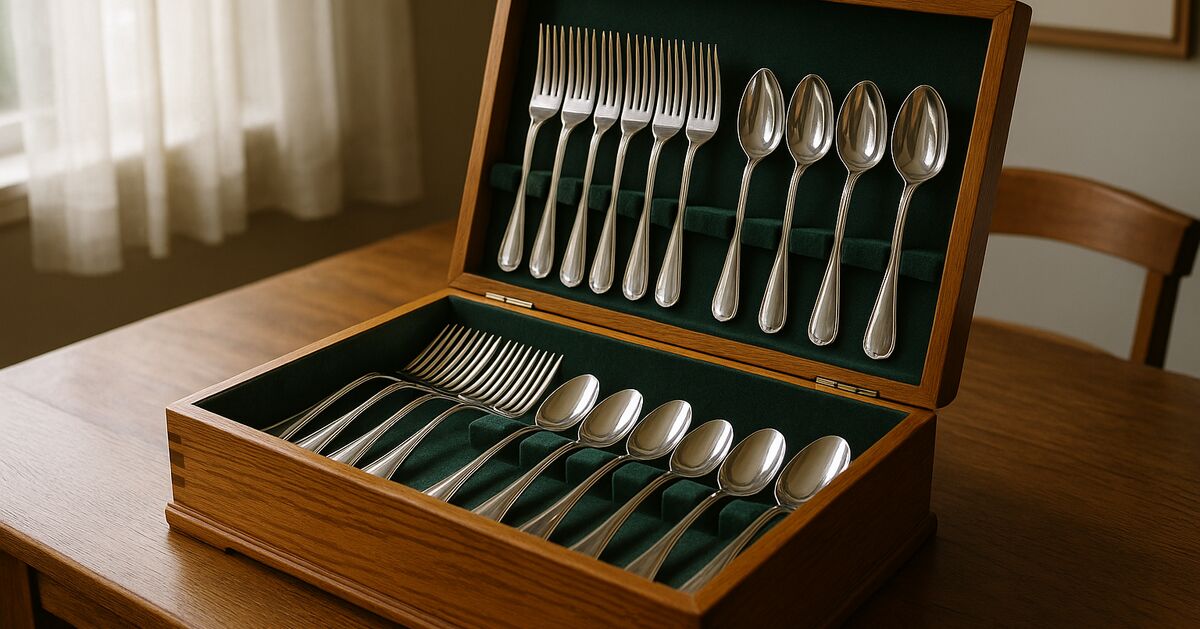
Selling a complete silver canteen of cutlery sitting in its fitted oak box can feel straightforward, yet a little thought about how you sell it can make a surprisingly large difference to what you walk away with. The honest answer to "whole or piece by piece?" is: it depends, and knowing what it depends on is exactly what this post is for.
What a "canteen" actually is, and why it matters to buyers
A canteen, in the British and Commonwealth sense, is a fitted case, traditionally wood lined with baize or velvet, containing a matched service of sterling silver flatware. A full service for twelve typically includes twelve each of table knives, dessert knives, fish knives, table forks, dessert forks, fish forks, soup spoons, dessert spoons, and teaspoons, plus a collection of serving pieces: fish servers, soup ladles, sauce ladles, salad servers, sugar tongs, and so on. Full services can run to 100 or more pieces.
The fitted case itself is part of the story. A locked, oak-and-baize box with a maker's label inside the lid signals to a buyer that the set is likely complete and well-cared-for. A loose bundle of spoons wrapped in a tea towel signals the opposite, even if the silver is identical.
Buyers price canteens the way auction houses price lots: there is a premium for completeness and coherence. Understanding that premium, and when it evaporates, is the key to your decision.
The completeness premium: when the whole is worth more than the sum of its parts
A matched, complete canteen by a well-regarded maker, say Mappin & Webb, Elkington, Walker & Hall, or a top-tier Scottish or Irish silversmith, will often attract a meaningful premium over the combined melt value of its pieces. Here is why.
Collectors and interior buyers want complete sets. Someone furnishing a country house or setting a formal dining table cannot use eleven soup spoons. They need twelve. When all pieces are present, all patterns match, and the case is intact, the buyer does not have to source replacements, which can be time-consuming and expensive. They pay for that convenience.
Auction houses like consigning complete canteens. A full canteen photographs well, fits neatly into a silver sale catalog, and attracts serious bidders. Hammer prices for complete services in popular Victorian or Edwardian patterns, from respected makers, can sit well above melt value, though the exact premium varies widely by pattern and maker.
The case itself adds value. An original fitted oak canteen box in good condition is not just packaging; it is part of the antique. Buyers who want the set for use or display want the box too.
For a set that ticks all of these boxes, selling as a complete unit is almost certainly the better route. The whole is genuinely worth more than the sum of its parts.
When selling piece by piece makes more sense
The completeness premium collapses under certain conditions, and in those cases breaking the set up, or at least thinking more carefully about which buyer you approach, can recover more value.
The set is already incomplete. If you are missing six fish knives and three dessert forks, the "complete canteen" premium disappears. A specialist buyer will simply price the remaining pieces at or near melt, because they cannot sell the set on as complete. In this situation you are already, effectively, selling pieces. Lean into it: route the heavier serving pieces and larger spoons (which carry more silver by weight) to a refiner or bullion dealer for a solid melt price, and offer any rarer serving pieces to a pattern-matching dealer who can sell them to someone completing their own set.
The pattern is unfashionable or by an unknown maker. Heavy, plain Victorian fiddle-and-thread patterns in good condition by a known maker still sell well. But some mid-century commercial patterns, made in very large quantities by trade silversmiths, have little collector appeal. If your canteen falls into this category, its collector value is low regardless of completeness. The melt route becomes your most reliable option, and a refiner or bullion dealer will pay by weight regardless of pattern. In that scenario, whether you deliver the pieces together or separately makes little practical difference to the price, though delivering them together saves you time.
The knives have weighted handles. This is a significant complication covered in detail in our guide to weighted knife handles and canteen value. In short, table and dessert knives in canteen sets are usually hollow-handled or weighted with pitch, resin, or cement, because a solid-silver handle would make the knife uncomfortably blade-heavy. A buyer paying by silver weight will deduct heavily, or refuse the knives altogether, because the handles contain little or no recoverable silver. If your canteen has twelve table knives and twelve dessert knives, a large chunk of its piece-count contributes almost nothing to melt value. Knowing this prevents nasty surprises.
Individual pieces have strong stand-alone demand. Some serving pieces, particularly fish servers, soup ladles, and berry spoons, attract enthusiastic collectors even when separated from their original set. If your canteen includes a particularly fine or early ladle, or a serving piece in a pattern that is actively sought, it may fetch more at a specialist auction than it would bundled into a general canteen sale.
How to assess your canteen before deciding
Before you commit to a selling route, spend an hour doing the following.
- Count every piece and compare against the original contents card. Many canteen boxes have a card or printed list inside the lid. If yours does not, look up the pattern name (usually engraved or stamped on the back of the spoons and forks) online or via a silver reference book to find out what a full service comprised.
- Check the hallmarks on a cross-section of pieces. All pieces should carry matching or compatible hallmarks: maker's mark, standard mark (the lion passant for English sterling), assay office mark, and date letter. Mismatched date letters can indicate later replacements, which slightly reduces collector appeal but does not affect melt value.
- Weigh the silver-bearing pieces separately from the knives. Spoons, forks, ladles, and servers are typically solid sterling and weigh accurately. Knives should be noted separately. You can learn about reading hallmarks in detail to confirm you are correctly identifying sterling versus silver plate.
- Research the maker and pattern. A quick search of completed auction results on major platforms will tell you whether your pattern sells for a premium or hovers near melt. This takes twenty minutes and can completely change your strategy.
- Inspect the case. Wobbly hinges, missing baize, cracked wood, or a broken lock all reduce the case's contribution to value but are sometimes repairable cheaply.
Which buyers to approach, and in what order
Once you have assessed the set, the buyer type matters as much as the selling format.
Specialist silver dealers and auction houses are the right first stop for a complete, well-marked canteen by a known maker. They can identify the pattern, know its market, and have customers waiting. Do not skip this step for a quality set, even if it feels like extra effort.
Pattern-matching services buy individual pieces to reunite with other sellers' incomplete sets. If your canteen is missing pieces or you are selling off individual serving pieces, these dealers pay a premium over melt for pieces in popular patterns.
Bullion dealers and refiners pay by weight at a percentage of the spot silver price. For unfashionable patterns, damaged pieces, or anything with minimal collector appeal, this is your reliable floor price. A well-run bullion dealer will weigh your pieces accurately and offer a clear percentage of spot. See how to figure out what your silver is actually worth for a worked explanation of the melt-value calculation.
Online auction platforms are worth considering for complete canteens you cannot easily move locally, and for individual serving pieces with stand-alone appeal. The trade-off is time, photography effort, and fees. For a full canteen with a quality case, the photography investment usually pays off.
Estate auction houses (not specialist silver auctioneers) are a middle ground. They will accept canteens and generally attract a mixed buyer pool. Reserve expectations are lower than a specialist sale, but so is the wait time.
For a deeper look at how different buyer types compare on price and process, the practical field guide for new sellers is worth reading before you make any calls.
The maths: a rough framework
Here is a thinking framework, not a specific quote.
Suppose your canteen contains 2,000 grams of actual sterling silver across the forks, spoons, and serving pieces (excluding knives). At spot silver, sterling at 92.5% purity gives you roughly 1,850 grams of fine silver. Bullion dealers typically buy at some discount to spot silver price, which produces your melt offer; check current spot price and ask dealers their percentage. Call it your floor.
A specialist dealer or auction house, seeing a complete set by a good maker in a clean case, will typically price it noticeably above the melt floor, though the exact multiple varies by pattern and maker. That gap, which can easily be several hundred pounds, is the completeness premium. It is the money you leave on the table by going straight to a refiner with a quality set.
Conversely, if your set is incomplete, unfashionable, or heavily knife-weighted, the specialist route may produce no premium at all, while costing you time and travel. In that case, going straight to a bullion buyer for the silver-bearing pieces is efficient and honest.
A note on silver plate canteens
Many canteen sets that look like sterling silver are in fact silver plate, EPNS (electroplated nickel silver), or Sheffield Plate. These have no melt value as silver. A plate canteen's value is purely as a usable or decorative antique, and that market is soft. If you are unsure whether your canteen is sterling or plate, testing silver at home walks you through the practical checks you can do before calling any buyer.
For an overview of how silverware and flatware fit into the broader world of selling silver, the home page has a full index of guides on this site.
Common mistakes sellers make with canteen sets
A mistake that comes up again and again in seller forums is routing a quality, complete canteen straight to a general scrap buyer without checking for a specialist premium first. The difference in return can be substantial, and the check takes only a few phone calls or online searches.
Another common problem is separating the set before approaching buyers, believing that individual pieces will each fetch their best price independently. For a quality complete set, this destroys the completeness premium permanently. Once you have broken the set up, you cannot reassemble it in a buyer's mind.
Selling without counting pieces first is also a trap. A buyer who counts and finds four pieces missing will revise their offer downward sharply, sometimes more than the missing pieces are actually worth, because it signals the seller did not know what they had.
For a broader look at questions sellers bring to this decision, the FAQ covers many of the common scenarios around selling silver flatware and inherited sets.
The bottom line
Sell as a complete set when: the canteen is genuinely complete, the pattern is identifiable and has collector appeal, the maker is known, the case is in good condition, and you are willing to take the time to approach a specialist buyer or auction house.
Sell piece by piece (or direct to a refiner) when: the set is significantly incomplete, the pattern has no collector premium, the pieces are heavily knife-weighted, or you simply need a quick, certain return and are comfortable with the melt-value floor.
The two routes are not mutually exclusive, either. A hybrid approach, selling fine serving pieces to a pattern dealer while sending the remaining forks and spoons to a bullion buyer, is perfectly reasonable and sometimes extracts the best of both worlds.
Whatever route you choose, go in knowing your piece count, your hallmarks, and your floor price. That knowledge costs nothing and is worth a great deal.
Sources & further reading
- Silver hallmarking standards and assay office guidance (The Assay Office London)
- Silver spot price and bullion market reference (London Bullion Market Association (LBMA))
Revision history (1)
- Pre-publish editorial QA: 1 flagged, 1 softened; claim audit: 4 claims, 3 rewritten
Claim-by-claim audit (4 checked)
- “Hammer prices for complete services in popular Victorian or Edwardian patterns, from respected makers, can sit well above melt value, though the exact premium varies widely by patt…” (rewritten to what the article can stand behind)
- “Mismatched date letters can indicate later replacements, which slightly reduces collector appeal but does not affect melt value.” (reasoning shown in the article)
- “A specialist dealer or auction house, seeing a complete set by a good maker in a clean case, will typically price it noticeably above the melt floor, though the exact multiple vari…” (rewritten to what the article can stand behind)
- “Bullion dealers typically buy at some discount to spot silver price, which produces your melt offer; check current spot price and ask dealers their percentage.” (rewritten to what the article can stand behind)