
Top 5 real reasons people sell their gold jewelry
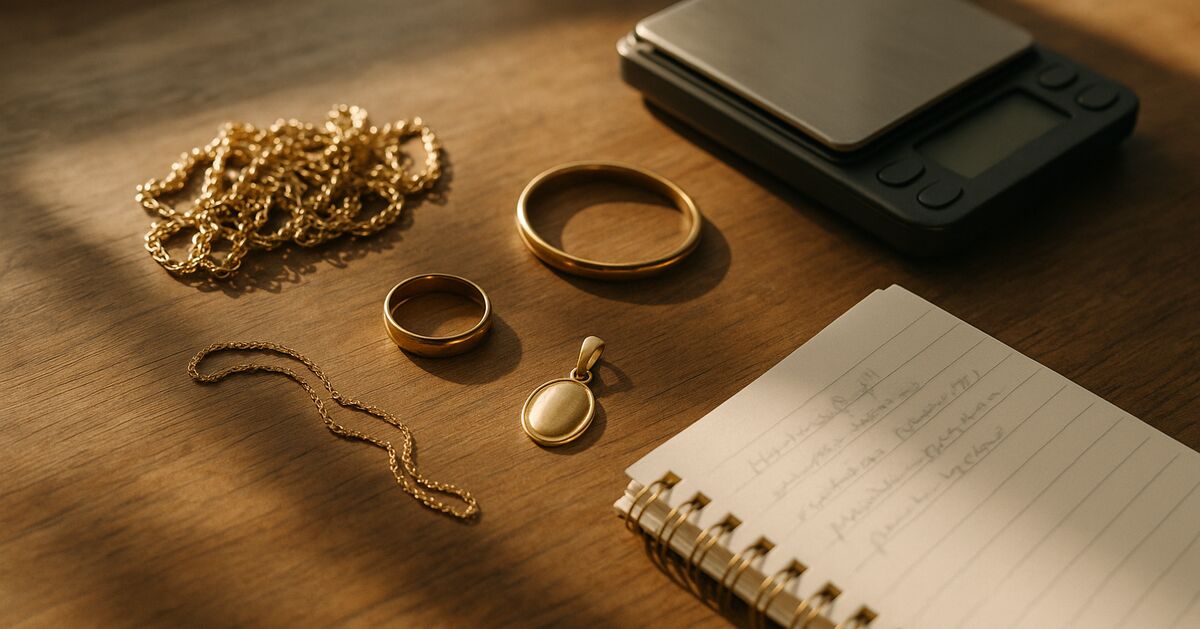
Selling gold jewelry is often not an impulsive decision. Something specific has to tip the scales - a piece that sits untouched for years, a financial squeeze, or a memory that no longer feels worth keeping. After spending nearly two decades buying gold and silver from the public, I heard the same five reasons come up again and again. This post lays them out honestly, explains the thinking behind each one, and gives you practical guidance for what to do once you have made up your mind.
1. The piece is broken or damaged
A snapped chain, a bent clasp, a ring that cracked at the shank - damaged jewelry has a way of disappearing into a drawer and never coming back out. The repair estimate arrives, it feels too high relative to what the piece is worth emotionally, and so the gold just sits there doing nothing.
Here is the important thing to understand: a buyer who is purchasing gold for its metal content does not care about the damage. They are going to melt it anyway. A broken 14-karat necklace and a pristine 14-karat necklace of the same weight will generally attract the same scrap offer. The damage that makes a piece unwearable and therefore "worthless" to you is irrelevant to a refiner.
The practical implication is that there is no point delaying a sale because a piece is bent or broken. Waiting will not improve the offer. What moves the offer is the weight and the karat stamp, not the condition. If you want to understand exactly how buyers calculate what your gold is worth, the FAQ page walks through the melt-value arithmetic in plain terms.
One common mistake reported by sellers in this situation is assuming that a jeweler will pay more than a scrap buyer because the jeweler could theoretically repair the piece and resell it. In practice, jewelers who buy damaged gold are usually buying for melt too, and their margins may be wider than a dedicated precious-metals buyer. Always get more than one offer before you commit.
2. You have stopped wearing it
Life changes. Tastes change. Bodies change. A ring that fit perfectly at twenty-five may no longer fit at forty-five, and resizing costs money. A yellow-gold bracelet bought in one decade can feel completely wrong in the next. The piece is not broken; it is just done.
Unworn jewelry is one of the most common categories I ever bought. People would bring in pieces that had been sitting untouched for five, ten, or even twenty years. The guilt of owning something valuable that serves no purpose is its own slow drain on the psyche.
Selling makes practical sense here for a simple reason: gold sitting in a drawer earns nothing. It does not compound, it does not appreciate on a schedule you can plan around, and it costs you nothing to hold it, but it also gives you nothing. Converting it to cash gives you a resource you can actually use. If you are curious about the broader question of gold as a financial asset versus gold as jewelry, the post on six gold investing truths every seller needs to know first is worth reading before you decide.
The one thing to check before selling is whether the piece has any value beyond its metal. A signed piece from a recognized designer, a vintage piece with collector appeal, or a piece with an unusually fine stone can be worth considerably more than its melt value. A quick appraisal or a search of completed auction listings will tell you whether you are looking at scrap value or something higher.
3. The style is outdated
Fashion has a long memory for jewelry. Wide, textured gold bangles from the 1980s, heavy rope chains from the 1990s, and certain pendant styles that were everywhere in one era can feel completely out of place today. Sentiment aside, if you genuinely dislike the way something looks, you are never going to wear it.
The good news is that style is entirely irrelevant to a scrap buyer. Buyers who purchase gold for its metal content are not evaluating aesthetics. An unfashionable piece and a timeless one fetch the same price per gram at the same karat.
The bad news, from a seller's perspective, is that pieces with strong period style sometimes have collector or vintage appeal that a scrap buyer will not pay for. If a piece is genuinely from a specific era and well-made, it is worth spending a few minutes seeing whether vintage jewelry dealers or auction houses show interest before you commit to selling it for melt.
For most dated gold jewelry, though, the honest answer is that the melt offer is the right offer. The market for second-hand gold fashion jewelry is thin, and unless a piece is signed by a recognized name, buyers for it as jewelry are hard to find. Selling it as metal and using the cash to buy something you will actually wear is a perfectly rational choice.
4. You need cash for household expenses
Financial pressure is one of the most direct paths to the decision to sell gold. A job loss, a medical bill, a car repair that cannot wait - these are real situations, and gold jewelry represents real money sitting idle.
There is no shame in this, and there is nothing financially unsophisticated about it either. Gold jewelry that was purchased as a luxury item has done its job once it has been enjoyed. Selling it in a moment of genuine need is a sensible use of an asset.
A few things are worth keeping in mind if this is your situation.
First, do not let urgency push you into the first offer you see. Even in a time crunch, getting two or three quotes takes very little extra time and can meaningfully change what you walk away with. The difference between a poor offer and a fair one on a couple of ounces of gold can be significant, so comparing offers is worth the time. The post on common complaints when selling silver and gold and how to protect yourself covers the pressure tactics some buyers use and how to sidestep them.
Second, know your karat before you walk in. The karat stamp on a piece (10K, 14K, 18K, 24K) tells you what percentage of the piece is pure gold. A 10K piece is 41.7% gold; an 18K piece is 75% gold. The difference in payout between a bag of 10K pieces and a bag of 18K pieces of the same total weight is enormous. Sorting by karat before you get quotes helps you understand the offers you receive rather than just accepting them.
Third, keep records. Note the weight of what you sold, the karat, the buyer, the date, and the price paid. If something goes wrong, or if you later want to compare offers, having a paper trail matters. The selling precious metal: your toughest questions answered post covers what documentation to ask for from the buyer.
5. The memories attached to a piece have become painful
This one does not get talked about enough, but it came up regularly in my years of buying. An engagement ring from a marriage that ended badly. A gift from someone who hurt you. A piece inherited from a family member with whom the relationship was complicated. Gold is not a therapy tool, and keeping an object that causes pain every time you open a drawer is not a form of loyalty to anyone.
Selling a piece in this category is a genuinely healthy choice for a lot of people. The money is neutral. It does not carry the history the object does. Using it for something that matters to you now is a clean break.
The emotional weight of this decision can sometimes make people rush, which is worth guarding against. The goal is still to get a fair price. Taking a day or two to get multiple offers costs you very little and ensures that the financial result of the decision is a good one, even if the emotional motivation is urgent.
If the piece includes gemstones, it is worth noting that scrap gold buyers typically do not pay for the stones. They will either return them to you or discard them. If the stones have any value - a genuine diamond, a sapphire, a ruby - have them evaluated separately before you sell the setting. Selling precious metal: your toughest questions answered covers how to handle mixed items like these.
What to do before you sell, regardless of your reason
The five reasons above are all valid. But the reason for selling does not change the mechanics of getting a fair deal. A few steps apply no matter which category you fall into.
Know what you have. Look for karat stamps. In the US, gold jewelry is typically stamped 10K, 14K, 18K, or 24K. European pieces may use millesimal fineness marks (585 for 14K, 750 for 18K). If you cannot find a stamp, a reputable buyer will test the piece rather than simply guessing.
Weigh what you can. A basic kitchen scale that reads in grams is enough to give you a ballpark. Understanding the weight units used in the precious-metals trade helps you follow the math when a buyer quotes you a price per pennyweight or per troy ounce.
Get multiple quotes. This is the single most reliable way to protect yourself. The spread between the lowest and highest legitimate offer on the same gold can be significant. Coin dealers, pawnshops, dedicated gold buyers, and mail-in refiners all operate on different margin structures and have different customer bases. Each type of buyer has trade-offs in convenience, speed, and payout.
Check the spot price. Gold trades on global markets, and the price changes every trading day. Before you walk into any buyer, check the current gold spot price from a financial site (Kitco, the London Bullion Market Association, or a major financial data provider all publish it). This gives you a reference point. No buyer pays 100% of spot, but knowing the spot price tells you how close any given offer is to a fair one.
Ask how the buyer tests. Legitimate buyers test gold before making an offer, typically with an acid test or an electronic tester. Be cautious of any buyer who makes an offer purely by eyeballing a piece.
For a broader view of the selling process from start to finish, the practical field guide for new sellers is a good place to start even if your focus is on gold rather than silver. The principles of finding buyers, comparing offers, and protecting yourself are the same across both metals.
One final thought
Whatever your reason for selling, it is a legitimate one. Broken gold, idle gold, unfashionable gold, needed cash, or a painful object: these are all sensible motivations. The gold does not care why you are selling it. The market just wants to know the weight and the karat. Your job is to present it to buyers who will pay fairly for those two things, and to take your time getting there even when the reason for selling feels urgent.
The home page of this site has more practical guidance across a range of selling situations. Take a look before your first appointment with a buyer - a well-informed seller often does better than one who walks in cold.
Sources & further reading
- Gold fixing and spot price data (London Bullion Market Association)
- Consumer guidance on selling gold and precious metals (U.S. Federal Trade Commission)
- Gold and precious metals market data (Kitco Metals Inc.)
Revision history (1)
- Pre-publish editorial QA: 2 flagged, 2 softened; claim audit: 3 claims, 1 rewritten
Claim-by-claim audit (3 checked)
- “A 10K piece is 41.7% gold; an 18K piece is 75% gold.” (reasoning shown in the article)
- “The difference between a poor offer and a fair one on a couple of ounces of gold can be significant, so comparing offers is worth the time.” (rewritten to what the article can stand behind)
- “No buyer pays 100% of spot, but knowing the spot price tells you how close any given offer is to a fair one.” (reasoning shown in the article)