
Selling silver tea sets: when the set is worth more than
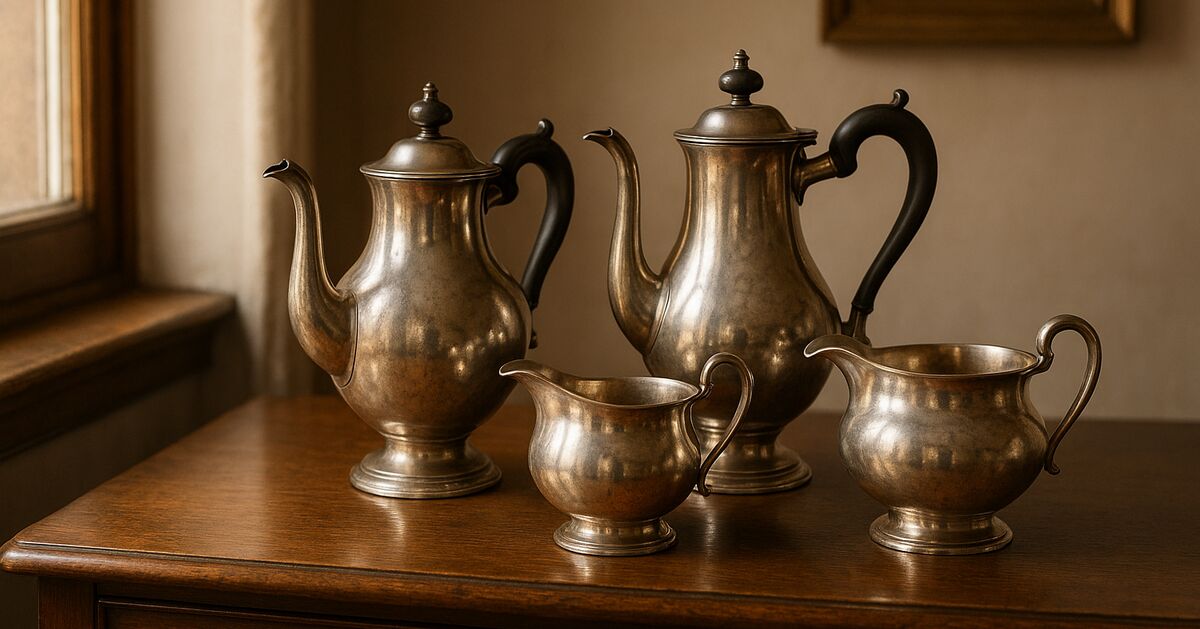
A matched silver tea set sitting on your sideboard is not simply a pile of silver by the ounce. In the right market, with the right buyer, it can be worth well above its melt value, so knowing which situation you're in can make a real difference to what you walk away with.
This post is about that decision: keep the set together or break it up? It covers how to read the signals, what collectors and dealers actually pay for, and the mistakes that quietly cost sellers hundreds of pounds or dollars before they even get to a negotiation.
What "the set" actually means to a buyer
A classic silver tea set typically includes a teapot, a hot water jug, a cream jug, and a sugar bowl. Grander sets add a slop bowl, a tea kettle on a stand, a tray, and sometimes matching cake baskets or toast racks. The more pieces that survive in matched condition - same maker, same date, same pattern - the stronger the collector premium.
Here is why: a collector who wants a complete George III four-piece set in Old Sheffield Plate cannot simply buy a spare teapot off eBay and call it done. The proportions, the engraving style, the patina, and the armorial crest all have to match. Complete, original sets are genuinely scarce, because over 150 years of use, storage, and estate sales, pieces get separated, lost, or damaged. When a collector finds one intact, they pay for that rarity, not just the silver content.
A scrap buyer, by contrast, sees only the weight and the purity. To them, a matched George III teapot is identical in value to a mismatched Victorian one of the same weight. That is not cynicism - it is just what their business model requires. Understanding this difference is the foundation of every good selling decision you will make.
The melt-value baseline: why you need it first
Before you can judge whether a premium is worth chasing, you need to know what the silver content alone is worth. That means weighing each piece (in troy ounces), noting the purity (sterling is 92.5 percent), and multiplying by the current spot price, then applying a realistic buyer's discount - typically 80 to 90 percent of spot for quality sterling hollowware in good shape.
The home page at How To Sell Silver has a live spot price reference that can help you with this calculation. Do not skip this step. Without a melt-value baseline, you have no way to judge whether the premium a dealer quotes for the "whole set" is genuinely above melt or is simply melt dressed up in auction language.
For a typical four-piece sterling tea service weighing around 60 troy ounces total, the melt value at a silver price of around $25 per troy ounce might be roughly $1,350 after a standard buyer's discount. A comparable set in excellent condition from a named maker such as Mappin and Webb, Elkington, or Tiffany could fetch considerably more than melt at a specialist auction, though exact prices vary widely by sale. That gap is real. It is also not guaranteed: a damaged, unmarked, or heavily repaired set may fetch barely more than melt.
Five signals that your tea set carries a collector premium
Not every set commands a premium. Here are the factors that tend to push value above melt, and what to look for.
1. A clear maker's mark from a respected silversmith
Hallmarks tell you who made the piece and when. A full set of British hallmarks (lion passant for sterling, date letter, assay office mark, and maker's mark) from a well-regarded firm is the single biggest signal of collector interest. American sterling sets often carry a maker's stamp rather than government hallmarks, but firms like Gorham, Reed and Barton, and Tiffany carry weight with buyers. If you need help reading the marks, our post on how to figure out what your silver is actually worth walks through the process clearly.
2. All pieces match in date and pattern
A set where teapot, jug, cream, and sugar all carry the same date letter and the same pattern number is worth considerably more than a "made-up" set assembled from similar-looking pieces across different decades. Buyers and auction specialists check this carefully.
3. Original surface condition with honest patina
Polished silver is not always more valuable - in fact, a set with original, unpolished surface and light tarnish often signals to a collector that it has not been buffed down, re-plated, or over-cleaned. Aggressive cleaning removes fine detail from chased decoration and can reduce value. If you have not already read our piece on what "as-found" silver means and why cleaning costs you money, it is worth a few minutes before you touch anything.
4. An intact tray
The tray is the piece most often sold separately or lost. A set with its original matching tray is substantially more complete in a collector's eyes, and the jump in price can be disproportionate - because the tray is also heavy, adding significant melt value, but it is the rarest survivor in an otherwise incomplete set.
5. Family provenance or original box
A fitted case, a receipt from the silversmith, or documented provenance (an armorial crest that can be traced to a known family, for example) adds interest and sometimes real value at specialist auctions. It is not essential, but it helps.
When breaking up the set actually makes sense
There are situations where selling piece by piece genuinely works out better. This tends to happen when:
- The set is "made up" from mismatched pieces and has no coherent maker or date story.
- One piece is significantly more valuable than the others - a teapot by a noted maker paired with later, anonymous cream and sugar pieces.
- The set is silver plate rather than sterling. Plate carries no melt premium, and collector demand for plated sets is narrower. Individual pieces may sell more reliably than the whole.
- Damage on one piece would drag down the price of the whole lot. A teapot with a repaired spout, sold separately to a parts buyer, might not penalise the remaining pieces.
This trade-off is similar to decisions sellers face with matched flatware services. Our article on selling a silver canteen set: whole versus piece by piece covers that parallel situation in detail, and a lot of the logic carries over.
Where to sell a tea set that has real collector value
The short answer: not to a scrap buyer. If the signals above point to genuine collector interest, you need a buyer who can actually value it correctly.
Specialist silver auctions are the natural home for quality tea sets. Houses like Bonhams, Woolley and Wallis, or Lyon and Turnbull in the UK, and Hindman or Heritage in the US, regularly handle Victorian and Edwardian silver services. Buyer's premiums mean the hammer price is not the same as what you receive, since auction houses typically charge a seller's commission, but this can still leave you well ahead of a scrap offer.
Antique silver dealers sometimes buy outright, at a discount to what they expect to sell for, but without the wait time or commission of an auction. A dealer who specializes in silver will know exactly what they can do with a quality set and may offer a discount to retail value, which on a genuinely rare set can still be far above melt.
Online specialist platforms such as 1stDibs, Sellingantiques, or Ruby Lane attract buyers who are specifically looking for matching sets. The audience is global, which matters when you have a set that appeals to a narrow collector market. You will need good photographs, accurate hallmark descriptions, and patience.
General online marketplaces (eBay being the obvious example) work well for middle-market sets - good quality, sterling, complete, but not rare enough for specialist auction. Research completed sales, not asking prices, to calibrate your expectations.
What does not work well is selling a quality matched set to a coin dealer or cash-for-silver shop. These buyers are structured around weight and purity, not craftsmanship, and they will typically offer melt value regardless of provenance or maker.
Getting a realistic pre-sale assessment
Before committing to any route, it is worth spending a little time on research and, if the set looks promising, getting a specialist opinion. A reputable auction house will assess silver without charge if you are considering consignment - this is standard practice, not a favor. Use at least two assessments if the set looks valuable, because opinions can vary considerably.
When you get an assessment, ask specifically:
- Is this set matched in date and maker throughout?
- Are there any repairs, replacements, or re-silverwork visible?
- What comparable sets have sold at auction in the last 12 months?
- What reserve price would you recommend, and why?
If the auction specialist hedges or avoids the comparables question, that is a signal to press harder or seek a second opinion. You can also check past auction results yourself on the auction house websites - most publish hammer prices going back several years.
Condition issues that quietly kill the premium
A few specific problems come up again and again that push a tea set from collector territory back toward melt value:
- Cracked or repaired bodies. Silver can be repaired, but poorly done repairs visible to the naked eye reduce collector confidence sharply.
- Missing or replaced finials. A replaced lid knop in the wrong style signals that the set has been mended from non-original parts.
- Over-polished surfaces. Aggressive machine polishing on chased or engraved decoration erodes the fine detail that collectors pay for. Once it is gone, it cannot be restored without extensive (and expensive) hand-chasing work.
- Removed crests. Armorial engraving that has been erased or buffed out leaves a thin, dished area on the surface that is obvious in raking light. Paradoxically, leaving an original crest intact - even one you do not know - is usually better for value than having it removed.
- Conversion work. Teapots converted to sugar bowls, or jugs that have had handles replaced with non-original designs, are a red flag for specialist buyers.
If you are unsure whether any of these apply to your set, reading our detailed post on what a silver assay report actually tells a buyer and whether you need one will give you a clearer picture of how professionals assess condition and purity together.
The timing question
Silver spot price affects the melt baseline of your set, but it has a smaller influence on the collector premium than people often assume. A rare matched set does not become twice as collectible because silver spot has risen 20 percent. What matters more for timing is the auction calendar, since specialist silver sales tend to cluster at certain times of year, along with the general health of the antiques market.
That said, if spot price is at a low and your set is borderline - neither rare enough for a strong premium nor damaged enough to be pure scrap - waiting for a better melt baseline can make a meaningful difference to what you walk away with. For a thorough explanation of how spot price interacts with your selling decision, see our article on how silver spot price is set each day and what that means for timing your sale.
A practical checklist before you sell
Pull the set out and work through this list before approaching any buyer:
- Photograph every piece in natural light, including all hallmarks with a macro shot.
- Weigh each piece separately in troy ounces and note the total.
- Record every mark you can read: maker's initials, date letter, assay office symbol, and any pattern numbers stamped inside lids or on the base.
- Check lids, handles, spouts, and finials for signs of repair or replacement.
- Note whether a tray is present and whether it carries matching marks.
- Look for any engraved inscriptions, crests, or presentation text - do not remove or erase these.
- Check online auction records for comparable sets sold in the last two years.
This preparation takes an hour and can make the difference between walking into a buyer's conversation informed and walking in blind. Buyers - whether auction specialists or dealers - respond better to a seller who has done their homework, and it reduces the chance of accepting a low offer simply because you did not know a better one was possible.
If you have broader questions about the selling process that this post does not cover, the frequently asked questions page is a good next stop, and you are always welcome to get in touch if something specific is puzzling you.
The bottom line
A silver tea set is not automatically worth more than its parts - but a complete, matched, well-marked set from a respected maker very often is, and sometimes dramatically so. The key is knowing which category yours falls into before you accept any offer. That means understanding the melt baseline, reading the hallmarks, assessing condition honestly, and choosing a buyer type that matches what the set actually is.
Do that work, and you will not leave money on the table. Skip it, and there is a real chance you will.
Sources & further reading
- Antique silver hallmarking guidance and assay records (The Assay Office London)
- Precious metals definitions, purity standards, and sterling silver specifications (London Bullion Market Association)
- Silver spot price benchmarking and commodity data (U.S. Commodity Futures Trading Commission)
Revision history (1)
- Sep 11, 2026 - Pre-publish editorial QA: clean; claim audit: 7 claims, 5 rewritten
Claim-by-claim audit (7 checked)
- “In the right market, with the right buyer, it can be worth well above its melt value, so knowing which situation you're in can make a real difference to what you walk away with.” (rewritten to what the article can stand behind)
- “that means weighing each piece (in troy ounces), noting the purity (sterling is 92.5 percent), and multiplying by the current spot price, then applying a realistic buyer's discount…” (cited → lbma.org.uk)
- “For a typical four-piece sterling tea service weighing around 60 troy ounces total, the melt value at a silver price of around $25 per troy ounce might be roughly $1,350 after a st…” (reasoning shown in the article)
- “A comparable set in excellent condition from a named maker such as Mappin and Webb, Elkington, or Tiffany could fetch considerably more than melt at a specialist auction, though ex…” (rewritten to what the article can stand behind)
- “Buyer's premiums mean the hammer price is not the same as what you receive, since auction houses typically charge a seller's commission, but this can still leave you well ahead of …” (rewritten to what the article can stand behind)
- “A dealer who specialises in silver will know exactly what they can do with a quality set and may offer a discount to retail value, which on a genuinely rare set can still be far ab…” (rewritten to what the article can stand behind)
- “What matters more for timing is the auction calendar, since specialist silver sales tend to cluster at certain times of year, along with the general health of the antiques market.” (rewritten to what the article can stand behind)