
What a silver assay report actually tells a buyer and
An assay report is one of those terms that gets thrown around in precious-metals circles as though everyone knows what it means and why it matters. Many sellers have never seen one. Some buyers wave them around to justify low offers. Others refuse to discount silver simply because no report exists. Understanding what the document actually says, and what it does not say, puts you in a much stronger position at the negotiating table.
What an assay report is (and is not)
At its core, an assay is a scientific test that determines the metal content of a sample. A silver assay report is the written result of that test, typically showing the percentage of silver in the item, the presence and percentage of other metals (copper, nickel, zinc, and so on), the method used, the date tested, and the identity of the laboratory or assayer who ran the test.
What it is NOT is a valuation. The report tells you composition, not price. It does not factor in silver spot price, collector premium, craftsmanship, or any of the other things that move an item's real-world value up or down. A seller who receives an assay report and expects it to directly translate into a specific cash offer will be disappointed; the report is one input among several.
It is also worth knowing that an assay report is a snapshot in time on a specific sample. If a tester drills a tiny core from a bar and sends that core to the lab, the report reflects that core. For genuinely homogeneous items like a freshly poured silver bar, that is perfectly representative. For complex objects, layered pieces, or old silverware with repair patches, it may not be.
The main testing methods you will see on a report
Assay laboratories use several techniques, and the method matters because it affects both accuracy and cost.
Fire assay is the traditional benchmark. A small amount of the metal is dissolved in a flux, lead is added to absorb the silver, and the resulting bead is weighed before and after treatment with acid. Fire assay is highly accurate, often to within a fraction of a percentage point, but it is destructive (a tiny sample is consumed) and takes time. Refiners use it as the gold standard when large quantities of metal are changing hands.
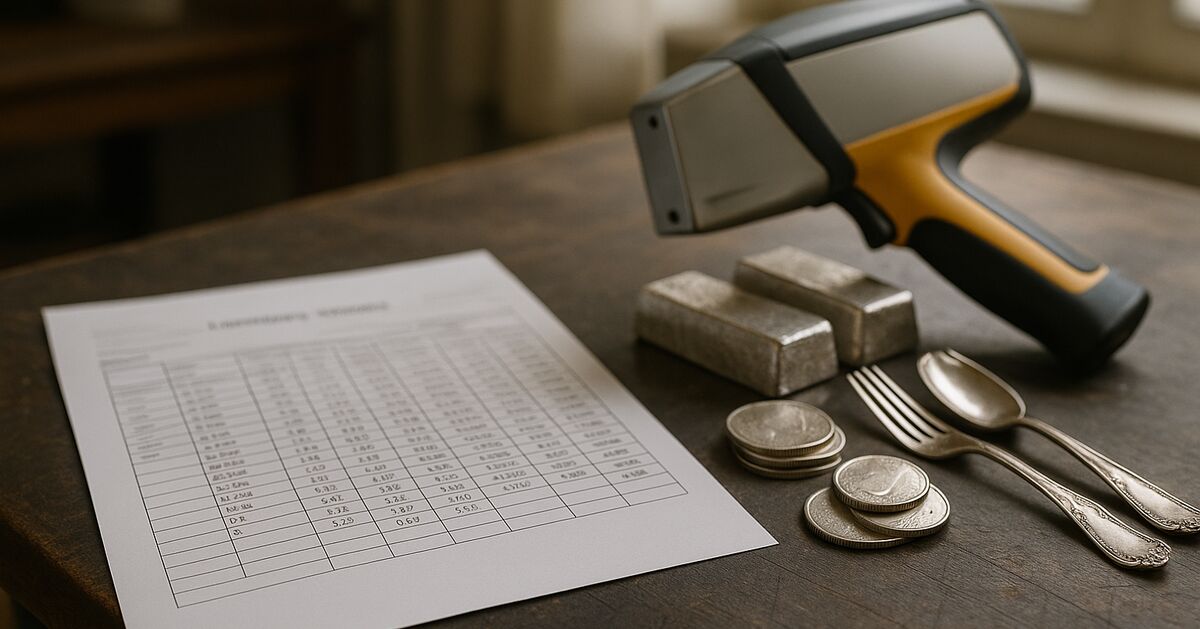
X-ray fluorescence (XRF) is the method you will most often encounter when selling everyday silver. A handheld or bench-mounted XRF gun fires X-rays at the surface and reads the energy spectrum bounced back. Results appear in seconds, are non-destructive, and are accurate enough for most commercial transactions. The limitation is that XRF reads a surface layer. If an item has been plated, polished with a silver-rich compound, or has surface oxidation patterns that differ from the core, the reading can be slightly off. A reputable buyer using XRF will test several spots on an item and note any variation.
Acid testing is a quick qualitative check rather than a precise quantitative measurement. A small scratch on a touchstone is treated with nitric acid of varying concentrations; the color of the reaction indicates approximate silver content. It is good for confirming that something is not silver at all, or for a rough purity bracket, but it will not give you a percentage to several decimal places.
Inductively coupled plasma (ICP) spectroscopy is the most comprehensive method. The sample is dissolved in acid and passed through a plasma torch; the light emitted identifies every element present. ICP is used in laboratory settings and is the method of choice when the exact alloy composition matters for industrial or scientific purposes. For most sellers, it is overkill.
What the numbers on the report actually mean
A typical report line might read: Ag 92.5%, Cu 7.4%, Pb 0.1%
- Ag is the chemical symbol for silver. 92.5% is sterling standard, and seeing that figure confirmed by a lab is reassuring when you are buying or selling a large lot.
- Cu (copper) is the standard alloying metal in sterling and most historical silver alloys. Its presence at ~7.5% is exactly what you expect from sterling.
- Pb (lead) at trace levels is common in old silver, sometimes introduced through repair soldering, sometimes present in the original ore. A very high lead reading can be a red flag for filler material inside a hollow piece.
- Other elements you might see: Zn (zinc), Ni (nickel), Sn (tin). Each tells a story about how the alloy was made and whether anything unusual is going on.
The purity figure is what buyers use to calculate melt value. They multiply the item's weight in troy ounces by the purity fraction, then by the silver spot price, then apply their margin. Understanding how silver spot price is set each day and what that means for timing your sale helps you follow that arithmetic and check whether the offer makes sense.
When an assay report genuinely earns its keep
There are situations where commissioning an independent assay is worth the cost and the wait.
Large quantities of unmarked silver. If you have inherited a substantial haul of silver bars, ingots, or flatware with no visible hallmarks, a buyer has no easy way to verify purity. Without independent confirmation, they will offer at the lowest plausible purity, often coin-silver level (90%) or even lower, to protect themselves. A fire assay or ICP report from a recognized laboratory shifts the risk back toward a fair average. On a large enough quantity, the difference in offer price can far exceed the assay fee.
Old or unusual alloys. Pre-1900 silverware, particularly pieces from Eastern Europe, the Middle East, or Russia, was sometimes made to standards other than 92.5%. Russian silver has historically been made to standards such as 84 zolotnik (87.5%) or 88 zolotnik (91.67%), though you should confirm this with a specialist rather than take it as universal. An assay report removes any dispute about what you actually have. The same applies to Continental silver marked with a number like 800 or 830, where a buyer might want independent confirmation rather than relying on a hallmark that could, in theory, be faked.
High-value bars without documentation. A 100-troy-ounce silver bar from a major refinery (Engelhard, Johnson Matthey, PAMP) carries its own credibility. A similar bar that is unsigned, has no serial number, or comes with a provenance story rather than paperwork is a different matter. An assay gives a buyer confidence. Without it, expect a haircut on price.
Disputes or estate settlements. If silver is being divided among heirs or sold as part of a formal estate administration, an independent assay report creates an objective record that is hard for any party to argue with. It removes one source of conflict from what can already be an emotionally charged process.
When you almost certainly do not need one
For a large proportion of sellers, commissioning an assay is unnecessary and the cost simply eats into what you receive.
Clearly hallmarked British sterling is tested and certified at the point of manufacture by one of the UK's assay offices, which have been doing this job since the 14th century. The lion passant mark on a piece of British silver is itself an assay result, backed by centuries of legal weight. A buyer who demands a fresh assay on a piece carrying a full set of British hallmarks is being either overcautious or difficult.
Standard silver coins from recognized mints. Government-issued coins from sovereign mints (US, UK, Canadian, Australian, and so on) have their purity guaranteed by the issuing government. A Silver Eagle is generally understood to be 0.999 fine, as specified by the US Mint. Pre-1965 US dimes are generally understood to be 90% silver, per US Mint specifications of the era. There is no assay result that is going to change those facts. If a buyer casts doubt on a coin's composition, authentication (checking for counterfeits) is the real issue, not a new purity test.
Small lots of common flatware. If you are selling a dozen sterling teaspoons, the assay fee could represent a meaningful percentage of the melt value. The hallmarks already tell you they are sterling. Getting an assay done on small lots rarely changes the outcome and delays your sale for no practical benefit.
For more background on navigating the selling process for everyday silver, the frequently asked questions page covers many of the practical issues sellers encounter before they even get a quote.
What assay costs and how long it takes
Costs vary by method and by laboratory. As a general guide drawn from publicly available refinery and laboratory fee schedules:
- XRF spot-testing at a dealer's counter: typically free, done on the spot. It is a service the buyer provides to themselves, not an independent report you can take elsewhere.
- Fire assay from a commercial laboratory: roughly $30 to $75 per sample in the US and similar in the UK, with turnaround of a few business days to a week or two.
- ICP analysis: $50 to $150 per sample is a reasonable ballpark, sometimes more if a full elemental scan is ordered.
Independent assay offices and commercial laboratories that serve the trade include state-registered laboratories in the US, UKAS-accredited labs in the UK, and the UK's own statutory assay offices in London, Birmingham, Sheffield, and Edinburgh, which will test items submitted by the public.
One thing to keep in mind: if you need to sell quickly, waiting for an assay report adds time you may not have. That trade-off is explored in more detail in the post on selling silver in a hurry: what you give up and how to limit the damage.
How buyers use (and occasionally misuse) assay information
A legitimate buyer who does their own XRF testing will typically share the reading with you. If they do not, ask. You are entitled to know what purity figure their offer is based on, because you can cross-reference it with the hallmarks on the piece.
A concern that comes up in seller forums is the buyer who implies that your hallmarks cannot be trusted and that only their in-house test matters. Hallmarks on British silver carry legal weight and have done for centuries. A buyer who dismisses them without a specific reason (a repair area, an unusual mark, obvious damage to the stamp) may be creating uncertainty to justify a lower offer. Knowing this dynamic exists is half the protection.
On the flip side, be cautious of sellers (when you are on the buying side) who provide an assay report but cannot explain the chain of custody. A report dated two years ago, on a bar with no serial number, does not tell you very much about the bar sitting in front of you today.
For a broader view of the landscape you're navigating, the home page has a clear overview of how this site approaches the silver-selling process, and the blog index collects all the practical guides in one place.
Putting it all together: a simple decision framework
Ask yourself these questions before spending money on an assay.
- Does the item have recognized, readable hallmarks? If yes, and the marks are consistent with what the seller claims, an assay is rarely necessary.
- Is the lot large enough that purity uncertainty could cost you significantly? A 1% purity difference on a single teaspoon is trivial; on 500 troy ounces of bars, it is meaningful money.
- Is the item from a system of hallmarking you do not recognize? Foreign marks, historical pieces, or unsigned bars are the natural candidates for independent testing.
- Are you involved in a formal transaction where an objective record matters? Estate settlements, insurance claims, or commercial deals between parties who do not know each other are all situations where a paper trail has value.
- Do you have time? If urgency is a factor, weigh the potential gain from an assay against the delay it introduces.
For items that pass the hallmark check and fall into common categories, your energy is better spent getting multiple offers from different buyer types and understanding the melt-value arithmetic. The post on selling inherited or scrap precious metal: tips that actually work walks through that comparison in practical terms.
And if you are still unsure about any of the specifics for your situation, the contact page is there for questions that do not fit neatly into a guide.
The bottom line
An assay report is a genuinely useful document in the right circumstances: large unmarked lots, unusual alloys, bars without provenance, or formal transactions that require an objective record. In those cases, the cost is small relative to what accurate purity information can protect.
For the majority of everyday silver, including marked British flatware, recognized government coins, and standard sterling items, the hallmarks already serve the same function. Paying for a fresh assay on those pieces is rarely money well spent.
What matters most is understanding what a report does and does not tell you, so that neither a buyer waving one around nor a buyer dismissing your perfectly good hallmarks can use your uncertainty against you.
Sources & further reading
- UK Assay Offices: hallmarking and independent testing services (The Assay Office (Birmingham))
- UKAS: accreditation of testing and calibration laboratories (United Kingdom Accreditation Service (UKAS))
- EPA: X-ray fluorescence (XRF) technology overview (U.S. Environmental Protection Agency)
Revision history (1)
- Pre-publish editorial QA: 1 flagged, 1 softened; claim audit: 7 claims, 3 rewritten
Claim-by-claim audit (7 checked)
- “Fire assay is highly accurate, often to within a fraction of a percentage point, but it is destructive (a tiny sample is consumed) and takes time.” (reasoning shown in the article)
- “Russian silver has historically been made to standards such as 84 zolotnik (87.5%) or 88 zolotnik (91.67%), though you should confirm this with a specialist rather than take it as …” (rewritten to what the article can stand behind)
- “A Silver Eagle is generally understood to be 0.999 fine, as specified by the US Mint.” (rewritten to what the article can stand behind)
- “Pre-1965 US dimes are generally understood to be 90% silver, per US Mint specifications of the era.” (rewritten to what the article can stand behind)
- “Fire assay from a commercial laboratory can cost roughly $30 to $75 per sample in the US and similar amounts in the UK, though you should confirm current pricing with a chosen lab,…” (rewritten to what the article can stand behind)
- “ICP analysis often runs $50 to $150 per sample as a rough ballpark, though you should check current rates with a chosen lab, sometimes more if a full elemental scan is ordered.” (rewritten to what the article can stand behind)
- “XRF spot-testing at a dealer's counter is often offered free and done on the spot, though this varies by dealer.” (rewritten to what the article can stand behind)