
Broken silver jewelry: does damage change what you get?
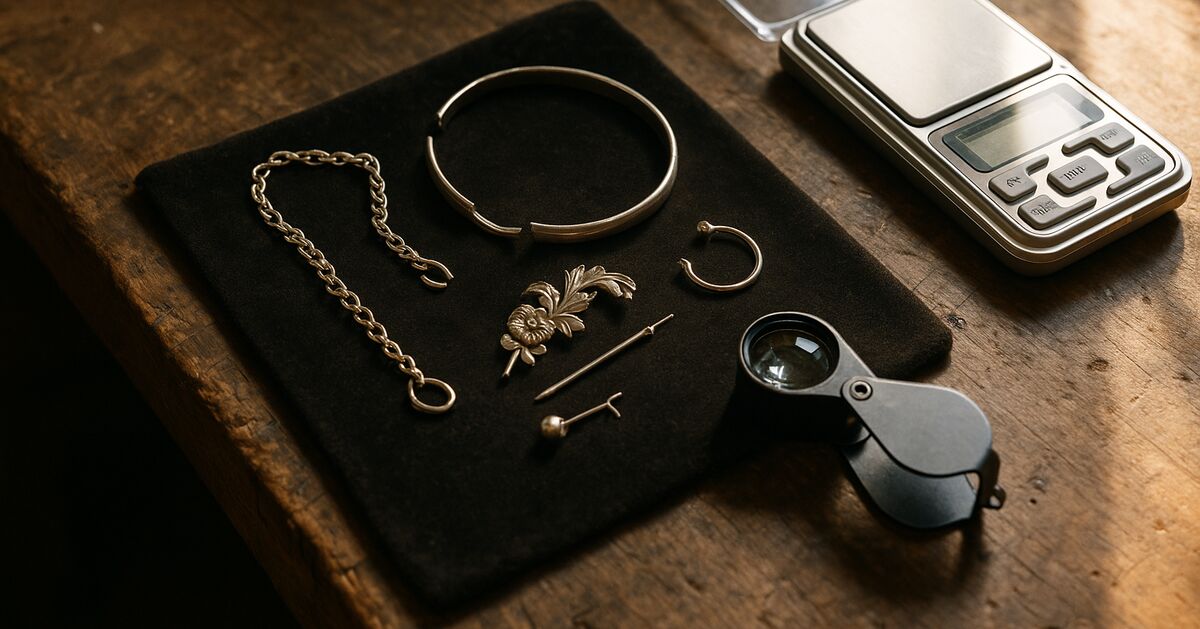
Snapped chains, crushed rings, bent brooches, earrings missing their backs - they pile up in jewelry boxes for years, and the question that finally surfaces is always the same: is this stuff worth anything now that it's broken? The short answer is yes, nearly always, but how much depends on what kind of buyer you approach and what the piece was worth before it got damaged.
This post walks through the mechanics of how damage is evaluated, which types of buyers discount it (and why), and what you can do to make sure you're not leaving money on the table with pieces a stranger might dismiss as rubbish.
Why damage matters less than you think for scrap buyers
When a buyer intends to melt your silver down, the physical condition of the piece is largely irrelevant. A bent bangle contains exactly the same number of troy ounces as an identical bangle in perfect shape. The silver doesn't care that it's been crushed. What the refinery sees is weight and purity, full stop.
So if you're selling to a scrap buyer or a smelter, a snapped chain is no different in value from an intact one. Both get weighed, both get tested for purity, and both get offered a percentage of the current spot price. The damage may actually help in one small way: bent or broken pieces are harder to re-sell as jewelry, so buyers who might otherwise try to cherry-pick wearable pieces for retail resale will simply route your item to the scrap pile, where the calculation is straightforward.
This is one of the first things worth understanding about how different buyers price silver. Not every buyer uses the same formula, and knowing which type you're dealing with changes how you interpret an offer.
When damage does reduce what a buyer will pay
Condition matters a great deal when the piece has value beyond its metal content. There are three situations where damage genuinely hurts your payout:
1. Designer or branded jewelry A snapped Georg Jensen bangle or a bent Tiffany chain has a secondary market as a recognisable, wearable piece. Intact, it could sell to a collector or vintage dealer at a premium over melt. Damaged, that premium vanishes and the piece falls back to metal value. The gap between those two figures can be large, sometimes several hundred pounds or dollars on a single item.
2. Antique or hallmarked pieces An antique brooch with an intact Georgian or Victorian hallmark, original pin mechanism, and clean enamel work can attract collector interest. Once the pin is snapped off or the enamel cracked, buyers who might have paid for the craftsmanship and age simply aren't interested any more. The hallmarks and maker's marks that drive that premium become largely decorative once the piece is structurally compromised.
3. Set gemstones If a ring is bent badly enough that a stone has been lost, or a pendant has been crushed and the prongs have torn away, the gemstone question becomes a real complication. A silver piece with a missing stone that left behind setting damage is worth less than either a clean silver piece or a piece with the stone intact. The buyer now has to factor in the ruined setting and the fact that re-setting a replacement stone costs more than the silver is worth.
For pieces that sit in this "might have been collectible" territory, the melt-versus-collectible question is always worth working through carefully before you accept the first offer.
The mechanics of a scrap assessment on broken pieces
Here's what actually happens when you hand a bag of broken silver to a scrap buyer:
- Sorting by purity. Everything gets sorted into groups: 925 sterling, 800 silver, silver plate, and unknowns. Broken pieces still need to be tested. Buyers use acid tests, XRF (X-ray fluorescence) guns, or both. A snapped chain end is actually easier to test than an intact hollow chain, because the cross-section is exposed.
- Weighing. All pieces in each purity group get weighed together on a calibrated scale, usually in grams or troy ounces.
- Applying the offer percentage. The buyer multiplies the fine silver content (weight times purity percentage) by the current spot price and then pays you a percentage of that figure. Scrap buyers generally pay a percentage below full melt value, with the exact rate depending on their overheads and how quickly they can move material.
Damage doesn't enter this calculation at all for a pure scrap assessment. The buyer wants fine silver ounces, and a bent earring delivers exactly as many as a pristine one.
The reason two buyers can quote very different prices for the same silver often has nothing to do with the condition of the pieces and everything to do with the buyer's own cost structure and how they categorise what you've brought in.
Hollow versus solid: the hidden complication with certain breakages
One category of damage genuinely does create a pricing headache: hollow jewelry that has been crushed or cracked open.
Hollow chains, beads, and large hollow bangles are manufactured with air inside to reduce weight and cost while maintaining visual size. When a hollow piece gets crushed, the air escapes, but so does any trapped moisture, cleaning product residue, or debris. None of that weighs much, but the real issue is that buyers know hollow silver has less actual metal per centimetre than it looks like it does.
If a hollow chain is intact, an experienced buyer can recognize it by feel and weight and adjust accordingly. If it's been partially crushed, the deformation makes it harder to read visually, which means some buyers will either test it more carefully or apply a more conservative offer to account for the uncertainty.
The practical upshot: if you have crushed hollow pieces, be prepared for the buyer to spend more time on assessment, and don't be surprised if the offer lands at the lower end of the normal range.
What to do before you sell broken pieces
A few straightforward steps make the process smoother and reduce the chance of being underpaid:
- Group by purity yourself if you can. Sterling (925) pieces marked with a hallmark or a "925" stamp should be separated from unmarked or plated items. Mixed bags create more work for the buyer, and some buyers apply a blanket lower rate to mixed lots to protect themselves.
- Don't try to repair pieces for scrap. It sounds logical to get a snapped chain soldered before selling, but repair costs more than the difference it makes to a scrap buyer. Skip it.
- Remove non-silver parts first. Many pieces have steel spring mechanisms, base-metal clasps, or plastic inserts. These should be removed before weighing, because a buyer will either deduct for them or strip them out themselves and offer you less overall. Selling small personal items like cufflinks involves similar prep work, where non-silver components need accounting for.
- Get more than one quote. The difference between buyers on broken material can be meaningful. A coin dealer who mostly handles numismatics might not want your broken chains at all and will offer accordingly. A dedicated precious metals buyer with a refining relationship will be more confident and more competitive.
- Know the spot price on the day. The London Bullion Market Association (LBMA) publishes daily silver fix prices, and the COMEX spot price updates in real time during trading hours. Knowing today's price means you can sense-check any offer you receive by working backwards through the melt calculation yourself.
Mail-in buyers and broken jewelry: a few extra cautions
Mail-in or postal buyers are a reasonable option for broken pieces, particularly if there are no local buyers nearby offering competitive rates. But broken jewelry introduces a couple of specific risks worth thinking through before you ship.
First, packaging matters more with broken pieces. A snapped chain or loose earring can work its way through a padded envelope if the packaging isn't secure. Use a rigid box, wrap each group of pieces separately in tissue or a small zip-lock bag, and tape everything so it can't migrate around in transit.
Second, read the returns policy carefully. If a mail-in buyer rejects part of your lot (for instance, plated pieces mixed in accidentally), you want to know whether they'll return those pieces or treat them as a handling fee. The fine print on this varies considerably between buyers, and it's always worth understanding how to read a mail-in buyer's terms before you send anything.
Third, keep photos of everything before it leaves your hands. Photograph each piece against a plain background, note any stamps or hallmarks visible, and record the total weight if you have a kitchen scale. This gives you a paper trail if there's any dispute about what you sent.
The special case of gemstone jewelry
Bent or broken silver rings and pendants with stones in them deserve a brief separate treatment, because they're common and the right approach isn't obvious.
If the stone is still in place but the setting is damaged, get the stone identified and valued separately before you sell the piece as scrap. A silver ring worth £15 at melt might contain a genuine garnet, amethyst, or even a sapphire worth more than the metal. Semi-precious stones set in older silver jewelry are worth checking, since many vintage pieces used real stones in modest silver mounts.
If the stone has been lost and the setting is torn up, the piece is straightforwardly a scrap silver item, and you can treat it exactly like any other broken piece.
A jeweller (not a gold or silver buyer, but a working bench jeweller) can usually identify and roughly value a stone for a small fee or sometimes for free, and that information lets you make a smarter decision about whether to sell the whole thing as scrap or separate the components.
Realistic expectations for a bag of mixed broken pieces
Say you have a small zip-lock bag with a snapped sterling necklace, two single earrings, a bent ring, and a brooch with a broken pin mechanism. Total weight 28 grams, all sterling. At a silver spot price of $30 per troy ounce (approximately $0.96 per gram), the theoretical melt value is around $26.90. A scrap buyer offering 80% of melt would pay roughly $21.50.
That's not a life-changing sum, but it's real money for items that would otherwise sit in a drawer forever, and it scales up quickly if you have larger quantities. The more you accumulate before selling, the more it's worth the time to get competing quotes.
If any of those pieces happened to be a recognisable designer name in salvageable condition, the calculation changes entirely, and separating it out to sell through a different channel (auction, vintage jewelry dealer, or an online marketplace) could easily double or triple what you recover on that one item.
Timing and market conditions
Silver's spot price moves daily, and the difference between selling in a strong market versus a weak one is real even for a small parcel of scrap. That said, trying to time the market precisely on a bag of broken jewelry isn't a strategy worth losing sleep over. The spread between a good and a mediocre buyer matters more than small day-to-day price movements.
If you're selling in a period when prices have been falling, it's worth knowing that buyers sometimes apply wider discounts during volatile periods to protect themselves against further drops between the time they buy and the time they sell to a refiner. The dynamics of selling in a bear market explain this behavior in more detail and are worth understanding so that a lower offer doesn't come as a surprise.
The bottom line
Broken and bent silver jewelry is worth selling. Damage rarely changes the melt value calculation, and for most pieces that's the calculation that matters. Where damage genuinely hurts is when the piece had collector or retail resale value before it was damaged, and you've lost the premium that would have captured.
Sort your pieces by purity, remove non-silver parts, get at least two quotes, and don't let anyone tell you that broken means worthless. Silver doesn't care what shape it's in.
If you've got questions about a specific type of piece or want to understand how the process works from start to finish, the FAQ section covers the most common scenarios sellers run into, and the blog has detailed guides on specific categories of silver items.
Sources & further reading
- Silver fixing and daily benchmark prices (London Bullion Market Association (LBMA))
- XRF technology in precious metals testing and refining (U.S. Environmental Protection Agency)
- Precious metals refining and scrap processing overview (U.S. Geological Survey (USGS))
Revision history (1)
- Pre-publish editorial QA: clean; claim audit: 2 claims, 2 rewritten
Claim-by-claim audit (2 checked)
- “Scrap buyers generally pay a percentage below full melt value, with the exact rate depending on their overheads and how quickly they can move material.” (rewritten to what the article can stand behind)
- “Semi-precious stones set in older silver jewelry are worth checking, since many vintage pieces used real stones in modest silver mounts.” (rewritten to what the article can stand behind)