
A practical guide to selling scrap gold: value, price, and
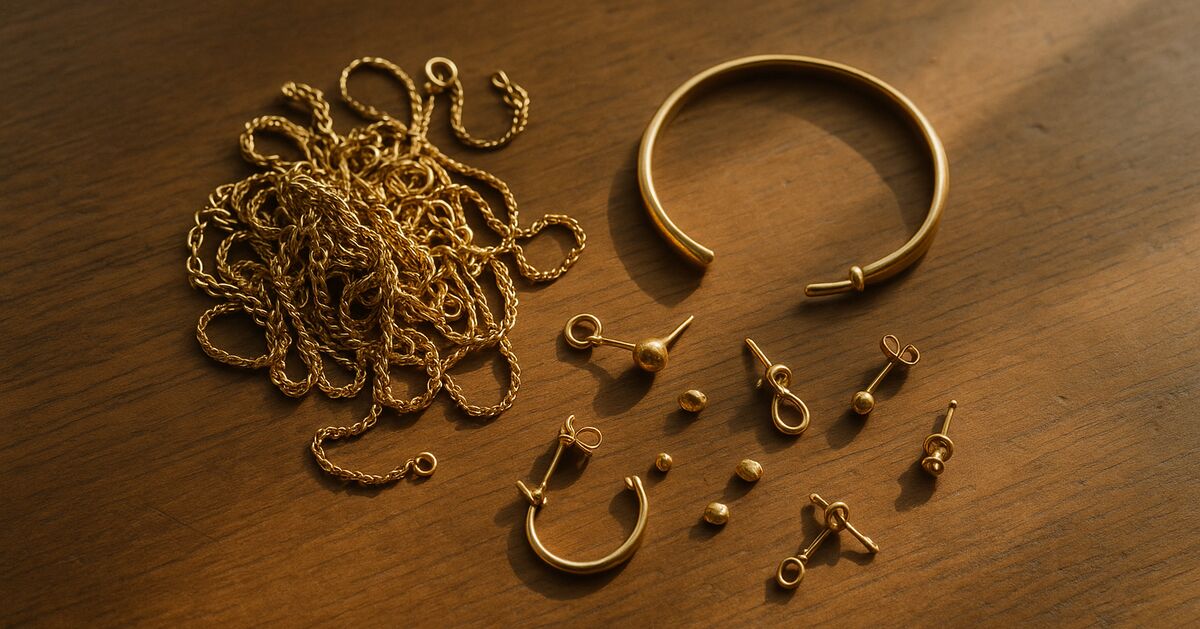
Broken chains stuffed in a drawer, a crown your dentist pulled last year, a tangle of mismatched earrings that nobody will ever wear again - all of it can be turned into real money, and the process is simpler than many people expect. After nearly two decades of buying scrap gold from everyday sellers, the thing I saw hold people back again and again was not the process itself but the uncertainty around value. Once you understand how scrap gold is priced, the whole thing gets a lot less intimidating.
What counts as scrap gold, exactly?
The term "scrap" does not mean junk in the derogatory sense. It means gold-containing material that is worth more as refined metal than as an object. A twisted necklace that nobody wants to wear is scrap. A complete, wearable piece with a designer hallmark may not be, because the craftsmanship adds value above the metal content.
Common categories of scrap gold include:
- Broken or unwanted jewelry - necklaces, bracelets, rings, earrings, brooches, and pins
- Watches - the cases on older dress watches are frequently gold-filled or solid gold
- Dental restorations - crowns, bridges, and inlays are often high-karat gold alloys
- Decorative items - picture frames, candle holders, figurines with gold plating or gold-filled construction
- Industrial and technical forms - gold wire, gold sheet, gold sponge, and plated electronic components
- Damaged coins - coins that have been drilled, mounted, bent, or otherwise altered beyond numismatic redemption
If you are not sure whether something qualifies, the practical test is this: does it contain gold? If the answer is yes, it has melt value. Whether that melt value is meaningful depends on the karat and the weight, which we will get to in a moment.
For a broader look at the gold-selling landscape beyond scrap, the post on selling gold: what it is worth and how to get a fair offer covers the bigger picture well.
How scrap gold is valued: the two factors that matter
Every calculation a buyer makes starts in the same place: karat times weight equals value, adjusted for the spot price and the buyer's margin. Understanding both variables puts you in a much stronger negotiating position.
Karat: how much of your gold is actually gold
Gold is almost never sold in pure form for jewelry or industrial use because pure gold (24 karat) is extremely soft. Instead it is alloyed with copper, silver, nickel, zinc, or palladium to add hardness and change color. The karat system simply expresses what fraction of the alloy is gold.
- 24 karat (24k) - 99.9% pure gold, the reference point for all pricing
- 22 karat (22k) - about 91.7% gold; common in British, Indian, and Middle Eastern jewelry
- 18 karat (18k) - 75% gold; a popular benchmark for fine jewelry worldwide
- 14 karat (14k) - 58.3% gold; the everyday standard in the United States for decades
- 10 karat (10k) - 41.7% gold; the legal minimum to be called gold in the US
- 9 karat (9k) - 37.5% gold; common in UK and Australian jewelry
The hallmark stamped inside a ring or on a clasp tells you the karat. In American jewelry you will usually see a number followed by "k" or "kt" (10k, 14k, 18k). European pieces often use a three-digit millesimal fineness instead: 750 means 18k, 585 means 14k, 375 means 9k. If no hallmark is visible, a reputable buyer will test the piece before making an offer, typically with acid testing or an XRF (X-ray fluorescence) analyzer.
Weight: the unit that trips people up
Gold is weighed in troy ounces for spot-price purposes, but buyers and sellers also encounter pennyweights and grams depending on the trade context.
- 1 troy ounce = 31.1 grams
- 1 troy ounce = 20 pennyweights (dwt)
- 1 pennyweight = 1.555 grams
The pennyweight is a unit with roots in medieval English coinage, and it hung around in the jewelry trade long after many people forgot where it came from. It is worth knowing because some buyers quote prices per pennyweight, and a figure like "$22 per pennyweight" sounds very different from "$440 per troy ounce" even when they represent the same rate.
A mistake that comes up regularly in seller forums is comparing quotes without confirming the unit. Always ask: "Is that per gram, per pennyweight, or per troy ounce?" Then convert everything to the same unit before comparing.
Finding the spot price and understanding what it means for you
The spot price of gold is the current market price for one troy ounce of 99.9% pure gold, quoted continuously during trading hours. You can check it on financial sites, precious-metals dealers' websites, or commodity exchanges. The London Bullion Market Association (LBMA) publishes twice-daily reference prices that are widely used in the trade.
Here is the key point: the spot price is what refiners and large institutional buyers pay each other for pure, refined metal in large quantities. It is not what a retail buyer will pay you for a handful of mixed-karat scrap. The gap between spot and what you receive reflects several real costs.
From spot price to your payout - the deductions:
- Purity loss - your 14k piece is only 58.3% gold, so the buyer starts there
- Refining costs - separating the gold from the alloy metals costs money; refiners charge a processing fee
- Assay costs - testing has a cost, usually absorbed by the buyer but factored into the margin
- The buyer's margin - this is how they stay in business; it varies widely
Reputable buyers commonly offer a discount off calculated melt value to cover refining and margin costs, so expect to receive less than the theoretical maximum; ask each buyer what percentage they pay. High-volume, low-overhead mail-in buyers sometimes pay at the upper end of that range. Pawn shops tend to be at the lower end because their overhead is high and gold is not their primary business.
How to estimate your own scrap gold value before you sell
You do not need to be a metallurgist. Here is a practical walkthrough.
Step 1: Find the current spot price in dollars per troy ounce (any reputable financial site will show this in real time).
Step 2: Convert that to a per-gram price by dividing by 31.1. For example, if spot is $3,100 per troy ounce, the per-gram price for pure gold is roughly $99.68.
Step 3: Find the karat of your piece and multiply by the purity fraction. For a 14k piece: $99.68 x 0.583 = about $58.10 per gram of melt value.
Step 4: Weigh your piece on a kitchen scale accurate to 0.1 grams. Multiply grams by the per-gram melt value to get the theoretical maximum.
Step 5: Expect to receive 70 to 90% of that number from a serious buyer.
This quick calculation arms you going into any conversation. If a buyer offers you 40% of melt value, you can politely decline. If they offer 85%, you know that is reasonable.
The categories of scrap gold that surprise people
Dental gold
Gold crowns, bridges, and inlays are often high-karat because dental applications historically prized durability and biocompatibility. A single crown can weigh 2 to 5 grams. A mouthful of older dental work can be worth a meaningful amount, and it is worth separating it from regular jewelry when you get quotes, since some buyers specialize in dental gold and pay better rates for it.
Gold-filled and gold-plated items
These are not the same as solid gold and will pay significantly less per item, but they are not worthless. Gold-filled (marked GF or 1/20 14k) has a layer of real gold bonded to a base metal core. Gold-plated items have a very thin electrochemical deposit. Refiners can process both, but the yield is low, so buyers either pay a flat low rate or require you to accumulate a meaningful quantity.
Do not mix gold-filled items in with solid gold pieces when seeking quotes. Buyers weigh them together and may apply the lower rate to everything.
Industrial gold
If you have come across gold wire, gold sheet, gold sponge, or gold-bearing electronic components (some older CPUs and connectors contain meaningful amounts), these are legitimate scrap. Industrial refiners often pay better rates than jewelry buyers for this material because the gold content is more consistent and easier to process.
Where to sell scrap gold: a realistic look at your options
Local coin and precious-metals dealers
A good local dealer will test your material in front of you, explain the reading, and make an offer on the spot. You can negotiate face to face, which many sellers prefer. The downside is that local dealers have higher overhead than mail-in operations, and their offers can vary widely. Get quotes from at least two before you commit.
Mail-in buyers
Specialist mail-in precious-metals buyers often operate at high volume with lower overhead than brick-and-mortar shops, which can translate to better offers. The trade-off is that you are shipping your gold before you have a guaranteed price. Reputable mail-in buyers use insured, trackable shipping, provide written offers you can accept or decline, and return your items at no cost if you decline. If a buyer does not offer all three of those things, look elsewhere.
Refiners
If you have a significant quantity (several hundred grams or more), going directly to a refiner cuts out the middleman entirely. Refiners generally pay a higher share of melt value than retail buyers since they cut out the middleman, but they have minimum quantities and more involved logistics than selling to a dealer.
Pawn shops
Pawn shops are convenient, but they are not specialists in precious metals. Their offers on gold are often well below what a dealer or mail-in buyer will pay. They are worth using only if speed and immediate cash are more important than getting a strong price.
The same framework applies when selling silver. The post on selling inherited or scrap silver covers the buyer comparison in that context, and much of the logic carries over.
Practical steps before you sell
Sort by karat. Keep 10k, 14k, 18k, and 22k pieces separate. Mixing them together means the buyer has to process and quote them as a batch at the lowest common denominator, which costs you money.
Remove non-gold components. Clasps made of steel, gemstone settings, enamel inlays, and beads add weight but no gold value. A fair buyer will exclude them from the calculation, but it is cleaner to separate them yourself when possible.
Weigh everything yourself first. You do not need a jeweler's scale; a kitchen scale that reads to 0.1 grams is fine for estimating. Note the weight for each karat group.
Know what you have before you talk to anyone. If you have items with unusual hallmarks or you are unsure of the karat, a jeweler or assayer can test them for a small fee. Going in with that knowledge shifts the conversation in your favor.
Get multiple offers. This cannot be said enough. Offer spreads between buyers can be surprisingly wide for identical material. Three quotes take a bit more time but routinely make a meaningful difference to the final number in your pocket.
For more on how to approach a gold-selling transaction from offer to acceptance, the guide on selling gold jewelry: what it's worth and how to get a fair offer goes into that detail thoroughly.
Red flags to watch for
- A buyer who will not tell you the spot price they are using as their reference
- An offer quoted in total dollars with no breakdown by karat or weight (so you cannot verify the math)
- A mail-in buyer with no clear return policy or who requires you to accept an offer before seeing it
- High-pressure tactics or very short deadlines on an offer
- A buyer who tests your gold out of your sight and declines to show you the result
A legitimate buyer welcomes your questions. If someone gets uncomfortable when you ask how they calculated the offer, that discomfort tells you something useful.
A note on gold coins that are damaged
A gold coin that has been drilled for a pendant, bent, heavily scratched, or otherwise altered has almost certainly lost any numismatic premium it once carried. In that case, it is worth melt value like any other scrap, and you should sell it through the scrap channel rather than to a coin dealer. Coin dealers buying damaged coins will offer melt or less, since damaged coins are not collectible. If you have undamaged gold coins you are considering selling, the guide on how to sell gold coins: identify, value, and find the right buyer is a better starting point than this one.
Putting it all together
Selling scrap gold is not complicated once you strip away the mystery. You are selling a commodity: a known weight at a known purity, priced against a publicly available spot price. The only variable under your control is which buyer you choose and how prepared you are when you walk in the door.
Do the math yourself before any conversation. Sort and separate your material. Get at least two or three offers. Ask every buyer to show you their calculation. Decline any offer that does not come with a clear breakdown.
If you are also dealing with silver alongside your gold, the How To Sell Silver home page has resources for both metals, and the frequently asked questions page covers a lot of the practical edge cases that come up when you are sorting through mixed lots.
The gold market rewards preparation. A seller who knows what they have and what it is theoretically worth will often walk away with a better outcome than one who is simply hoping for the best.
Sources & further reading
- Gold price and market data (London Bullion Market Association)
- Troy weight and precious metals measurement (National Institute of Standards and Technology (NIST))
Revision history (1)
- Pre-publish editorial QA: 4 flagged, 3 softened; claim audit: 4 claims, 3 rewritten
Claim-by-claim audit (4 checked)
- “Reputable buyers commonly offer a discount off calculated melt value to cover refining and margin costs, so expect to receive less than the theoretical maximum; ask each buyer what…” (rewritten to what the article can stand behind)
- “Refiners generally pay a higher share of melt value than retail buyers since they cut out the middleman, but they have minimum quantities and more involved logistics than selling t…” (rewritten to what the article can stand behind)
- “10 karat (10k) is 41.7% gold, commonly treated as the minimum karat marketed as gold jewelry in the US.” (rewritten to what the article can stand behind)
- “Gold crowns, bridges, and inlays are often high-karat because dental applications historically prized durability and biocompatibility.” (rewritten to what the article can stand behind)