
A practical guide to selling diamonds online: what to expect
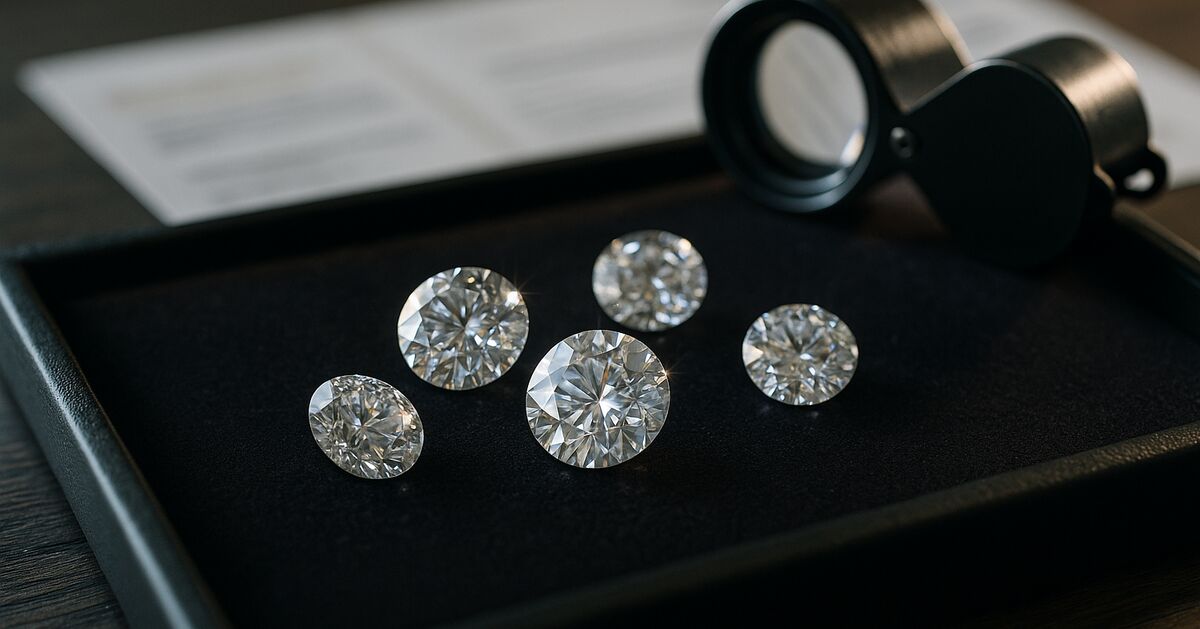
Diamonds hold a strange place in the public imagination: they feel like they should be worth a fortune, and yet the moment you try to sell one, the offers come in far lower than expected. That gap between expectation and reality is not a scam - it is simply the nature of the diamond market, and understanding it is the single most useful thing you can do before you approach a buyer.
This guide covers how diamond value is actually determined, what separates a good online buyer from a bad one, how to prepare your stone, and what fair looks like when an offer arrives.
Why diamonds are different from gold and silver
When you sell a silver coin or a gold chain, the math is almost mechanical: spot price multiplied by weight and purity, minus the buyer's margin. Diamonds have no equivalent spot price. There is no real-time exchange where diamonds trade at a published rate anyone can check.
What diamonds have instead is a wholesale price guide called the Rapaport Diamond Report, which publishes price-per-carat benchmarks by shape, weight, color grade, and clarity grade. Dealers use it, but it is not publicly free, and the prices in it represent high-end wholesale - the ceiling, not the floor. The actual transaction price depends on current demand, the specific stone, and how motivated both parties are.
This means that selling a diamond well requires more research, more patience, and a clearer picture of what your stone actually is before you approach anyone. If you want a broader sense of how selling precious items online works in general, the home page of How To Sell Silver walks through the principles that apply across metals, coins, and gemstones.
The four Cs - and what they mean for resale
You have probably heard of the four Cs: cut, color, clarity, and carat weight. Jewelers explain them in the context of buying a new stone. When selling, the same four Cs matter, but what they mean in practice shifts a little.
Carat weight is the most straightforward factor. One carat equals 0.2 grams. Larger stones command dramatically higher prices per carat, not just higher total prices. A two-carat diamond is not simply worth twice a one-carat diamond of similar quality; it can be worth considerably more per carat, because large stones are rarer. The catch for sellers is that buyers know this too, and a stone just under a key weight threshold (0.90 carats instead of 1.00, for example) will fetch noticeably less.
Cut matters more than many sellers realize. Cut refers to proportions, symmetry, and polish - the craftsmanship that determines how well a stone handles light. A well-cut diamond sparkles in a way a poorly cut one never will, regardless of color or clarity. GIA grades cut on round brilliants as Excellent, Very Good, Good, Fair, or Poor. An Excellent-cut stone sells faster and for more.
Color is graded on a scale from D (completely colorless) to Z (visibly yellow or brown). The colorless range (D through F) commands the highest prices. In the resale market, G and H stones are nearly indistinguishable from colorless to the naked eye, but they sell at a meaningful discount to D-F. Stones in the K-Z range sell for considerably less, though some buyers specifically seek warm-toned stones.
Clarity describes the presence of internal inclusions or external blemishes, graded from Flawless down through VS1, VS2, SI1, SI2, and into the I grades, where inclusions are visible without magnification. Eye-clean stones (where inclusions are invisible to the naked eye) are significantly more saleable than stones with obvious flaws.
The honest truth is that on the resale market, only the top combinations of all four factors command prices close to what a retailer might advertise. A 0.80-carat, J-color, SI2-clarity stone with a Fair cut grade is a nice diamond to wear but a difficult one to resell at any satisfying price.
Why your retail appraisal is almost certainly misleading you
A retail replacement appraisal - the document your insurance company asked for - is designed to give a replacement value at retail prices. It often reflects what it would cost a consumer to buy a comparable stone at a jewelry store, which includes the store's overhead, markup, and retail margin.
Resale is not retail. A buyer purchasing your stone is not a consumer at a jewelry counter; they are a trader who needs to resell the stone themselves and make a margin doing so. They will pay a fraction of the retail replacement value, and that is not dishonesty - it is economics. Resale offers often fall well below retail appraisal value, though the exact percentage varies with the stone's quality and current demand. Exceptionally fine stones in strong demand can do better; lower-quality or unusual stones can do worse.
Do not go into the process anchored to your appraisal number. It will only make every offer feel insulting when it may, in fact, be fair.
GIA certification and why it matters so much
If your diamond comes with a GIA (Gemological Institute of America) grading report, or a certificate from another respected lab such as AGS (American Gem Society), you are in a meaningfully stronger position as a seller. A grading report gives every buyer an objective, third-party description of the stone. It removes ambiguity about color and clarity grades and eliminates the need for the buyer to rely solely on their own assessment.
A certified stone is easier to sell, sells faster, and in competitive offer situations tends to attract higher bids. If your stone does not have a certificate and is large enough to justify the cost (generally one carat or above), it may be worth having it certified before you sell. GIA certification involves a fee and a waiting period, but for a high-quality stone, the improved offers can more than offset that cost.
If your stone has an older report or a report from a less well-known lab, that is still better than nothing, but buyers will treat it with more scrutiny. Some labs are considered by dealers to grade more leniently than others, so buyers may scrutinize reports from less well-known labs more closely.
What online diamond buyers actually do
The mail-in model for diamonds works similarly to mail-in buying for precious metals. You describe your stone, receive a preliminary offer, ship it securely, and then receive a final offer once the buyer has examined the stone in person. You then either accept and get paid, or decline and get the stone returned.
The process used at Silver and Gold Exchange when buying diamonds followed this pattern: the seller submitted details about the stone, received a preliminary quote from an appraiser, shipped the stone via insured mail, and then the stone was examined in person by someone with proper gemological equipment before a final offer was made. If the final offer differed from the preliminary quote, the seller always had the right to decline and receive the stone back. That right to decline is not a courtesy - it is a baseline standard you should insist on with any buyer you approach.
A few things to look for when evaluating an online buyer:
- Clear return policy: If you decline the final offer, how quickly do they return the stone, and who pays the return shipping? Legitimate buyers make this easy.
- Insured shipping: The buyer should provide or reimburse insured, trackable shipping. Never send a diamond in a plain envelope with your own postage.
- Transparent grading: A good buyer will tell you what grade they assigned to your stone and why the final offer differs from the preliminary, if it does. Vague explanations are a warning sign.
- BBB or equivalent standing: Not the only thing to check, but a long, clean track record with a complaints organization tells you something about how disputes are handled.
You can find a broader overview of how to evaluate online precious-materials buyers in our FAQ, which covers the questions worth asking before you ship anything to anyone.
Preparing to sell: what to do before you contact a buyer
Taking a little time to prepare will make the process smoother and help you assess offers more confidently.
Gather your documentation. Find the original GIA or AGS certificate if you have one. Find any receipts, appraisals, or prior insurance documents. Even if the numbers in those documents are retail-inflated, they give a buyer useful information and demonstrate that you know what you have.
Weigh the stone if you can. A precise carat weight requires a gemological scale. If the stone is unmounted, a jeweler can weigh it for you at low or no cost. If it is still set in a ring, you cannot get an accurate carat weight from the piece's total weight, but you can often find the carat weight stamped inside the band or on the original paperwork.
Photograph it clearly. Good photographs in natural light, showing the stone from above and from the side, help an online buyer give you a more accurate preliminary quote and help you document the stone's condition before shipping.
Get more than one offer. This is not optional advice - it is essential. The diamond resale market has real variation in what buyers will pay. One offer tells you almost nothing. Three or four offers give you a genuine picture of what the market will bear for your specific stone on any given day.
If you are also selling precious metals alongside a diamond (a ring with a significant gold setting, for example), it is worth reading our guide on selling silver and gold jewelry together, which covers how to handle pieces where the metal and the stone each need to be valued separately.
Selling through different channels
Online mail-in buyers are not the only route. Understanding all your options helps you weigh the trade-offs.
Local jewelers and estate buyers will look at a diamond in person, which eliminates shipping risk. The disadvantage is that you are dealing with a single buyer with no competitive pressure, and local buyers for fine diamonds can be limited depending on where you live. Jewelers who primarily sell new jewelry are often less motivated to buy estate stones than dedicated estate dealers.
Auction houses (both traditional and online) can be excellent for exceptional stones, one carat and above, with strong certification and high color and clarity grades. The audience is broader, and competitive bidding can push prices up. The trade-off is time: a traditional auction can take months, and both buyer's premiums and seller's commissions eat into your net.
Diamond consignment platforms such as Worthy allow sellers to list stones for auction to a community of vetted dealers. This can produce strong results for certified stones and requires less legwork than managing your own auction listing.
Peer-to-peer selling (platforms like eBay or Facebook Marketplace) eliminates the middleman but introduces real risk: fraud, disputes, and the difficulty of finding a buyer who both wants your specific stone and trusts a private seller enough to pay a fair price. If you go this route, you need excellent photographs, honest grading, and patience.
For perspective on how location affects the selling process when you do opt to sell in person, our post on selling gold and silver in Dallas covers how local buyer competition affects what you ultimately take home.
Realistic price expectations by stone type
It helps to go in with realistic ranges. These are general observations, not guarantees:
- Small diamonds under 0.50 carats often have disappointing resale value unless they are in a desirable designer setting. The stones themselves may fetch as little as a few dozen dollars at wholesale. The metal in the setting may be worth more than the stone.
- Round brilliants between 0.75 and 1.50 carats, G-H color, VS2-SI1 clarity, GIA-certified: This is the sweet spot of the resale market. Demand is real, buyers are competitive, and you can expect offers that represent a meaningful percentage of current wholesale benchmarks.
- Fancy shapes (ovals, cushions, pears, princess cuts) have surged in consumer popularity in recent years. This has helped resale values for fancy shapes compared to where they were a decade ago, though round brilliants remain the most liquid.
- Large stones above three carats can either be spectacular to sell or very difficult, depending on quality. There are fewer natural buyers for a $30,000 stone than for a $3,000 one, and the process takes longer. Auction or consignment is often the better route here.
- Stones with significant color or clarity issues often sell close to scrap value (the value of the metal setting) because wholesale buyers have limited use for them. A stone graded I2 or I3 for clarity, or below J for color, is in a difficult selling position.
Common mistakes that come up again and again
A mistake that surfaces repeatedly among first-time diamond sellers is accepting the first offer without comparison shopping. Unlike selling scrap silver (where spot price provides an external anchor), diamond prices are negotiable and buyer-specific. There is no equivalent of a live spot price to tell you whether an offer is fair. The only way to know is to collect multiple quotes.
Another pattern that comes up is sending a stone to a buyer without confirming the return policy in writing before shipping. Always confirm: is return shipping free? How quickly does it happen? Is the return itself insured? Get that in writing.
A third is confusing an insurance appraisal with market value. If you have already read the section above on retail appraisals, you know why these numbers mislead sellers. Keep the appraisal document because it describes the stone, but set aside the dollar figure on it before you start evaluating offers.
Finally, selling a diamond still in a significant gold or platinum setting without accounting for the metal separately is a mistake that leaves money on the table. A buyer making a composite offer for stone-plus-setting may be paying you fairly for the total, or may be paying you fairly for just one and discounting the other. Ask how the offer breaks down. Our guide on selling inherited or scrap gold explains how to value the metal portion separately so you can assess a combined offer with clear eyes.
Shipping your diamond safely
When the time comes to ship, treat the process as seriously as you would sending cash.
Use a carrier that provides tracking and insured delivery. USPS Priority Mail with full insurance is a workable option for domestic US shipments; so is FedEx or UPS with declared value coverage. Do not use a plain envelope. Package the stone in a rigid container within a padded outer box. Do not put any description of contents on the outside of the package.
Photograph the stone and its packaging before you seal the box. This gives you documentation of condition and of what was shipped in the event of a dispute.
Confirm with the buyer exactly what address to ship to, what name or reference number to include inside, and how to notify them that the package is on the way. Good buyers have a clear, written intake process for this. If a buyer's instructions are vague or their contact process is difficult, that tells you something.
Putting it all together
Selling a diamond takes more work than selling silver or gold, but the work is worth doing carefully. The gap between a hasty sale and a well-researched one can be hundreds or even thousands of dollars depending on the stone.
Know what you have. Gather any certification. Get multiple offers from different types of buyers. Understand the difference between retail replacement value and resale market value. Confirm return policies before you ship anything. Document everything.
The diamond market rewards sellers who are informed and patient. It tends to disappoint sellers who are in a hurry or anchored to a number from an insurance appraisal.
If this is part of a larger estate situation where you are sorting through a mix of metals, coins, and jewelry, the How To Sell Silver blog has practical guides covering most of the categories you are likely to encounter. Working through each category methodically, rather than bundling everything together and accepting a single lump offer, nearly always produces a better result.
Sources & further reading
- GIA Diamond Grading: the four Cs (Gemological Institute of America)
- Rapaport Diamond Report overview (Rapaport Group)
- AGS diamond grading and cut science (American Gem Society)
- USPS Priority Mail insurance and shipping options (U.S. Postal Service)
Revision history (1)
- Pre-publish editorial QA: 2 flagged, 2 softened; claim audit: 5 claims, 4 rewritten
Claim-by-claim audit (5 checked)
- “Resale offers often fall well below retail appraisal value, though the exact percentage varies with the stone's quality and current demand.” (rewritten to what the article can stand behind)
- “GIA certification involves a fee and a waiting period, but for a high-quality stone, the improved offers can more than offset that cost.” (rewritten to what the article can stand behind)
- “A two-carat diamond is not simply worth twice a one-carat diamond of similar quality; it can be worth considerably more per carat, because large stones are rarer.” (rewritten to what the article can stand behind)
- “Fancy shapes (ovals, cushions, pears, princess cuts) are increasingly popular with consumers, according to buyers in the trade.” (rewritten to what the article can stand behind)
- “Some labs are considered by dealers to grade more leniently than others, so buyers may scrutinize reports from less well-known labs more closely.” (rewritten to what the article can stand behind)